 Bellingham Siding
 York sits close enough to the water and under enough tree cover that its homes take a different kind of beating than siding a few miles inland. Salt-laden air off the Salish Sea, wind-driven rain that comes in sideways during a proper Pacific Northwest storm, and long stretches of shade that never quite dry out are three separate problems your siding has to solve at once. Most siding products are built to handle one of those reasonably well. Very few handle all three for twenty-plus years without babysitting. That's the problem this page is actually about.
What York's Microclimate Does to Siding
Bellingham as a whole deals with high humidity and heavy annual rainfall, but neighborhoods like York have their own wrinkles depending on tree canopy, lot orientation, and proximity to the water. If your home sits in partial shade for most of the day, or backs up to mature trees, you're dealing with conditions that keep siding damp longer after every storm than a home in full sun a half-mile away.
Salt Air and Corrosion
Marine air carries fine salt particles that settle on exterior surfaces and accelerate corrosion of fasteners, trim, and any metal flashing that isn't properly rated or protected. Over years, this also degrades cheaper paint finishes faster than inland exposure would, leading to chalking, fading, and eventually peeling at the seams.
Driving Rain and Wind-Loaded Moisture
Whatcom County storms don't just drop rain straight down — wind pushes it sideways into wall assemblies, seams, and joints. Siding that isn't installed with correct overlaps, flashing, and water-shedding detail will let moisture behind the cladding, where it doesn't dry out quickly because the same weather that put it there keeps humidity high for days afterward.
Moss, Algae, and Shade
Shaded siding in this climate develops moss and algae growth faster than sun-exposed walls. That's mostly cosmetic on a properly engineered product, but on a material that absorbs moisture into its core, sustained dampness under moss and algae growth is exactly the setup that leads to swelling, softening, and eventual failure.
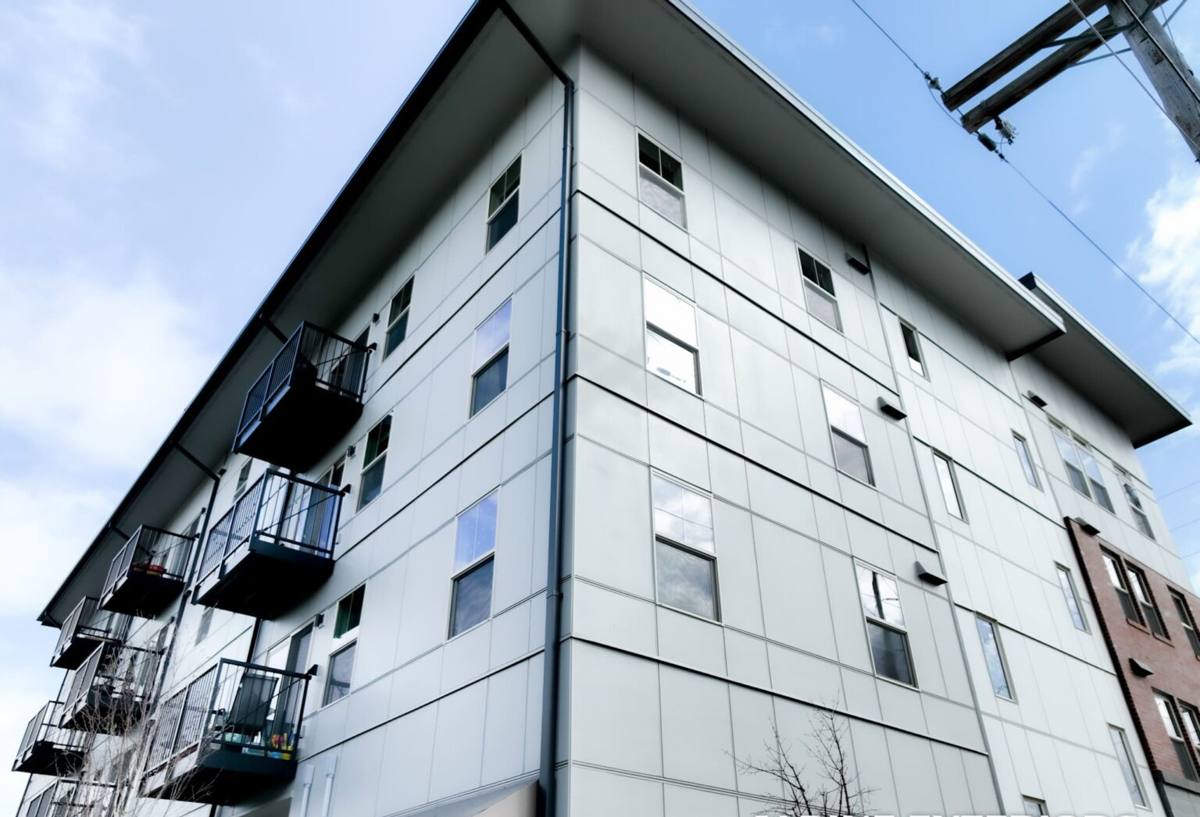
Why We Only Install James Hardie Here
We standardized on James Hardie fiber cement siding for every job we do in Bellingham, including York, because it's engineered around exactly the failure modes this climate produces. Hardie's HZ5 product line is formulated specifically for climates with freeze-thaw cycling and sustained moisture exposure — the Pacific Northwest is one of the regions this engineering targets.
Fiber cement is non-combustible, doesn't provide a food source for moss and algae to feed on the way wood-based products can, and holds paint and factory finish far longer than wood or wood-composite siding because it doesn't expand and contract with moisture the same way. The ColorPlus factory finish process bakes color onto the board under controlled conditions before it ever reaches your house, which produces a more even, more durable finish than field-applied paint — and it comes backed by a real finish warranty, not just a product warranty.
This is also why we don't install LP SmartSide, vinyl, Cemplank, Allura, primed spruce, or cedar. Each of those products has legitimate uses somewhere, but for a marine-influenced, high-rainfall, moss-prone climate like York's, we've made Hardie our standard because we don't want to be the crew that installed something that looked fine at closeout and started failing at year eight.
What a Correct Installation Actually Involves
Hardie siding performs the way it's rated to perform only when it's installed to manufacturer spec. A rushed or shortcut install on the exact same boards can fail in this climate in a fraction of the time a correct install would take. The details that matter most in a place like York:
- Proper clearance and flashing at every window, door, deck ledger, and roofline intersection so wind-driven rain has somewhere to go besides behind the board
- Correct fastener spacing and type — corrosion-resistant fasteners matter more here than in drier inland climates because of salt exposure
- Manufacturer-specified gaps at butt joints and trim to allow for expansion without trapping moisture
- A functioning rainscreen or drainage plane behind the siding so any moisture that does get past the cladding can drain and dry instead of sitting against the sheathing
- Caulking only where Hardie's install guide calls for it — over-caulking traps moisture just as badly as under-caulking lets it in
None of this is exotic. It's just detail work that takes longer to do right, and it's the difference between siding that looks the same in year fifteen and siding that needs board replacement in year six.
Our Process on a York Job
- On-site assessment — we look at your home's specific exposure: shade patterns, water table proximity, existing moisture damage, and how the current siding has held up, which tells us a lot about what your walls are actually dealing with.
- Tear-off and sheathing check — old siding comes off and we inspect sheathing underneath for rot or existing moisture intrusion before anything new goes on. Covering up a problem is worse than not touching it.
- Weather barrier and drainage plane installation — this layer does as much work as the siding itself in a climate like this.
- Hardie installation to spec — correct fastening, flashing, and joint gaps throughout, not just at the parts that are easy to see.
- Trim, caulking, and final inspection — we walk the whole exterior before calling it done, checking every seam and transition.
Choosing the Right Hardie Product Line
James Hardie makes several distinct product lines, and the right one for a given home in York depends on the home's architecture, exposure, and your maintenance preferences.
| Product | Look | Best suited for |
|---|---|---|
| HardiePlank Lap Siding | Traditional horizontal lap | Most single-family homes; the most common choice in this area |
| HardiePanel Vertical Siding | Vertical panel, often board-and-batten | Accent walls, gables, modern or farmhouse-style exteriors |
| HardieShingle Siding | Staggered or straight-edge shingle profile | Craftsman and cottage-style homes wanting a shingle look without cedar's moisture upkeep |
| HardieTrim Boards | Smooth or textured trim | Window/door surrounds, corner boards, fascia — paired with any of the above |
What Drives Cost on a Job Like This
We don't quote exact numbers without seeing the house, but these are the real factors that move the price on a York siding job:
| Factor | Why it matters |
|---|---|
| Tear-off condition | Rotted sheathing found during tear-off adds repair scope before new siding can go on |
| Home size and wall complexity | More corners, dormers, and roof intersections mean more flashing and cut work |
| Product line and profile | Shingle and vertical panel profiles generally run higher than standard lap |
| ColorPlus vs. primed-for-paint | Factory-finished ColorPlus boards cost more upfront but eliminate a paint job and hold finish longer |
| Access and site conditions | Tree cover, tight lot lines, and steep grades common in some York properties can add labor time |
Maintaining Hardie Siding in a Moss-Prone Climate
Hardie siding is genuinely low-maintenance compared to wood, but "low-maintenance" doesn't mean "zero-maintenance," especially in shaded, damp spots. A short annual routine keeps it looking right and catches problems while they're still cheap to fix:
- Rinse shaded and north-facing walls once a year to knock back moss and algae before it builds up
- Check caulking at trim joints and window surrounds for cracking or separation
- Trim back vegetation and tree limbs that keep specific wall sections in constant shade or dripping after rain
- Look at ground-level boards for splashback staining, which signals gutters or grading that need attention
- Have any visible fastener corrosion or paint chalking checked before it spreads
Why a Crew That Already Works in York Matters
Siding installation isn't one-size-fits-all across a city, let alone a county. A crew that regularly works York's specific mix of tree cover, marine exposure, and lot layouts already knows where water tends to collect on homes like yours, which orientations need extra flashing attention, and how the local moss season actually behaves through the fall and winter. That's the kind of knowledge that shows up in the details — the ones you don't see until fifteen years in, when the house down the street with the shortcut install is dealing with soft trim and the one done right still looks the way it did on day one.
If you're weighing a siding replacement or repair in York, we're happy to take a look and give you a straight, no-pressure assessment of what your home actually needs. Fill out the form below for a free estimate.