 Bellingham Siding
 Exterior Work Built for Columbia's Corner of Bellingham
Columbia is one of Bellingham's older, closer-in neighborhoods, and that history shows up on its houses. You'll find a real mix here: early-1900s homes with decades of paint layers and additions, mid-century ranches, and newer infill built to modern energy codes, often sitting shoulder to shoulder on the same block. Whatever era a home falls into, its siding, roof, windows, and any exterior decking are doing the same job — standing between the house and Whatcom County's marine climate, day after day, year-round.
Being close to Bellingham Bay means Columbia properties deal with more than average rainfall. They get salt-laden air off the water, wind-driven rain that hits siding at an angle instead of falling straight down, and the kind of persistent cloud cover and shade that keeps north-facing walls damp long after a storm has passed. Add mature tree canopy, common throughout this part of town, and you get a longer moss season than drier inland neighborhoods see. None of this is unusual for Bellingham — but it's a real, ongoing maintenance load, and it's worth understanding before you decide what to put on your walls, roof, or deck.
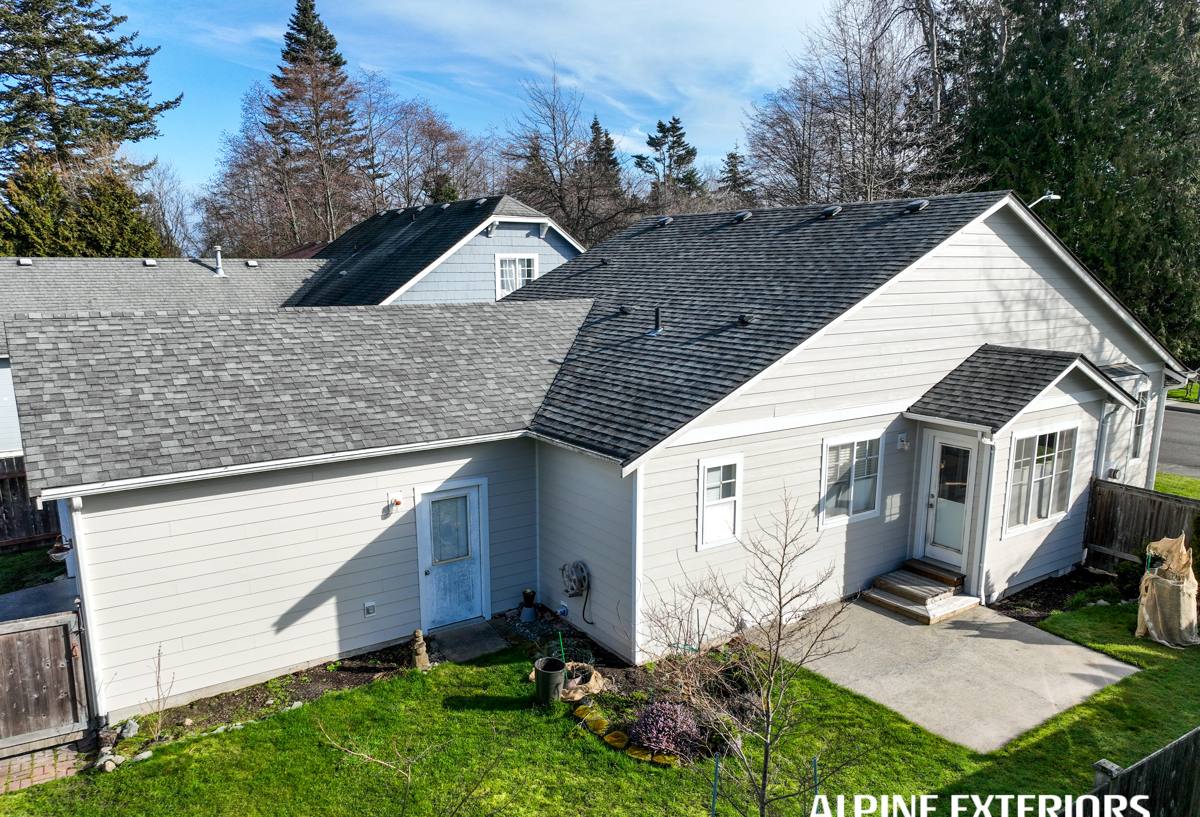
What the Climate Actually Does to a House Here
Salt Air and Metal Fasteners
Homes within a few miles of Bellingham Bay are exposed to airborne salt, which accelerates corrosion on exposed metal — nail heads, flashing, gutter fasteners, and hardware that isn't rated for coastal exposure. Over years, corroding fasteners can streak siding, loosen trim, and create small gaps where water gets behind the exterior envelope. It's a slow process, which is exactly why it's easy to miss until the damage is visible.
Driving Rain and Wall Assemblies
Straight-down rain is relatively easy for any siding to shed. Wind-driven rain, which is common off the bay, pushes water sideways into laps, seams, and butt joints. A siding system that isn't installed with the right overlaps, flashing details, and drainage plane behind it will eventually let moisture in, even if the surface material itself is sound. This is as much an installation issue as a product issue.
Moss, Shade, and Slow-Drying Surfaces
Tree cover and shorter winter daylight mean some exterior surfaces in Columbia simply don't dry out as fast as they would in a sunnier part of the county. That extends moss and algae growth on roofs, north walls, and decking, and it means any exterior material that's sensitive to sustained moisture exposure is working harder here than it would on a south-facing lot in full sun.
Siding: Why We Only Install James Hardie
We install James Hardie fiber cement siding exclusively. We don't install vinyl, LP SmartSide, Cemplank, Allura, primed spruce, or cedar. That's not a marketing line — it's a standard we hold because of what we've seen these products do (and not do) in exactly the conditions Columbia homes face.
- Vinyl is affordable and low-maintenance, but it expands and contracts with temperature swings, can warp near heat sources, and its seams and J-channels give wind-driven rain more places to work its way behind the panel over time.
- LP SmartSide, Cemplank, and Allura are engineered wood or fiber cement alternatives with their own trade-offs — engineered wood products carry a wood-based core that is more sensitive to sustained moisture exposure than fiber cement, and coating consistency varies between manufacturers.
- Primed spruce and cedar are real wood. Real wood needs a maintained paint or stain film to perform, and in a shaded, damp neighborhood like Columbia, that film breaks down faster than it would in a drier climate — which means more frequent repainting, more caulking, and a higher long-term ownership cost, even though the upfront material can look great.
James Hardie fiber cement is non-combustible, dimensionally stable across our temperature range, and factory-finished with ColorPlus technology, so the color coat is baked on under controlled conditions rather than applied on-site where weather can affect cure quality. Hardie's HZ5 product line is engineered for this kind of marine, high-moisture climate, and the warranty is transferable if you sell the home. It costs more than vinyl upfront. For a neighborhood this close to the water, we think that difference is worth it.
Siding Product Comparison
| Material | Moisture Behavior in Marine Climate | Maintenance Load | Typical Lifespan |
|---|---|---|---|
| Vinyl | Seams and channels vulnerable to wind-driven rain intrusion | Low, but limited repair options if damaged | 20-30 years |
| Cedar / Primed Spruce | Wood core needs an intact paint/stain film to resist moisture | High — repainting, caulking, spot repairs | Variable, heavily maintenance-dependent |
| LP SmartSide / Engineered Wood | Wood-strand core more sensitive to sustained damp exposure than fiber cement | Moderate | 25-30 years with maintenance |
| James Hardie Fiber Cement | Non-combustible, engineered for marine/high-moisture regions (HZ5) | Low — occasional wash, no repainting of the color coat | Multi-decade, factory-backed warranty |
Roofing for a Shaded, Wet, Salt-Air Lot
Roofs in Columbia carry the same load siding does, plus standing water risk on low-slope sections and moss growth wherever shade lingers. We look at ventilation, underlayment quality, and flashing details around chimneys, skylights, and valleys — the places roofs actually fail first. A roof that's shedding water correctly but trapping moisture in the attic will still cause problems, so we treat roofing and ventilation as one system, not two separate jobs.
Windows: Sealing Out Driving Rain
Old single-pane or early dual-pane windows are common in Columbia's older housing stock, and their weak point usually isn't the glass — it's the seal and flashing around the frame. Wind-driven rain off the bay finds gaps that wouldn't matter in a calmer climate. When we replace windows, proper flashing integration with the siding and building wrap matters as much as the window unit itself, because a well-built window installed wrong will still leak.
Decks: Built to Handle Standing Moisture
Decks in shaded, damp yards deal with slower drying, more algae growth, and faster wear on fasteners exposed to salt air. Board spacing, ledger flashing, and joist protection all affect how long a deck holds up here. A deck built without attention to drainage and airflow underneath will show rot and softness well ahead of schedule in a neighborhood like this.
Why a Local Crew Matters in a Neighborhood Like This
Columbia isn't a subdivision built all at once — it's a patchwork of home ages, additions, and prior renovations, which means every project starts with figuring out what's actually behind the existing exterior before deciding what goes back up. A crew that works across Whatcom County regularly knows how this specific stretch of coastline behaves: which walls stay damp longest, how far moss creeps down a north-facing roof by mid-winter, and what flashing details actually hold up against driving rain off the bay. That's knowledge you build by doing the work here repeatedly, not by reading a spec sheet.
It also matters for something more practical: being reachable. If a storm knocks something loose or a leak shows up, a local company can get someone out to look at it without the delay of coordinating a crew based somewhere else in the state.
What to Check Before Hiring Anyone for Exterior Work
- Washington state contractor license and current liability insurance, verifiable through the state's public license lookup
- Manufacturer certification if the job involves a specific siding system like James Hardie
- A written estimate that spells out material, underlayment/house wrap, flashing approach, and cleanup — not just a total price
- Willingness to explain their installation approach for wind-driven rain and moisture management, not just the product brand
- References or past project history in your specific area, not just general company reviews
- A clear warranty structure — both the manufacturer's product warranty and the contractor's workmanship warranty
How We Approach a Columbia Project
We start by looking at what's actually happening on the house — where moisture is getting in, where moss and algae are heaviest, what condition the sheathing and trim are in once old siding or roofing comes off. That inspection drives the plan, not a generic package. For siding, that plan always centers on James Hardie fiber cement, sized and detailed for the exposure that specific wall or elevation is getting. For roofing, windows, and decks, it means matching materials and installation details to a marine climate with real wind-driven rain and a long wet season, not a one-size-fits-all approach borrowed from a drier region.
If your Columbia home is showing early signs of trouble — peeling paint that keeps coming back, moss that won't stay off the roof, soft spots on a deck, or drafts around older windows — those are usually easier and cheaper to address before they become structural. We're happy to take a look, walk you through what we're seeing, and put together a straightforward, no-pressure estimate for whatever combination of siding, roofing, windows, or deck work your home actually needs.