 Bellingham Siding
 A Familiar Product With a Real Track Record — and Real Limits
Primed spruce lap siding has been going up on Pacific Northwest homes for generations. It's affordable, it's easy for framers and painters to work with, and when it's fresh off the truck it looks exactly like the traditional wood-sided homes that give Bellingham neighborhoods their character. We're not going to pretend it's a bad product on paper. The problem is what happens to it after five, ten, and twenty years on a house that sits in Whatcom County's weather — and that's the part a lot of homeowners don't find out until they're already living with it.
This page explains why, after years of doing exterior work in this region, we made the call to stop installing primed spruce siding and put James Hardie fiber cement on every home we side instead. We'll give the product its due credit first, then walk through the trade-offs that changed our mind.
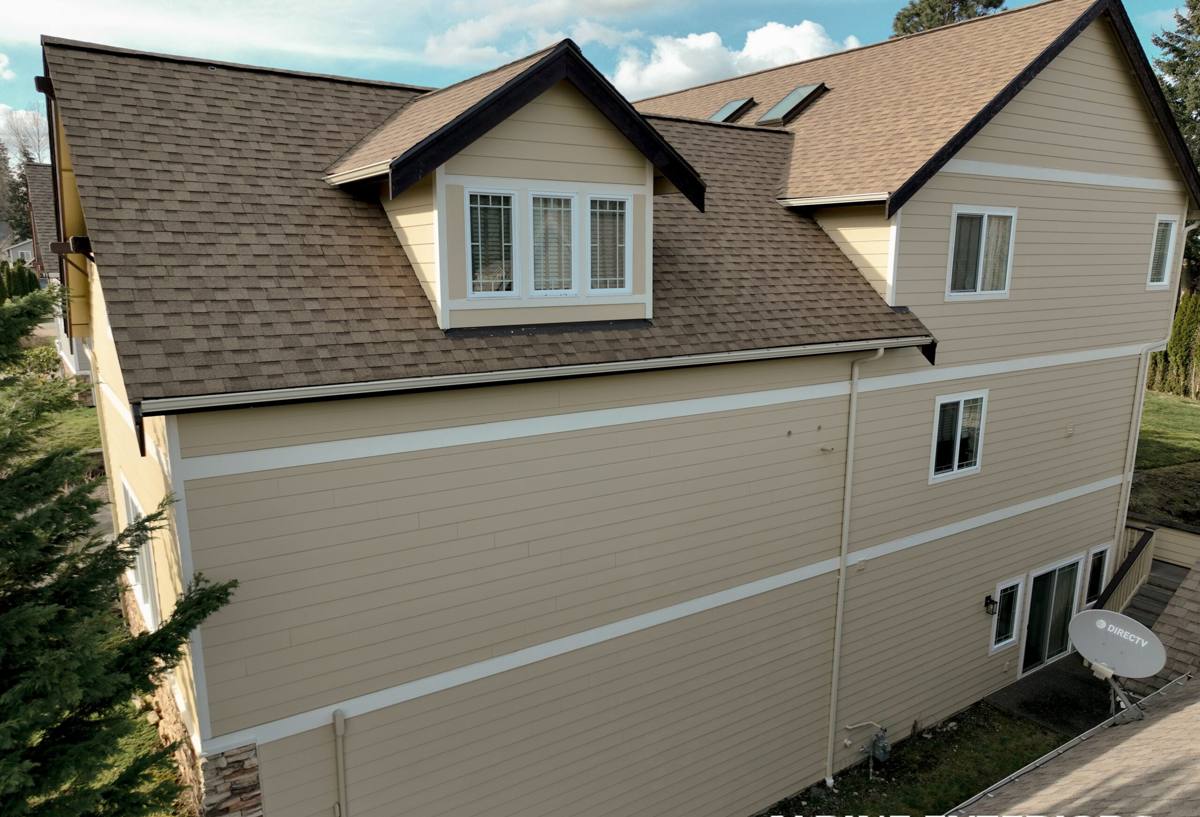
What Primed Spruce Siding Gets Right
To be fair to the material, primed spruce has some genuine advantages that explain why it's stayed popular for so long:
- Lower upfront material cost compared to fiber cement, which matters on tight budgets or large projects.
- Easy to cut and fasten with standard carpentry tools, which can simplify complex trim details.
- A natural wood look that some homeowners specifically want, especially on older Craftsman and farmhouse-style homes around Bellingham.
- It's a renewable material, which appeals to homeowners weighing environmental factors.
If you install it correctly, prime and paint every surface including the back and end grain, and stay on top of maintenance without fail, it can perform reasonably well. The trouble is that "correctly" is a much higher bar than most people realize, and this climate doesn't forgive shortcuts.
The Core Problem: Primer Is Not a Seal
This is the piece that gets misunderstood most often. Primer is a paint base coat, not a moisture barrier. It gives the topcoat something to grip and slows — but does not stop — water absorption. On most primed spruce siding, only the visible face and edges get primed at the mill. The back side of the board, and the cut ends made on-site during installation, are frequently left bare or under-primed unless a contractor takes the extra time to field-prime every single cut.
Wood is hygroscopic — it absorbs and releases moisture with the seasons. Spruce in particular is a softer, more porous species than cedar, which means it takes on water faster and holds it longer. Once moisture gets into an unsealed cut end or the unprimed backside, it migrates through the board from the inside out, and that's happening behind the paint film where you can't see it until blistering, cracking, or soft spots show up.
Why This Matters More Here Than in a Dry Climate
In a low-humidity region, a few unsealed cut ends might never become a real problem. Bellingham isn't that region. Between the marine air off the Salish Sea, long stretches of driving rain, and a genuine moss season that keeps north-facing walls damp for months, any gap in a wood siding system's protection gets tested constantly rather than occasionally.
What Bellingham's Climate Does to Wood Siding Specifically
We size up siding performance around three regional realities:
Salt Air
Homes closer to Bellingham Bay and the surrounding shoreline deal with airborne salt that accelerates corrosion on fasteners and hardware, and speeds up the breakdown of paint films. Once a paint film starts chalking or thinning from salt exposure, the wood underneath loses its protection faster than the maintenance schedule assumes.
Driving Rain
Wind-driven rain doesn't just fall on siding, it gets pushed sideways and upward into laps, joints, and butt seams — exactly the spots where primed spruce is weakest. Lap siding depends on gravity-fed drainage working perfectly at every seam, year after year, to keep water out of those vulnerable joints.
A Long Moss Season
Whatcom County's moss and algae season runs long compared to drier parts of the state. Organic growth holds moisture directly against the siding surface, keeps the wood from drying out between rain events, and creates the damp, shaded conditions that wood rot and paint failure both thrive in. On primed wood, this shows up as green-black staining and softened paint well before the wall assembly itself is actually compromised — but it's often the first visible sign that something worse is starting underneath.
The Maintenance Burden Most Homeowners Underestimate
Primed spruce siding is a coated wood product, which means its lifespan is really the lifespan of its paint job, repeated indefinitely. In this climate, that typically means:
| Task | Typical Interval Here | Why It's Non-Negotiable |
|---|---|---|
| Full repaint | Every 5–8 years, often sooner on sun/rain-exposed elevations | Paint film is the only thing standing between the wood and moisture |
| Caulk inspection and touch-up | Annually | Failed caulk at joints and trim is a direct water entry point |
| Moss/algae wash | 1–2x per year | Organic growth holds moisture against the wood and stains paint |
| Spot repair of soft or cracked boards | As discovered | Localized rot spreads if boards aren't replaced promptly |
None of this is unusual for wood siding — it's how wood siding has always worked. The issue is that skipping or delaying any one of these steps for even a couple of years, which is common with busy homeowners, is often enough for moisture to get past the paint film and into the wood in a climate this consistently wet.
Where Primed Spruce Tends to Fail First
When we've been called in to look at aging wood siding, the damage shows up in predictable places, not randomly across the wall:
- Butt joints where two boards meet end-to-end — the most common entry point for water, since end grain absorbs moisture many times faster than the face of the board.
- Bottom courses near grade, where splashback keeps the lowest boards wetter than the rest of the wall and rot often starts unnoticed behind foundation plantings.
- Nail heads that pop or rust-stain as the board swells and shrinks seasonally, breaking the paint seal around the fastener.
- Cupped or bowed boards from uneven moisture absorption between the primed face and less-protected backside.
- Around windows and trim, where cut ends made during installation are the most likely spot to have been under-primed in the field.
Primed Spruce vs. James Hardie: The Practical Differences
| Factor | Primed Spruce Siding | James Hardie Fiber Cement |
|---|---|---|
| Repaint interval | Every 5–8 years | ColorPlus factory finish; typically no repaint needed for 15+ years |
| Moisture behavior | Absorbs and swells; end grain and backside are vulnerable | Engineered to resist moisture-driven warping and rot |
| Fire performance | Combustible | Non-combustible material |
| Pest resistance | Vulnerable to insects and wood rot | Doesn't provide a food source for insects |
| Climate matching | One product regardless of exposure | HZ product lines engineered for regional moisture/climate zones |
| Warranty | Varies; often limited and non-transferable | Strong manufacturer warranty, transferable to a new owner |
Why We Standardized on James Hardie Instead
We stopped installing primed spruce, along with a handful of other products, because we got tired of watching homeowners inherit a maintenance schedule they didn't fully sign up for, only to see rot show up at butt joints and bottom courses a decade or two later regardless of how careful the paint schedule had been. James Hardie's fiber cement is engineered specifically to hold up to sustained moisture exposure rather than just resist it temporarily with a coating. The ColorPlus factory finish is baked on under controlled conditions, not brushed on in the field, and it's backed by a warranty that actually transfers if you sell the home. The HZ5 product line is formulated for the wetter, moisture-heavy climate zones that include Western Washington, which matters given the amount of driving rain and humidity this part of the state deals with.
It's also a non-combustible material, which is a meaningful consideration given how many homes in Whatcom County sit close to trees and vegetation. None of this means primed spruce is a scam or that everyone who's installed it made a mistake — it's a legitimate, traditional product. It just isn't the product we're willing to put our name behind anymore, once we account for what this specific climate does to it over the life of a home.
If You Already Have Primed Wood Siding
Not every home with primed spruce siding needs to be resided immediately. If you're trying to decide whether to keep maintaining what's there or plan for a replacement, look for these signs before deciding:
- Soft or spongy spots when you press on the siding, especially near the bottom courses or window sills
- Paint that's cracking or peeling in sheets rather than just chalking evenly
- Visible cupping or bowing in individual boards
- Dark staining or persistent moss growth that returns within months of cleaning
- Gaps or separation at butt joints and around trim
- A repaint cycle that's crept from every 6-7 years down to every 3-4 because the paint keeps failing early
If you're seeing two or more of these, it's worth getting an honest assessment before more of the wall assembly is affected.
If you're weighing your options for a Bellingham home — whether that's maintaining existing wood siding, comparing materials for a full replacement, or just want a straight answer about what's actually going on with your exterior — we're happy to take a look and walk you through it. Reach out for a free, no-pressure estimate.