 Bellingham Siding
 Why Happy Valley Homes Take a Different Kind of Beating
Happy Valley is a quiet, tree-lined residential pocket of south Bellingham, and it looks the part of a Pacific Northwest neighborhood — mature landscaping, close-set homes, plenty of shade. That same setting is exactly what makes siding a harder problem here than it looks. Whatcom County's marine climate means moisture is a year-round presence, not a seasonal event, and homes tucked under tree cover or set back from full sun stay damp longer after every rain.
Three things do most of the damage to siding in this part of Bellingham. Salt-laden air drifts inland off Bellingham Bay and settles on exterior surfaces, accelerating corrosion of fasteners, trim, and any coating that isn't built to resist it. Driving rain — wind-pushed, not just falling straight down — forces water sideways into laps, seams, and butt joints that a calmer climate would never test. And a long moss season, often running from early fall through late spring, means anything organic (wood, wood-based composites, poorly sealed edges) stays wet enough, long enough, for moss and mildew to take hold and start working into the material itself.
None of this is unique to one street or one lot — it's the baseline reality for exterior materials anywhere in this part of Whatcom County. The difference between siding that holds up for decades and siding that fails early usually isn't the weather. It's whether the product and the installation were actually built to handle it.
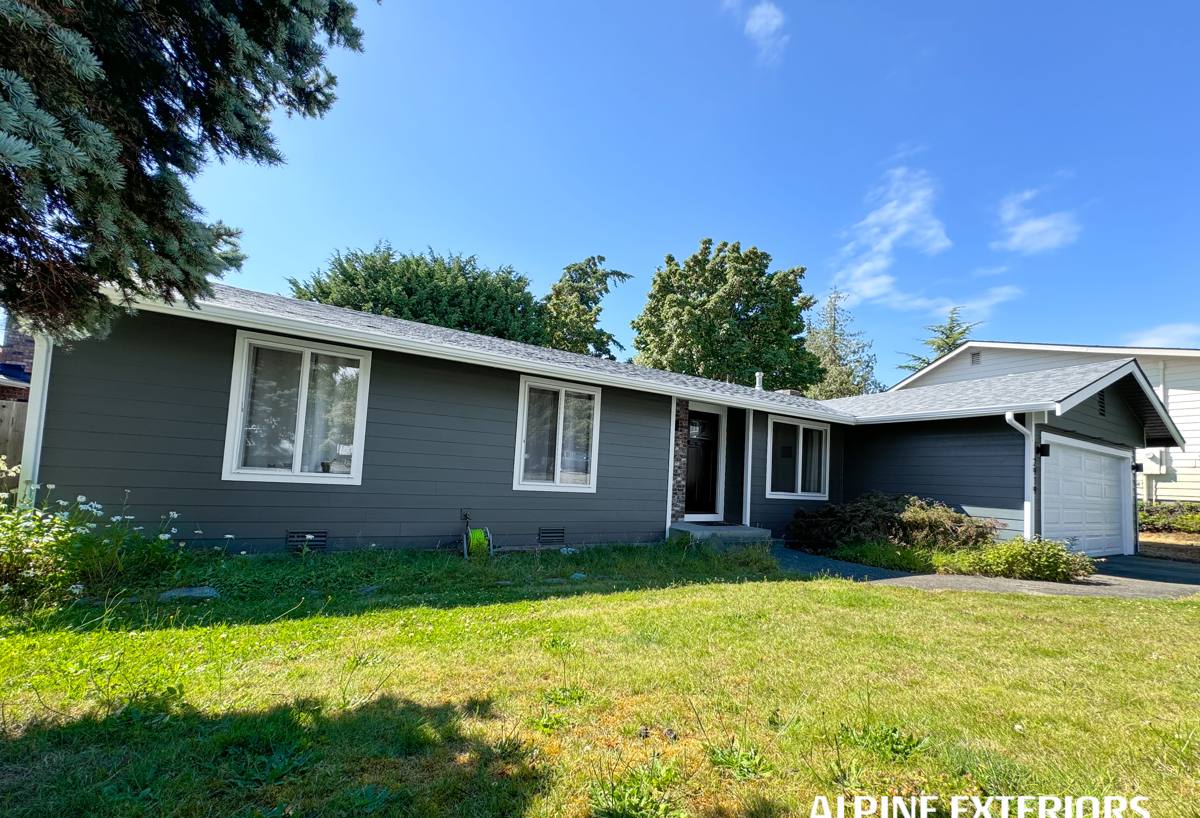
What Fiber Cement Siding Needs to Do Here
Resist Moisture Without Absorbing It
Fiber cement is dimensionally stable and doesn't swell, rot, or delaminate the way wood and wood-composite products can when they stay wet. That matters directly in a climate where siding may not fully dry out between rain events for weeks at a time. But the material only performs this way if it's installed with the moisture-management details intact — proper flashing, correct gaps at grade and trim, and drainage paths that let incidental water escape instead of pooling behind the cladding.
Hold a Factory Finish Through Salt Exposure
Field-applied paint is the first thing to fail under repeated salt-air exposure and driving rain — it chalks, fades unevenly, and opens hairline cracks at laps where water gets in. A factory-baked finish is engineered and cured under controlled conditions specifically to resist that kind of weathering, which is a meaningful advantage for homes exposed to Bellingham Bay's salt-carrying air.
Discourage Moss and Mildew Growth
Moss doesn't grow on siding because the material is "bad" — it grows wherever there's a damp, textured surface it can grip and organic material it can feed on. Dense fiber cement gives moss and algae far less to hold onto than rough-sawn wood or fibrous composite panels, and it doesn't feed fungal growth the way wood-based products can once moisture gets into the substrate.
What a Correct Installation Actually Involves
Fiber cement is only as good as the install behind it. In a climate like this one, a few details separate siding that lasts thirty-plus years from siding that develops problems in five.
- Weather-resistive barrier installed and lapped correctly, with all penetrations properly sealed before siding goes on
- Rainscreen gap or furring where the wall assembly calls for it, so water that gets behind the cladding can drain and the wall can dry
- Correct clearance at grade, decks, and roof lines — fiber cement that sits too close to soil, concrete, or roofing traps moisture at the bottom edge
- Butt joints and laps sealed or flashed per manufacturer specification, not just caulked and left
- Corrosion-resistant fasteners driven to the correct depth — overdriven or underdriven nails are one of the most common causes of early siding failure
- Trim, corners, and penetrations (vents, hose bibs, light fixtures) flashed individually rather than relying on caulk as the only barrier
Every one of these steps is spelled out in the manufacturer's installation manual, and every one of them is a place where a rushed or unfamiliar crew can cut a corner that won't show up as a problem for a year or two — which is exactly long enough for it to become the homeowner's problem instead of the installer's.
Why We Install Only James Hardie Fiber Cement
We standardized on James Hardie products rather than offering multiple fiber cement brands or alternative claddings like vinyl or wood composite. Hardie's siding is non-combustible, engineered in climate-specific formulations, and finished with a factory-applied ColorPlus coating backed by a real, transferable warranty. For a climate that combines salt exposure, sustained moisture, and heavy rain, that combination of durability and finish performance is what we're willing to put our name behind. We'd rather install one product system correctly and stand behind it than offer a menu of materials with different trade-offs we can't fully warranty in this climate.
Matching the Right Hardie Product to a Happy Valley Home
Hardie makes several distinct product lines, and the right choice depends on the home's existing architecture, exposure, and the look the homeowner wants — not a one-size answer.
| Product | Typical Use | Best Suited For |
|---|---|---|
| HardiePlank lap siding | Traditional horizontal lap profile | Most single-family homes; the standard replacement choice |
| HardiePanel vertical siding | Board-and-batten or modern vertical look | Accent walls, gables, or homes going for a more contemporary look |
| HardieShingle siding | Staggered or straight-edge shingle profile | Homes with a Craftsman or cottage character |
| HardieTrim | Corner boards, fascia, window/door trim | Finishing out any of the above for a consistent system |
Color matters too. Hardie's ColorPlus palette is factory-matched to hold up under UV and salt exposure far better than a job-site paint job, and choosing from that palette (rather than requesting field painting after install) is what keeps the finish warranty intact.
Our Process on Happy Valley Projects
1. On-Site Assessment
We look at the existing siding and sheathing condition, moisture history, sun and shade exposure on each elevation, and any trouble spots — areas near grade, under decks, or in shaded corners tend to need the closest attention in this climate.
2. Removal and Substrate Check
Old siding comes off and we check what's underneath before covering anything back up. Hidden rot or compromised sheathing needs to be addressed before new siding goes on — installing over a bad substrate just hides the problem.
3. Weather Barrier and Flashing
This is the step that determines how the wall performs for the next thirty years, and it's also the step that's invisible once the job is finished. We don't shortcut it.
4. Hardie Installation to Manufacturer Spec
Fastening, spacing, and joint treatment follow Hardie's published installation requirements — not general contractor habit — because that's also what keeps the product warranty valid.
5. Trim, Caulking, and Final Inspection
We finish out trim details and walk the whole exterior before calling it done, checking clearances, seals, and fastener lines.
Living With Fiber Cement in This Climate
Fiber cement is low-maintenance compared to wood, but "low-maintenance" doesn't mean "no maintenance," especially with a long moss season working against you. A little seasonal attention goes a long way toward protecting the investment.
- Rinse siding gently once or twice a year to clear pollen, salt residue, and early moss growth before it establishes
- Keep gutters clear so overflow doesn't run down the wall face and stay wet longer than necessary
- Trim back vegetation and tree limbs that shade siding and slow drying time
- Inspect caulking at trim and penetrations annually and re-seal where it's cracked or pulled away
- Address any moss or algae promptly with a gentle wash rather than pressure-washing, which can force water behind laps
Cost Factors for a Happy Valley Fiber Cement Project
| Factor | Why It Affects Cost |
|---|---|
| Home size and elevation count | More square footage and more complex rooflines mean more cutting, flashing, and labor |
| Substrate condition | Rot or damaged sheathing found during tear-off adds repair scope before new siding goes on |
| Product line and profile | Lap, panel, and shingle profiles carry different material and labor requirements |
| Trim and detail work | Corner boards, window trim, and accent details add finish labor |
| Access and site conditions | Tight lots, mature landscaping, or difficult staging can affect scheduling and labor time |
We give homeowners a real, itemized number after seeing the home in person — broad ranges without an on-site look aren't useful to anyone.
Why Hiring a Crew That Already Works This Neighborhood Matters
A crew that regularly works Happy Valley and the rest of Bellingham has already seen how this specific combination of salt air, driving rain, and shade-driven moss plays out on real homes — which elevations tend to hold moisture longest, where flashing details get skipped most often, and what actually needs to change from a generic installation manual to hold up here. That local pattern recognition is difficult to substitute for, and it's the difference between siding that's technically installed and siding that's installed correctly for this climate.
If you're weighing a siding replacement for your Happy Valley home, we're glad to take a look and walk you through what we'd recommend — no pressure, no obligation. Reach out below for a free estimate.