 Bellingham Siding
 Blaine sits about as close to saltwater and the Canadian border as a Whatcom County home can get, and that location shapes what a house has to deal with year-round. Between the marine air rolling off Semiahmoo Bay and Drayton Harbor, the sideways rain that blows in off the Strait of Georgia during winter storms, and the long gray stretch from October through April when surfaces barely get a chance to dry out, exterior materials in Blaine work harder than they do almost anywhere else in the county. We've built our siding, roofing, window, and deck work around that reality, not around what looks good in a showroom somewhere inland.
What Blaine's Climate Actually Does to a House
Salt air is corrosive in ways that aren't always obvious right away. It accelerates the breakdown of fasteners, flashing, and paint film, and it settles into porous or fibrous siding materials over time, holding moisture against the substrate longer than it would in a drier inland town. Combine that with driving rain — wind-driven precipitation that gets pushed sideways into wall assemblies rather than just falling straight down — and you get a house that's under constant pressure on its weather barrier, especially on west- and southwest-facing walls that catch the brunt of Strait storms.
Then there's moss. Blaine's moss season isn't a few weeks in spring; it's most of the year. Any surface that stays damp and shaded — north-facing siding, roof valleys, the undersides of deck boards — is a candidate for moss and algae growth. Moss doesn't just look bad. It holds moisture against the material beneath it, and on organic or wood-based products that moisture retention is exactly what accelerates rot, delamination, and paint failure.
Why This Matters for Material Choice
A siding product that performs fine in a dry climate can struggle here. Materials that absorb moisture, swell, or rely on a surface coating to keep water out are fighting an uphill battle in a town where the air itself carries salt and the rain comes in sideways for months at a stretch. That's a big part of why we standardized on James Hardie fiber cement siding for every home we side, rather than offering a menu of products with different moisture tolerances.
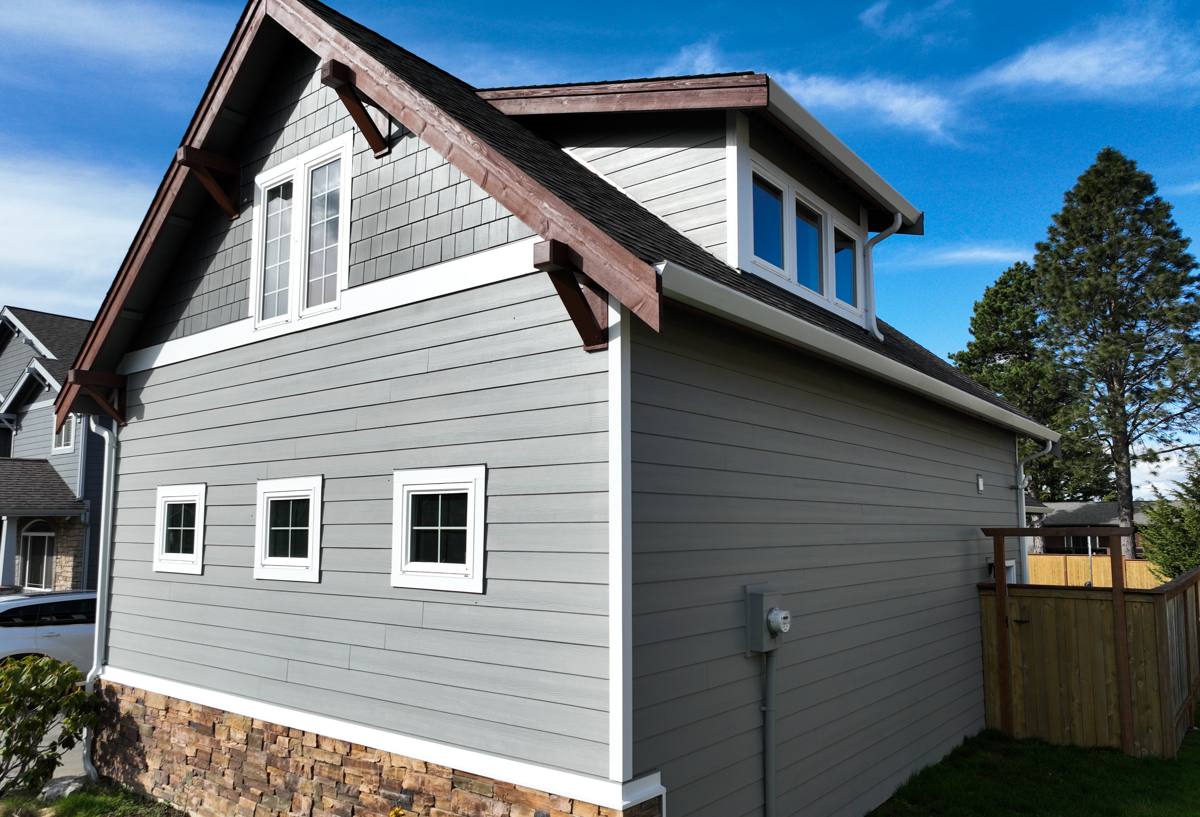
Why We Only Install James Hardie Siding
We get asked fairly often why we don't offer vinyl, LP SmartSide, or some of the other fiber cement alternatives on the market. The honest answer is that we looked at what Blaine's climate does to a house over 15, 20, 30 years, and we decided we didn't want to install anything we'd have reservations about recommending to our own family.
- Vinyl siding is inexpensive and low-maintenance in the short term, but it's a thin plastic product that can warp, crack, or fade under UV exposure and temperature swings, and it doesn't hold up well to impact. In a coastal wind environment, seams and panel edges are also a point where wind-driven rain can find its way behind the cladding.
- LP SmartSide and other engineered wood products use a wood-strand core with a resin coating. That coating is doing a lot of work to keep moisture out, and any breach — a nail hole, a cut edge that wasn't properly sealed, a scratch — gives water a path into a wood-based substrate that will swell and eventually rot if it stays damp. In a climate with Blaine's rain totals and moss season, that's a real long-term risk, not a hypothetical one.
- Primed spruce and cedar are attractive natural materials, but they require an ongoing maintenance commitment — recoating, caulking, and vigilant moisture management — that most homeowners underestimate until they're a decade in and dealing with soft boards.
James Hardie fiber cement is made from cement, sand, and cellulose fibers. It doesn't absorb water the way wood-based products do, it's non-combustible, and it holds paint and factory finish far longer than wood substrates because it isn't expanding and contracting with moisture the way organic materials do. That's the trade-off that matters most in a place like Blaine, where the exterior envelope is under near-constant moisture pressure for a good chunk of the year.
Hardie's HZ5 Line and Why Zone Matters
James Hardie engineers its siding by climate zone, and Whatcom County — including Blaine — falls into HZ5, the company's zone designation for regions with significant moisture exposure and temperature swings. HZ5 products are formulated with that moisture load in mind. It's a small detail that a lot of homeowners never hear about, but it's the difference between a generic siding product and one that's actually engineered for what a Blaine roofline and wall assembly go through every winter.
The ColorPlus factory finish that comes on Hardie products is also worth understanding in a marine climate. It's baked on in a controlled factory environment rather than field-applied, which gives it better adhesion and UV resistance than a job-site paint job — and in a town where salt air degrades painted surfaces faster than inland areas, that factory-cured finish holds its color and integrity noticeably longer.
How We Approach a Blaine Siding Project
Assessment First
Before we talk product or price, we look at the house: which walls take the worst of the weather, where moss and moisture staining are already showing up, what condition the existing sheathing and flashing are in, and whether there's evidence of past water intrusion. A siding replacement is also the one time it's easy and affordable to fix flashing, housewrap, and trim details that are otherwise buried behind the wall.
Installation Detail Matters More Than the Product
Fiber cement siding is only as good as its installation. Improper fastening, missing or incorrect flashing at windows and doors, insufficient clearance at grade, and poor joint sealing are the most common causes of problems on any siding job — and in a high-moisture coastal environment, those mistakes show up faster and cause more damage than they would somewhere drier. We install to Hardie's published specifications because those specs exist for a reason, not as a formality.
Beyond Siding: Roofing, Windows, and Decks in a Coastal Climate
Siding doesn't work in isolation — it's one piece of an exterior envelope that also includes the roof, windows, and any exterior structures like decks. In Blaine, all four face similar pressures from wind-driven rain and near-constant humidity.
- Roofing takes the first hit from driving rain and needs flashing and underlayment details that account for wind uplift, not just straight-down precipitation.
- Windows are one of the most common points of water intrusion when flashing isn't integrated correctly with the siding plane — this is a detail we pay close attention to on every siding replacement that includes window work.
- Decks exposed to Blaine's damp, shaded conditions need material and fastener choices that resist moisture retention and the moss growth that comes with it, along with drainage that keeps water from pooling against ledger boards and framing.
Handling all four trades under one roof means the details at the transitions — where siding meets roofline, where a window is flashed into the wall assembly, where a deck ledger attaches to the house — get coordinated instead of handed off between separate contractors who may never talk to each other.
Cost Factors for a Blaine Siding Project
Every house is different, but a few factors consistently drive cost on siding projects in this area:
| Factor | Why It Matters in Blaine |
|---|---|
| Extent of moisture damage found | Coastal humidity and moss can hide sheathing or framing damage that isn't visible until old siding comes off |
| Home size and wall complexity | More corners, dormers, and trim details mean more labor and material for proper flashing and fit |
| Siding profile and finish | Lap width, texture, and ColorPlus finish options affect material cost |
| Trim and accessory work | Fascia, soffit, and trim boards are often replaced alongside siding for a consistent, weathertight result |
| Access and site conditions | Waterfront lots, steep grades, or limited access can affect staging and labor time |
What to Check Before Hiring a Contractor Here
- Washington state contractor license and current insurance, verifiable through the state's contractor lookup
- Experience specifically with fiber cement installation, not just general siding work
- Familiarity with coastal Whatcom County conditions — moss management, wind-driven rain, flashing detail
- A written scope that specifies siding line, profile, and finish, not just a lump-sum price
- Manufacturer-backed warranty documentation, not just a verbal promise
- Willingness to walk the exterior with you and point out problem areas before quoting
Warranty Protection Worth Understanding
James Hardie backs its siding products with a transferable limited warranty, which matters both for your own peace of mind and for resale value — a documented, transferable warranty is something a buyer's inspector will notice and appreciate. Warranty coverage is generally tied to proper installation, which is another reason installation quality isn't a corner worth cutting, whether that's on your own home or one you might sell down the road.
A Local Crew Understands the Difference
A lot of siding problems in coastal towns like Blaine trace back to a crew that installed correctly for a drier, calmer climate and didn't adjust for wind-driven rain, salt exposure, or extended damp seasons. Working in Whatcom County day in and day out means we see how houses here actually age — which walls fail first, where moss takes hold, which details hold up and which don't — and that shapes how we flash, fasten, and finish every job, not just how we sell it.
If you're weighing a siding, roofing, window, or deck project on a Blaine home, we're happy to take a look and walk you through what we're seeing and why. Reach out for a free, no-pressure estimate using the form below.