 Bellingham Siding
 Two Very Different Materials, One Big Decision
If you're re-siding a home in Bellingham, you've probably narrowed it down to two finalists: vinyl siding and James Hardie fiber cement. Both are common, both are sold by reputable installers around Whatcom County, and both will make an old house look new again. But they are not similar products wearing different colors. One is a plastic extrusion that expands and contracts with temperature. The other is a cement-based board engineered to hold paint, resist moisture, and stay put. The right choice depends less on which one is "better" in the abstract and more on how each one performs specifically in a marine climate like ours — salt air off Bellingham Bay, driving winter rain, and a moss season that seems to stretch from October through May.
This page lays out the honest differences: what each material is made of, how they hold up here, what they cost over time, and why our company made the decision years ago to install only James Hardie fiber cement siding. We don't install vinyl, and we want you to understand exactly why before you decide what goes on your own home.
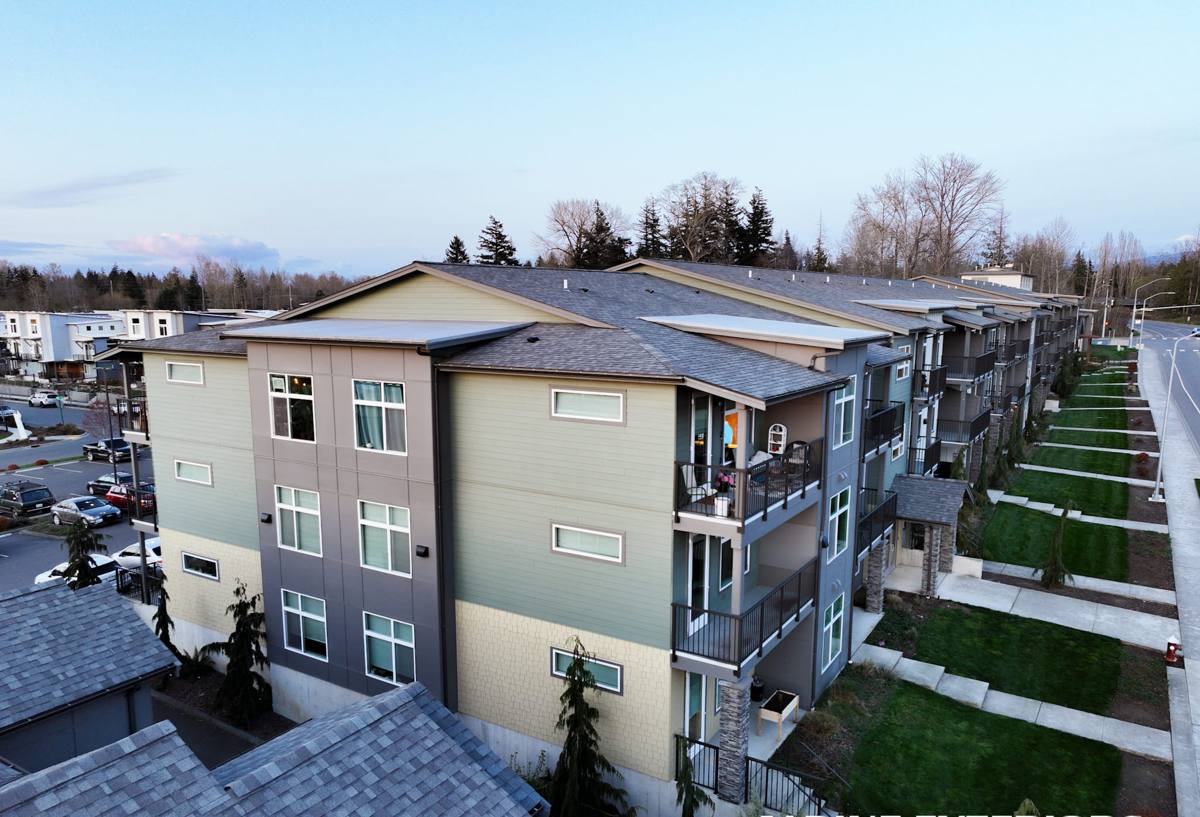
What Vinyl Siding Actually Is
Vinyl siding is extruded PVC (polyvinyl chloride) plastic, formed into panels that interlock and hang on the wall rather than being fastened rigidly to it. That "hanging" installation method is intentional — vinyl needs room to expand and contract with temperature swings, so panels are nailed loosely through slotted holes. It's lightweight, inexpensive, and widely available, which is why it's been the default siding choice in much of the country for decades.
Where Vinyl Does Fine
In dry, moderate climates, vinyl can perform acceptably for fifteen to twenty-five years. It doesn't rot, it doesn't need painting, and installation is fast. For budget-driven projects where the homeowner plans to move in a decade, it can be a reasonable, honest choice.
Where Vinyl Struggles in Bellingham Conditions
Our climate is a different story. Vinyl is a moisture-management product by design — meaning water is expected to get behind it, and the wall assembly behind the panels is what's supposed to keep the house dry. In a region with Bellingham's rainfall totals, that reliance on the water-resistive barrier behind the siding to do all the real work leaves very little margin for error in the original install. Salt-laden air off the water also accelerates fading and can be harder on the fasteners and trim accessories than it is inland. And vinyl becomes brittle in cold snaps — not something we see for weeks at a stretch here, but our occasional hard freezes are enough to crack panels that get bumped by a ladder, a branch, or hail.
What James Hardie Fiber Cement Actually Is
James Hardie siding is made from cement, sand, and cellulose fiber, cured into dense, rigid boards. It's fastened directly and rigidly to the wall — no expansion gaps, no loose hanging. It's also non-combustible, which matters increasingly to insurers and to homeowners thinking about wildfire smoke and ember exposure even on the wet side of the state.
The HZ5 Engineering Detail That Matters Here
James Hardie makes climate-specific product formulations called HZ (HardieZone) products. The Pacific Northwest, including Whatcom County, falls in a HZ5 moisture zone, and Hardie engineers its boards' density and moisture resistance differently for wetter regions than they do for the dry Southwest. That's not marketing language — it reflects that a fiber cement board sitting under Bellingham's rain load for thirty years needs different performance characteristics than one in Phoenix. We only install the product line engineered for our zone.
ColorPlus Factory Finish
Most Hardie products we install come with ColorPlus Technology — a factory-applied, baked-on finish rather than field-applied paint. It's more UV- and fade-resistant than site-painted siding, and it carries its own finish warranty separate from the product warranty. For a house facing the salt air and UV exposure of a water-adjacent lot, a factory finish that doesn't rely on a painter's prep work and weather conditions on install day is a real advantage.
Head-to-Head: The Practical Differences
| Factor | Vinyl Siding | James Hardie Fiber Cement |
|---|---|---|
| Material | Extruded PVC plastic | Cement, sand, cellulose fiber |
| Installation method | Hung loosely to allow expansion | Fastened rigidly to the wall |
| Fire behavior | Combustible plastic; can melt or warp near heat | Non-combustible |
| Cold/impact resistance | Can crack or become brittle in hard freezes | Resists cracking from impact when installed properly |
| Moisture role | Relies on the barrier behind it to keep the wall dry | Engineered moisture resistance in the board itself (HZ5 for our region) |
| Finish | Color molded through the plastic; fades over time, cannot be repainted easily long-term | Factory ColorPlus finish or field-painted; can be repainted |
| Typical lifespan (Whatcom County conditions) | 15-25 years | 30-50+ years when installed to spec |
| Warranty structure | Prorated, often reduced with second ownership | Non-prorated, transferable product warranty |
The Cost Conversation, Honestly
Vinyl siding costs less per square foot installed than James Hardie fiber cement — that's simply true, and we won't pretend otherwise. If your only constraint is the lowest possible number on a quote, vinyl will usually win that specific line item. But cost-per-square-foot isn't the same as cost-per-year-of-ownership, and that's the number that actually matters for a house you plan to keep.
Factors That Change the Real Math
- Replacement cycle: if vinyl needs replacing in 15-20 years and Hardie is still performing at year 30, you may be paying for siding twice under the cheaper option.
- Repainting: field-painted siding (including some vinyl-adjacent trim) needs repainting on a cycle; ColorPlus-finished Hardie extends that interval significantly.
- Resale perception: fiber cement is frequently viewed by buyers and appraisers as a permanent upgrade; vinyl is often viewed as a maintenance item.
- Repair costs after storm damage: cracked vinyl panels from wind-driven debris are common after Whatcom County winter storms and often require replacing a section rather than a single board.
- Insurance considerations: some insurers are beginning to factor non-combustible exterior materials into wildfire-adjacent risk pricing, even in western Washington.
We'd rather walk you through these factors honestly during an estimate than let a lower upfront number make the decision for you.
Why We Don't Install Vinyl — Our Actual Reasoning
We're not going to tell you vinyl siding is a bad product; plenty of it is out there performing as designed. Our decision to install only James Hardie is a professional standard, not a claim that every vinyl job fails. Three things drove it:
1. Installation Sensitivity
Vinyl's performance depends heavily on getting the water-resistive barrier and flashing details behind it exactly right, because the panel itself isn't the primary moisture defense. We'd rather stand behind a system where the board itself is doing real structural and moisture work, on top of correct flashing and house wrap — belt and suspenders, not one or the other.
2. Long-Term Appearance
Vinyl's color is in the plastic itself, and it fades unevenly over the decades, especially on south- and water-facing elevations that see more UV. There's no practical way to refresh it short of replacement. A Hardie board can be repainted when the owner wants a new look, decades in.
3. What We Want to Stand Behind
When we put our name on a job, we want the material to still be doing its job in thirty years, not fifteen. Standardizing on one proven fiber cement system lets us install it to spec every time, know its long-term behavior in this climate, and back it with confidence — rather than juggling multiple product lines with different failure modes and warranty terms.
What Correct James Hardie Installation Involves
Fiber cement is only as good as its installation. A rushed or incorrect install can cause problems — trapped moisture, cracked caulking joints, premature paint failure — that give the material a bad reputation it doesn't deserve. Correct installation includes:
- Proper house wrap or weather-resistive barrier behind the boards, with correctly lapped and taped seams
- Correct fastener spacing and type per Hardie's published installation specifications
- Proper clearance between siding and grade, decks, roof lines, and other flatwork to avoid wicking moisture
- Factory-mitered or properly caulked joints at butt seams, corners, and trim
- Correct nail placement to avoid blow-through or under-driven fasteners that compromise the board
Cutting corners on any of these is how a fifty-year product ends up with a ten-year problem. Ask any contractor bidding fiber cement work how they handle each of these details — the answer tells you a lot about the crew.
James Hardie Product Lines We Work With
James Hardie makes several distinct product lines, and matching the right one to your home matters:
- HardiePlank lap siding — the most common choice, available in multiple textures and exposure widths, the classic horizontal look for Craftsman and traditional Northwest homes
- HardiePanel vertical siding — often used for board-and-batten accents or modern facades
- HardieShingle — a shaped-shingle profile for homes wanting a cedar-shake look without the maintenance
- HardieTrim — matching trim boards for a consistent, factory-finished look at corners, fascia, and window surrounds
All of these are available with the ColorPlus factory finish in a range of colors suited to the muted, natural palette common around Bellingham's older neighborhoods and newer builds alike.
What This Means for Your Bellingham Home
If you're weighing vinyl against James Hardie, the honest summary is this: vinyl is cheaper upfront and can be a fine choice in the right circumstances, but in a climate defined by persistent rain, salt air, and a real moss season, it's asking a thinner, non-rigid material to hold up over the same decades that a denser, rigid, climate-engineered board is built for. We chose to specialize in the material we believe holds up best here, install it correctly every time, and stand behind that work with a warranty structure that doesn't erode the moment you sell the house.
If you'd like to talk through what this looks like for your specific home — colors, product lines, and a straightforward cost comparison — we're happy to walk your property and put together a free, no-pressure estimate.