 Bellingham Siding
 A Different Kind of Exposure at Lake Whatcom
Sudden Valley sits in a setting that's unlike most of the rest of Whatcom County. Instead of open, wind-scoured lots, homes here are tucked into dense second-growth forest along the south shore of Lake Whatcom, with tree canopy pressing close to rooflines and siding on more than a few houses. That combination of shade, standing timber, and lake-adjacent humidity creates a very specific set of demands on exterior materials that a house out in open farmland or downtown Bellingham simply doesn't face in the same way.
We've worked on homes throughout the Bellingham area long enough to know that a siding product that performs fine in a sunny, open subdivision can struggle in a shaded lake community. Sudden Valley is one of those places where the climate on paper — "western Washington, maritime, wet winters" — undersells what actually happens to a wall assembly that rarely gets a full day of direct sun and sits a few hundred yards from open water.
Why Moss and Sustained Moisture Are the Real Threat Here
Every property in the Bellingham area deals with moss to some degree, but Sudden Valley's tree cover extends the season and the severity. Where a home on a cleared lot might get a few weeks of heavy moss growth in the darkest part of winter, a shaded Sudden Valley wall can stay damp for months at a stretch. Moss and algae don't just look bad — they hold moisture against the surface of the siding, which matters enormously depending on what that siding is made of.
This is where material choice stops being cosmetic and starts being structural. Wood-based products (cedar, primed spruce, and engineered wood siding like LP SmartSide) are organic material at their core. When moss and biofilm keep a wall damp for extended stretches, wood-based siding is chemically primed to eventually take on that moisture, and once moisture gets past a compromised seam or fastener point, swelling, delamination, and rot can follow. Vinyl doesn't rot, but it doesn't stop moss either — it just hides what's happening behind it, since vinyl siding isn't a moisture barrier on its own and relies entirely on the water-resistive barrier underneath doing its job for decades without ever being inspected.
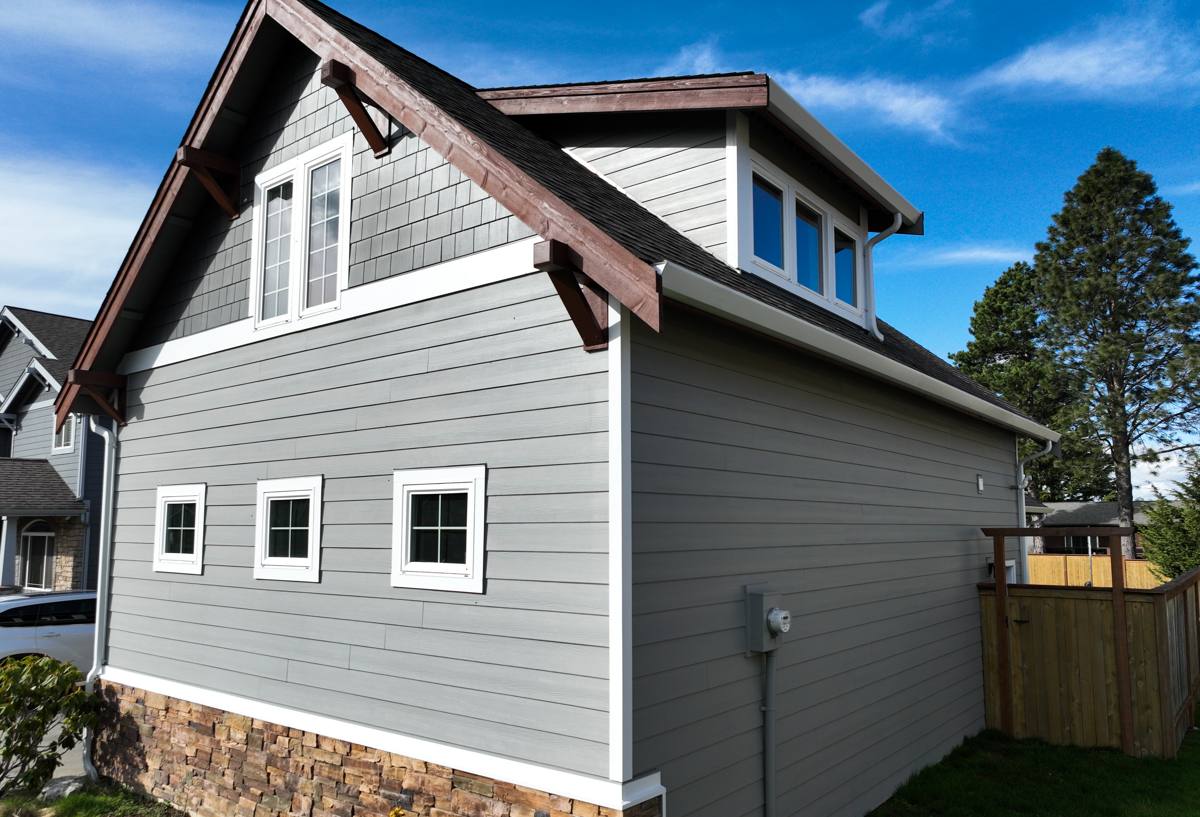
Fiber cement siding behaves differently because it isn't organic. James Hardie's product is made from cement, sand, and cellulose fibers, engineered specifically to resist the swelling and softening that wood-based products are vulnerable to. Moss can still grow on it — moss will grow on almost anything left damp long enough — but the material underneath isn't feeding off that moisture the way wood fiber can.
What Moss Season Actually Costs a Homeowner
The real cost of moss isn't the moss itself — it's what happens when a homeowner puts off dealing with a siding product that's degrading underneath green growth they assumed was just a surface issue. By the time paint is visibly failing or boards are visibly cupping, the damage is often already well past a simple wash-and-repaint fix.
Driving Rain and Wind-Driven Exposure
Whatcom County gets its share of straight-down drizzle, but Sudden Valley — like much of the lake basin — also catches genuine driving rain during winter storm systems, when wind pushes water sideways into wall assemblies rather than letting it run straight off a roof. Driving rain is a harder test for siding than steady vertical rainfall because it finds every gap in flashing, every under-caulked seam, and every joint where two pieces of siding meet.
This is why installation quality matters as much as material choice. A high-quality product installed with poor flashing details, wrong nail placement, or insufficient gapping at butt joints will still let water in. We install to James Hardie's published fastening and clearance specifications on every job — not because it's required, but because skipping those details is exactly how driving-rain exposure turns into hidden rot years down the road.
Why We Install Only James Hardie Fiber Cement
We made the decision years ago to standardize on James Hardie fiber cement siding and not offer vinyl, LP SmartSide, Cemplank, Allura, primed spruce, or cedar. That's not a knock on every homeowner who has one of those products on their house today — plenty of them are properly maintained and doing fine. It's a reflection of what we've seen hold up best, install after install, in exactly the kind of damp, shaded, lake-and-forest environment Sudden Valley sits in.
James Hardie's fiber cement is non-combustible, which matters in a wooded community where wildfire risk is a real seasonal concern for the Pacific Northwest. It carries a factory-applied ColorPlus finish that's baked on and warranted separately from the substrate, so homeowners aren't relying on field-applied paint to be the only thing standing between the material and years of moss and rain. And Hardie engineers specific product lines (their HZ5 line, for example) for wetter, colder climate zones — which is a more useful distinction than most homeowners realize, since not every fiber cement product on the market is built the same way for the same conditions.
None of that means Hardie is maintenance-free. It still needs caulking checked, paint touched up over its expected repaint cycle, and moss kept from building up against it like any exterior surface would. What it means is that when those maintenance basics are followed, the material itself isn't the weak link.
Comparing Siding Options for a Shaded, Lake-Adjacent Home
| Material | Behavior in sustained shade/moisture | Maintenance | Fire resistance |
|---|---|---|---|
| James Hardie fiber cement | Non-organic core resists moisture-driven swelling and rot | Periodic caulk checks, repaint on factory finish's cycle | Non-combustible |
| Vinyl siding | Won't rot, but traps moisture behind it if the barrier fails; moss still grows on the face | Low, but hides problems behind the panel | Combustible, can deform near heat |
| LP SmartSide / engineered wood | Wood-strand core vulnerable if moisture reaches cut edges or fastener points | Regular inspection of seams and edges | Combustible |
| Cedar / primed spruce | Organic material, most exposed to moss-driven rot in sustained shade | Highest — regular refinishing, edge sealing | Combustible |
A Full Exterior Approach: Siding, Roofing, Windows, and Decks
Because Sudden Valley homes take on moisture from multiple directions at once — canopy drip, driving rain, and long stretches without direct sun to dry things out — siding rarely tells the whole story on its own. We look at the roof, window flashing, and any deck or exterior structure attached to the house at the same time, because a failure point in one of those systems will undermine even a perfect siding installation.
- Roofing: moss and needle debris build up fast under a forest canopy; a roof that's shedding water properly protects the wall assembly below it
- Windows: flashing details around window openings are one of the most common points where driving rain gets behind siding, regardless of what siding material is installed
- Decks: ledger board connections and deck-to-house flashing near Lake Whatcom properties see heavy moisture cycling and deserve the same scrutiny as the siding itself
When we're on-site for a siding estimate in Sudden Valley, we'll flag anything we see in these other systems, even if it's outside the original scope of the job — it's a disservice to hand back a new wall of siding without mentioning a roof or window detail that's going to undermine it.
What Our Process Looks Like for a Sudden Valley Property
Access and staging matter more here than in a typical Bellingham neighborhood. Sudden Valley's roads, tree cover, and lot layouts mean every job gets a site visit before we quote it, not a drive-by estimate. We look at existing moss and moisture patterns on the current siding, check for soft spots or delamination at ground level and around penetrations, and talk through which parts of the house get the least sun exposure, since those areas typically need the most attention to detail during installation and the most consistent upkeep afterward.
From there, a full siding replacement generally includes removing the existing material down to the sheathing, correcting any water-resistive barrier or flashing issues we find underneath, and installing James Hardie panels or planks to manufacturer spec — proper fastener spacing, gapping at joints, and flashing at every window, door, and roofline intersection.
Questions Worth Asking Any Contractor Before Sudden Valley Siding Work
- Are they installing to the manufacturer's published fastening and flashing specifications, or a generic approach used everywhere?
- Do they carry current Washington contractor licensing and liability insurance, and will they provide proof without being asked twice?
- Have they worked on lake-adjacent or heavily wooded properties before, and can they speak specifically to moisture and access challenges?
- Is the estimate written with a defined scope — material, fastening pattern, flashing details — or just a lump-sum number?
- What does their workmanship warranty cover, separate from the manufacturer's material warranty?
Ongoing Maintenance for a Shaded, Lake-Adjacent Home
Whatever siding is on a Sudden Valley home today, a few habits go a long way toward keeping moss and moisture from becoming a bigger problem:
- Keep tree limbs and brush trimmed back from siding to let more light and air reach the wall surface
- Rinse visible moss and algae buildup off siding at least once a year, ideally before the wettest months set in
- Check caulking at trim, window, and door joints annually — this is where water intrusion most often starts
- Clear gutters and downspouts regularly so roof water isn't being dumped directly against a wall section
- Walk the base of the home after major storms and look for any soft, discolored, or bubbling siding near ground level
Local Crews, Not a Regional Sales Team
Sudden Valley homeowners deal with a specific setting, and a crew that only knows how to install siding on open, sunny lots elsewhere in Whatcom County can miss the details that matter here — where flashing needs extra attention, which walls need the most moss prevention, and how tree cover changes the whole moisture picture. We're a Bellingham-based crew that works this area regularly, and we bring that local knowledge to every estimate rather than a one-size-fits-all pitch.
If you're weighing a siding replacement, or want a second opinion on moss, moisture, or a roof, window, or deck issue on a Sudden Valley property, we're happy to come take a look. The estimate is free, there's no pressure to sign anything on the spot, and you'll get a straight answer about what your home actually needs.