 Bellingham Siding
 Cedar comes up in almost every siding conversation we have with Bellingham homeowners. It's a beautiful, natural material, and there's a reason it's associated with Pacific Northwest architecture more than almost any other cladding. We understand the appeal. We also don't install it. Our crews put James Hardie fiber cement on every siding job we take, and we think homeowners considering cedar deserve a specific, honest answer for why we stopped — not a vague "it's not really our thing." This page is that answer.
What Cedar Siding Gets Right
Credit where it's due. Western red cedar has natural oils that give it real resistance to decay and insects compared to most other softwoods, and it takes stain or a clear finish in a way few manufactured products can fully imitate. It's lightweight, easy to work with, and the grain and texture read as warm and organic in a way that appeals to a lot of homeowners, especially on homes with a craftsman or modern-rustic design in mind.
Cedar is also a renewable, natural material, and when it's properly finished and genuinely kept up, it can last for decades. Plenty of well-maintained cedar homes around Whatcom County prove this isn't a product that fails right out of the gate. The catch is in that phrase — "properly finished and genuinely kept up" — and what that actually demands, year after year, in Bellingham's specific climate.
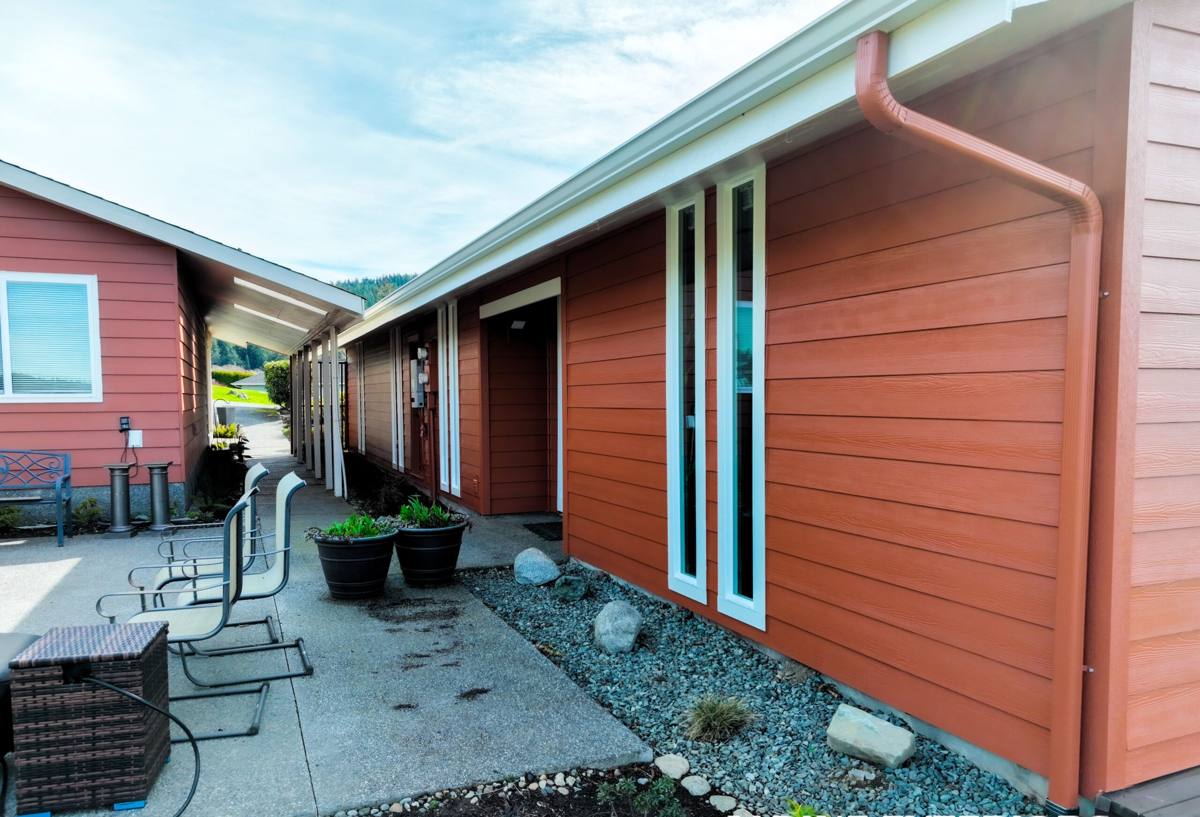
Bellingham's Climate: Salt Air, Driving Rain, and a Long Moss Season
Salt Air Off Bellingham Bay
Bellingham sits right on the water, and that means a steady flow of moisture-laden, salt-tinged air moving across the city on most days, not just during storms. That kind of sustained exposure accelerates the breakdown of exterior finishes and speeds up corrosion at fasteners and flashing points. It's a slow, quiet process, and on a wood product like cedar, it shows up first as a faster fade in the finish that's supposed to be keeping the boards sealed.
Driving Rain
Like the rest of coastal Whatcom County, Bellingham gets rain that arrives sideways as often as it falls straight down. That matters more than it sounds like it should, because a finish and joint detail that would hold up fine in a calmer, drier region can still let water in here specifically because wind is driving rain into butt joints, trim seams, and end grain from an angle a purely vertical rainfall assumption never accounts for.
A Long Moss Season
Mild year-round temperatures, tree cover on a lot of Bellingham lots, and consistent dampness add up to a moss and mildew season that can stretch across most of the calendar year on shaded and north-facing walls. Any material that holds moisture against itself instead of shedding it becomes a growth surface, and cedar's texture gives moss and mildew more to hold onto than a smoother manufactured product would.
Put those three things together and you get a climate that tests a wood product's finish and joint details harder, and more often, than almost anywhere else in the state. Cedar itself can handle real stress. The finish protecting it, and the homeowner's ability to keep up with maintaining that finish, is usually what can't keep pace.
Where Cedar Actually Runs Into Trouble Here
When cedar siding fails, it's rarely all at once. It's usually a slow, localized process: a stain film that thins and lets UV and moisture reach bare wood, a caulked joint that cracks and opens a path for wind-driven rain, a lower course near grade that stays wet longer than the rest of the wall and starts to soften. Because cedar is an organic material, sustained moisture exposure in those localized spots can lead to cupping, checking, or actual decay. Because it happens gradually and unevenly, it's easy for a homeowner to not notice until a board needs replacing rather than just refinishing.
We've also seen how location on a given lot changes the timeline. A wall that gets full afternoon sun dries out and its finish chalks and fades faster from UV; a shaded, tree-covered wall stays damp longer and grows moss faster. Most Bellingham homes have some of both, which means cedar siding on the same house can be aging at two different rates depending on which wall you're looking at.
The Maintenance Cedar Actually Requires
Cedar gets described as "low-maintenance" in a lot of marketing copy, and compared to raw, unfinished wood, that's fair. But it isn't maintenance-free, and the schedule it actually needs is real, recurring, and easy to underestimate, especially in a climate that doesn't give a house much of a dry stretch to recover in between storms.
| Task | Typical interval in Bellingham's climate | What happens if it's skipped |
|---|---|---|
| Re-staining or refinishing | Every 2-4 years, sooner on sun- and salt-exposed walls | Finish thins, UV and moisture reach bare wood, graying and checking begin |
| Caulk inspection and renewal | Annually, especially at butt joints and trim | Cracked caulk opens a direct path for wind-driven rain into the wall assembly |
| Moss and mildew treatment | Seasonally on shaded, north-facing walls | Organic growth holds moisture against the wood and accelerates finish breakdown |
| Inspection near grade and roof lines | Annually | Splash-back and reduced clearance are common early spots for decay to start |
| Board replacement | As needed, often localized | Deferred repairs let decay spread to adjacent boards and fasteners |
None of this is a defect in cedar as a material. It's what a natural, organic product needs from its owner to perform the way it's capable of performing, and in a bay-side climate with this much salt exposure and rain, that schedule is tighter and less forgiving than it would be somewhere drier and further from the water.
Why We Chose to Stop Installing Cedar
We used to get asked for cedar more often than we do now, and for a while we installed it when a homeowner wanted it. What changed was what we kept seeing on repair calls and tear-offs across Bellingham: cedar siding that had been installed correctly and finished well at the start, and still needed real, ongoing attention within a handful of years to keep performing. The material wasn't the problem. The mismatch between what the climate demands and what most maintenance schedules actually deliver was the problem, and it's one we watched play out on enough homes that we made a professional decision to stop offering the product rather than keep selling something we knew would quietly become a maintenance burden for the homeowner down the road.
That's not a judgment on cedar as a material, and it's not a claim that every cedar installation fails. It's a statement about what we're willing to stand behind on a Bellingham home specifically, given what this climate does to a finish and to end grain year after year.
What We Install Instead: James Hardie Fiber Cement
We install James Hardie fiber cement siding exclusively, and the reasons track directly against the trade-offs cedar carries in this climate.
- Non-combustible core: Fiber cement doesn't feed a fire the way wood-based siding can, which matters for household safety and can matter for insurance as well.
- Factory-applied ColorPlus finish: The color coat is cured under controlled factory conditions rather than brushed on at the job site, so it resists fading and moisture intrusion far longer than field-applied stain or paint.
- Climate-engineered HZ product lines: Hardie's HZ5 formulation is built for regions with heavy sustained moisture and freeze-thaw cycling, which fits Bellingham's bay-side exposure better than a general-purpose product spec.
- Dimensional stability: Fiber cement doesn't cup, check, or warp the way wood siding can after repeated wet-season moisture cycles.
- Strong transferable warranty: Hardie backs its products with one of the more substantial warranty structures in the industry, provided the installation follows spec.
We also don't install LP SmartSide, vinyl siding, Cemplank, Allura, or primed spruce. Those are legitimate products, and other contractors install them well. But standing behind one system we trust completely, in a climate this consistently wet and salt-exposed, is a better position for our customers than offering options that quietly shift maintenance risk onto them a few years down the line.
Cedar vs. James Hardie for a Bellingham Home
| Consideration | Cedar | James Hardie Fiber Cement |
|---|---|---|
| Finish upkeep | Re-stain or repaint every 2-4 years in this climate | Factory ColorPlus finish, no refinishing cycle under normal conditions |
| Moisture behavior | Organic material; sustained wetness can lead to decay | Engineered for wet-climate performance; doesn't rot |
| Salt air exposure | Accelerates finish breakdown and fastener corrosion | Formulated to hold up under sustained coastal exposure |
| Moss and mildew resistance | Textured surface gives organic growth more to hold onto | Smoother, less hospitable surface; still needs periodic washing |
| Fire behavior | Combustible | Non-combustible core |
| Warranty structure | Varies by finish product; wood itself typically unwarrantied | Substantial manufacturer warranty when installed to spec |
Signs Existing Cedar Siding Needs Attention
If your Bellingham home already has cedar siding, none of this means it needs to come off tomorrow. It means it's worth knowing what to watch for so small issues get caught before they become structural ones.
- Graying or chalky patches where the stain or finish has visibly thinned
- Cracked or missing caulk at butt joints, trim, and corners
- Soft or spongy spots when pressed, especially near the base of the wall
- Moss or dark staining that returns quickly after cleaning
- Cupping, checking, or splitting boards, particularly on sun-exposed walls
- Visible gaps at seams where wind-driven rain could be tracking in
Any one of these on its own might just mean a maintenance visit. Several at once, especially paired with soft wood underneath, usually means the wall assembly has been taking on water for a while and it's worth having someone look at what's happening behind the siding, not just on the surface.
Getting a Straight Answer About Your Home
Whether you're weighing cedar against fiber cement for a new project, or trying to figure out what's actually going on with cedar siding you already have, we'd rather give you a straight, specific answer than a sales pitch either way. We handle roofing, windows, and decks alongside siding, so if the real issue is a flashing detail or a roofline rather than the siding itself, we'll tell you that too.
If you're planning a siding project in Bellingham or want an honest second opinion on cedar siding that's already on your home, reach out using the form below to schedule a free, no-pressure estimate.