 Bellingham Siding
 Siding Repair in Sudden Valley: A Different Set of Conditions
Sudden Valley sits back from downtown Bellingham along the shore of Lake Whatcom, tucked into wooded, sloped lots with heavy tree cover and long stretches of shade on north- and east-facing walls. That setting is part of what makes the neighborhood a great place to live, and it's also exactly the kind of setting that's hard on exterior siding. Between the tree canopy holding moisture against walls, the driving rain that blows in off Pacific storm systems each fall and winter, and the marine-influenced air that reaches this far inland from Bellingham Bay and the Sound, siding here works harder than siding in a drier, more open part of Whatcom County.
When we're called out for a siding repair in Sudden Valley, the damage pattern is rarely random. It follows the shade lines, the roof valleys, the low corners near grade, and the north walls that never fully dry out between storms. Understanding that pattern is the difference between a repair that lasts and one that fails again in two years.
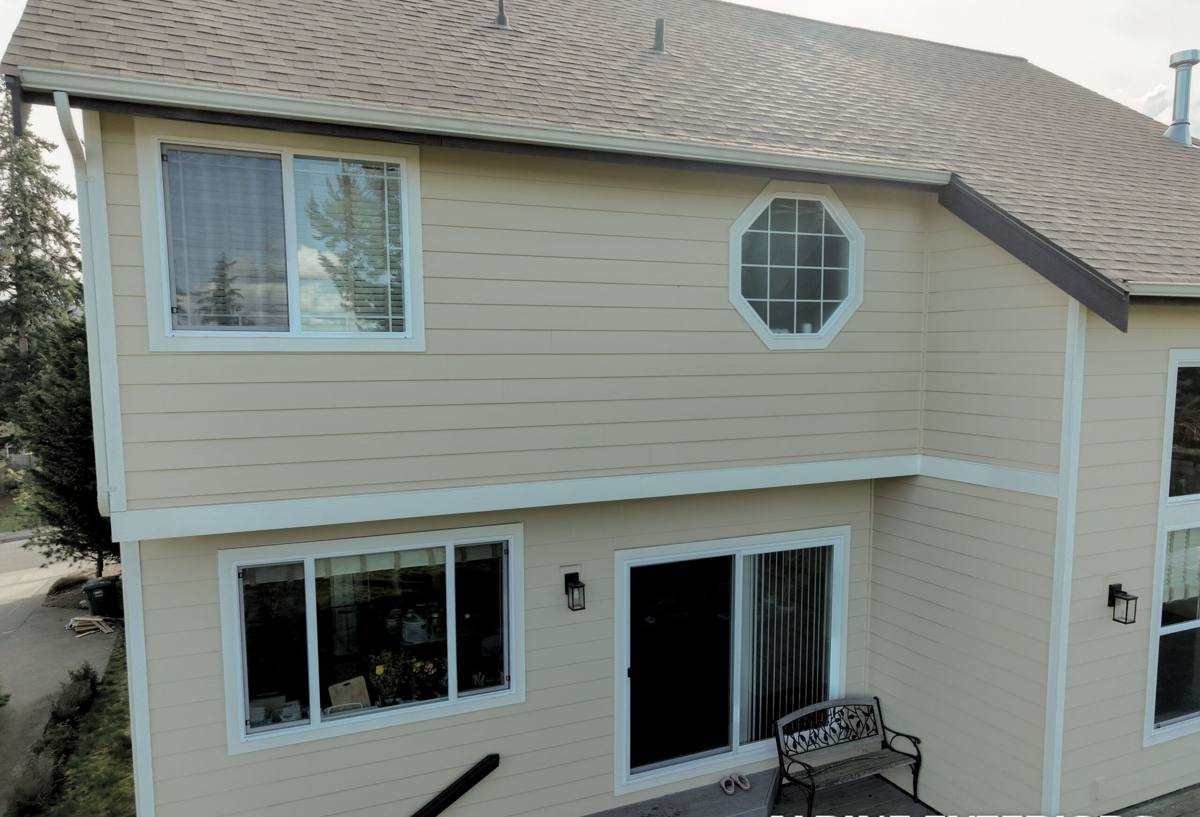
What the Local Climate Does to Siding Over Time
Moss and Algae
Whatcom County has a long moss season — realistically most of the year on shaded, damp surfaces. Moss and algae don't just look bad; they hold moisture against the siding surface, and on porous or damaged material, that trapped moisture is what eventually leads to soft spots, swelling, and rot underneath.
Driving Rain and Wind-Driven Moisture
Storms in this area rarely fall straight down. Wind pushes rain sideways into wall assemblies, which means the real vulnerability isn't the flat face of a siding panel — it's the seams, the trim joints, the butt joints between courses, and any spot where caulking has cracked or pulled away.
Salt Air and Hardware
Bellingham sits close enough to Puget Sound that salt-laden marine air reaches inland communities like Sudden Valley, particularly during winter storms when wind carries moisture off the water. That salt air speeds up corrosion on exposed nails, fasteners, and metal trim faster than a purely inland climate would. When we open up a repair area, corroded fasteners are one of the first things we check, because a failed nail head is often what let water behind the siding in the first place.
Freeze-Thaw and Seasonal Swings
Whatcom County winters bring enough freeze-thaw cycling that any siding already holding water — from a failed seam or a rot pocket — gets pushed further along by ice expansion. A small issue in October can be a real repair by February.
Common Siding Repair Issues We See in Sudden Valley
- Soft or spongy siding near ground contact, deck ledgers, and low corners where splash-back keeps material wet
- Cracked, buckled, or delaminating panels from long-term moisture absorption
- Moss and algae staining that has moved past a surface problem into the material itself
- Failed caulking and trim joints around windows, doors, and outside corners
- Nail pops and loose panels from seasonal expansion and contraction
- Isolated impact damage from storm debris or falling branches, common on heavily treed lots
Most of these issues start small. The reason they show up as a repair instead of getting caught earlier is that they're often hidden — behind foundation plantings, under deck overhangs, or on a shaded wall nobody looks at closely from the ground.
Repair or Replace? How We Make That Call
Not every damaged section needs a full re-side, and we won't tell a homeowner they need one if a proper repair will hold. But we also won't patch over a problem that's going to come back. Here's generally how we think through it:
| Factor | Repair Usually Makes Sense | Replacement Usually Makes Sense |
|---|---|---|
| Extent of damage | Isolated to one or two areas | Spread across multiple walls or elevations |
| Underlying sheathing | Sound, dry once opened up | Soft, stained, or rotted where exposed |
| Siding material | Still structurally sound elsewhere | Original material is failing broadly, not just where visible |
| Age of existing siding | Relatively recent, isolated failure | Near or past its expected service life |
| Match availability | Compatible replacement material can be sourced or fabricated | Material is discontinued or a repair would look visibly patched |
The only way to answer these honestly is to open up the damaged area and look, not guess from the ground. That's a standard part of how we scope every repair.
What a Correct Siding Repair Actually Involves
A siding repair that's done right addresses the cause, not just the visible symptom. That means:
- Finding the moisture source first. A damaged panel is a symptom. If the water intrusion point — a failed flashing, a bad caulk joint, a grading issue at the foundation — isn't fixed, the new material fails the same way the old material did.
- Removing all compromised material. Cutting out only the visibly bad section and leaving softened material at the edges just moves the failure point a few inches over. We remove back to solid material.
- Inspecting what's underneath. Once siding is off, we check the house wrap or building paper and the sheathing itself for hidden rot before anything new goes back on.
- Correcting flashing and drainage details. A repair is also a chance to fix the water management detail that caused the failure in the first place, not just replace what was there.
- Matching material and finish. A patch that doesn't match in profile, reveal, or color reads as a patch forever. We match as closely as the original product allows, or explain honestly when a perfect match isn't realistic.
Why We Repair and Patch With James Hardie Fiber Cement
We install James Hardie fiber cement exclusively, and that carries into how we approach repairs. When a repair area is being opened up and re-clad, we use Hardie fiber cement for the patch whenever it's a workable match, because it's non-combustible, engineered for wet Pacific Northwest climates in Hardie's HZ5 product line, and finished with a factory-applied ColorPlus coating that isn't relying on field-painted caulk joints to hold up against driving rain.
We're also straightforward when a repair is really a stopgap. If a home is sided in a material that's showing broad, systemic failure — swollen hardboard, cracked and checking cedar, or vinyl that's brittle and pulling away at the seams — patching one section will hold for a while, but it won't solve what's happening across the rest of the house. In that case we'll say so plainly, give you the honest repair option if that's what you want, and lay out what a full re-side in James Hardie would look like as the longer-term fix. That decision is always the homeowner's to make; our job is to give you an accurate picture, not a sales pitch.
Our Repair Process for Sudden Valley Homeowners
The process is straightforward and doesn't require a big time commitment on your end:
1. On-Site Inspection
We walk the full exterior, not just the area you called about. Given how shaded, damp conditions in this area tend to hide problems on walls that don't get looked at often, a full walk-around catches issues before they become a second visit.
2. Diagnosis and Written Scope
We tell you what we found, what's causing it, and what it will take to fix, in writing, before any work starts. If it's a simple caulk-and-patch job, we say so. If it's more, we explain why.
3. Scheduling Around the Weather
Siding repair work needs a dry window to do right, particularly for caulking and finish work. We schedule around Whatcom County's weather rather than rushing a repair into a wet stretch where it won't cure properly.
4. The Repair Itself
Damaged material comes out, the structure underneath gets checked, water management gets corrected, new material goes in, and everything is finished and sealed to spec.
5. Walkthrough
We walk the finished repair with you before we consider the job done.
Why a Crew That Already Works in Sudden Valley Matters
Sudden Valley's mix of private, HOA-governed streets, gated access points, and heavily wooded lots means a repair here isn't quite the same logistics as a job in an open subdivision closer to town. A crew that's worked in the community before knows to plan for narrower access, tree cover that limits ladder and lift placement, and the exterior guidelines some homeowners associations in the area maintain. That familiarity means less back-and-forth and fewer surprises once work actually starts.
It also means we've already seen how this specific microclimate — lake-adjacent, tree-shaded, set back from open wind but still catching plenty of driving rain — treats different siding materials over time. That's local knowledge that's hard to replace with a one-time visit from a crew that mostly works somewhere else.
Signs You May Need a Siding Repair
- Soft spots you can press in with light hand pressure, especially near the bottom courses
- Visible gaps, cracks, or peeling at caulked joints and trim corners
- Persistent moss or algae growth that doesn't clean off, or comes back within weeks
- Panels that look wavy, bowed, or separated from the wall
- Paint or finish that's bubbling, peeling, or flaking in one concentrated area rather than evenly across the house
- A musty smell or visible staining on an interior wall that shares an exterior wall with a suspect area
If any of that sounds familiar, it's worth having it looked at before the next wet season rather than after.
If you're dealing with a siding issue on a Sudden Valley home, we're glad to take a look and give you a straight answer about what it needs, whether that's a targeted repair or something more. Reach out for a free, no-pressure estimate using the form below.