 Bellingham Siding
 Fairhaven sits right on Bellingham Bay, which means its homes take a different kind of weather beating than houses a few miles inland. Salt-laden air off the water, wind-driven rain that finds every gap in a window frame, and a moss season that stretches for months all work on window assemblies in ways that shorten their service life if the original install wasn't done with that exposure in mind. This page covers what window installation looks like specifically for Fairhaven properties — what the climate demands, what a correct install involves, and how our process works from first look to final walk-through.
Why Fairhaven's Climate Is Harder on Windows
Whatcom County's marine climate is generally mild, but "mild" doesn't mean easy on building materials. Fairhaven's proximity to the bay adds a layer most inland Bellingham neighborhoods don't deal with as heavily.
Salt Air and Metal Components
Airborne salt accelerates corrosion on window hardware — hinges, cranks, balance systems, and screws — especially on lower-grade aluminum or unprotected steel components. Over years, that corrosion can seize moving parts or eat away at fasteners holding a window in its frame. It doesn't happen overnight, but on a home a block or two from the water, it happens faster than manufacturers' generic testing usually accounts for.
Driving Rain and Wind-Driven Moisture
Storms off the Strait of Georgia and the Salish Sea don't always arrive as gentle vertical rain. Wind pushes water sideways into wall assemblies, and a window that's flashed correctly shrugs that off — one that isn't will let water track behind the trim and into the wall cavity. This is the single most common cause of hidden rot we find behind older Fairhaven windows: not a bad window, but a window that was never flashed and sealed to handle sideways rain in the first place.
Moss, Algae, and Prolonged Dampness
Bellingham's long wet season keeps north-facing and shaded walls damp for months at a time, which is exactly the environment moss and algae need. On wood sills and trim, that sustained moisture accelerates decay. On vinyl and fiberglass, it's mostly cosmetic, but it's also a sign that water is sitting where it shouldn't — which matters more for what's happening underneath than what you see on the surface.
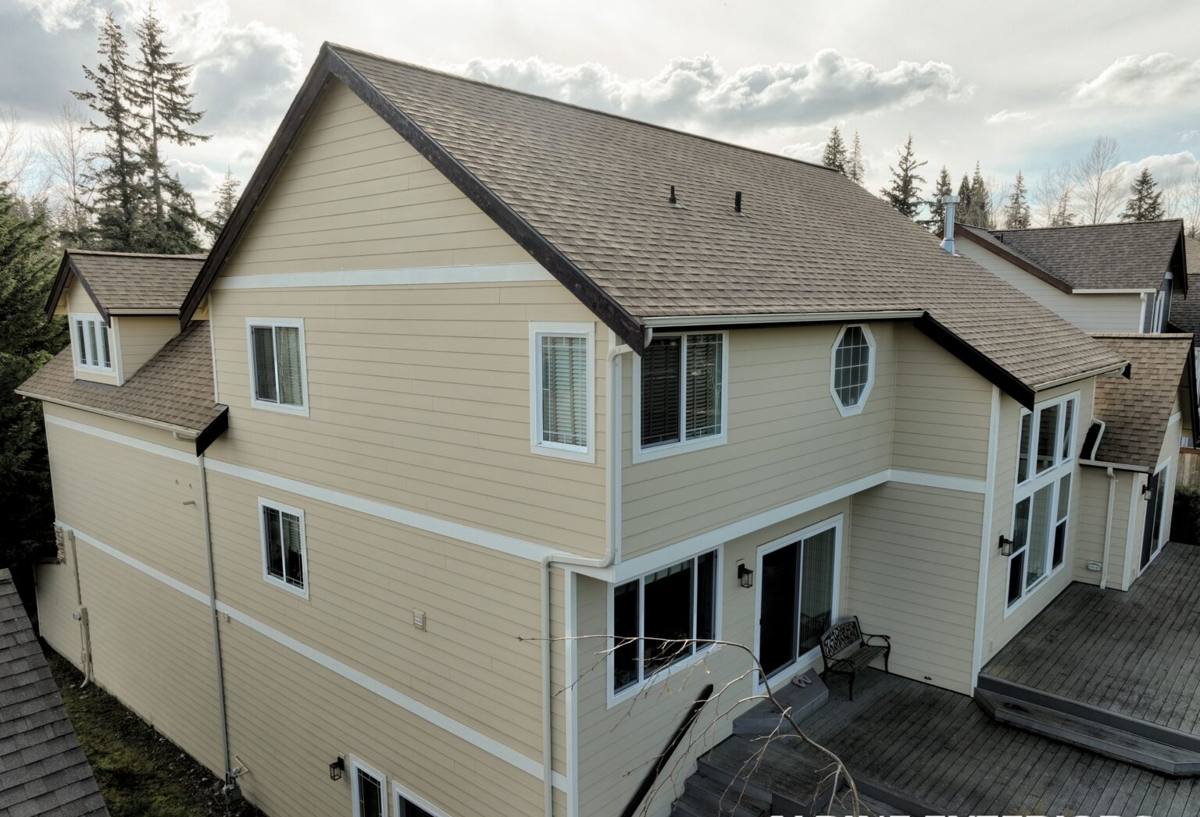
Signs a Fairhaven Home Needs New Windows
Not every drafty window needs full replacement, but in a coastal microclimate like this one, certain symptoms point clearly toward it rather than a repair.
- Wood trim or sills that are soft, discolored, or crumbling to the touch
- Fogging or a permanent haze between glass panes (failed seal on a double-pane unit)
- Windows that are difficult to open, close, or lock — often a sign of hardware corrosion or a warped frame
- Visible daylight or a noticeable draft around the frame when it's shut
- Paint that keeps failing on the same window's trim no matter how often it's redone
- A musty smell or soft drywall near a window after wind-driven rain events
- Noticeably higher heating bills compared to similar homes nearby
If you're seeing more than one or two of these, it's worth a look before the underlying framing is affected — that's a bigger and more expensive repair than the window itself.
Choosing a Frame Material for a Marine Microclimate
Every frame material has trade-offs. In a salt-air, high-moisture setting like Fairhaven, some of those trade-offs matter more than they would a few miles inland.
| Material | How It Handles This Climate | Maintenance |
|---|---|---|
| Vinyl | Won't rot or corrode; handles moisture and salt air well; good value | Low — occasional cleaning |
| Fiberglass | Excellent stability in temperature and moisture swings; strong resistance to salt exposure | Low |
| Wood (unclad) | Classic look, especially for older Fairhaven homes, but most vulnerable to rot and moss in this climate without diligent upkeep | High — regular painting/sealing |
| Wood-clad (aluminum or vinyl exterior) | Wood interior look with a protective exterior shell; good middle ground for character homes | Moderate |
| Aluminum | Strong and slim-profile, but bare aluminum is more prone to salt-air corrosion and conducts cold/condensation | Moderate |
We don't push one material on every job. A lot of it comes down to the home itself — a historic Fairhaven house with wood trim throughout is a different conversation than a newer build a few streets up the hill. What we won't do is install a bare, unprotected wood frame on a home that gets direct salt spray and call it a long-term solution — that's setting a homeowner up for a repeat of the same rot problem in a decade, and we'd rather be honest about that trade-off up front than sell a product that doesn't fit the exposure.
Windows on Fairhaven's Older and Character Homes
Fairhaven has a mix of housing stock, including a number of older and historic homes with distinct window profiles, trim details, and sightlines. Replacing windows on these properties isn't just a swap — getting the proportions, muntin pattern, and trim reveal wrong is one of the fastest ways to flatten a home's character, even with a technically good window.
A few things we pay attention to on older Fairhaven homes:
- Matching sash proportions and glass-to-frame ratio so the new window doesn't look undersized or oversized in the original opening
- Preserving or replicating trim profiles rather than defaulting to flat modern brickmold
- Choosing grille/muntin patterns that match the home's era instead of a generic grid
- Checking whether the property falls under any city design guidelines before work begins — if it does, we account for that in the plan rather than finding out mid-project
None of that is guesswork we do from a truck — it starts with actually looking at the house and asking what the original builder was going for.
What a Correct Window Installation Actually Involves
The window unit itself is maybe half the job. The other half — the part nobody sees once trim goes back on — is what determines whether it holds up against Bellingham Bay weather for the next 20-plus years.
Our Process
- On-site assessment — we look at the existing windows, framing condition, and any signs of past water intrusion before quoting anything.
- Accurate measurement — every opening gets measured individually; older homes rarely have perfectly uniform openings even when the windows look matched.
- Removal and inspection — once the old unit is out, we check the rough opening and sill for rot or soft framing before anything new goes in.
- Flashing and weatherproofing — proper sill pan flashing and window flashing tape integrated with the home's weather-resistive barrier, so wind-driven rain has nowhere to get behind the window.
- Setting and shimming the unit — level, plumb, and square, with correct shim placement so the frame isn't stressed and the window operates smoothly for years.
- Insulating the gap — low-expansion foam or backer rod and sealant around the frame, avoiding over-packing that can bow the frame inward.
- Exterior and interior sealing — weather-appropriate sealant on the exterior, and finish trim work on the interior to match the home.
- Final walk-through — every window opened, closed, and locked to confirm smooth operation before we consider the job done.
Skipping or rushing any one of these steps is exactly how a brand-new window still ends up with water damage behind it two winters later. It's rarely the window unit that fails first — it's the installation detail around it.
What Affects the Cost of Window Installation in Fairhaven
We're not going to quote a number without seeing the house, but these are the factors that typically move the price up or down on a Fairhaven job.
| Factor | Why It Matters |
|---|---|
| Frame material | Vinyl is generally the most budget-friendly; fiberglass and wood-clad cost more but hold up better against salt air over time |
| Number and size of openings | More straightforward driver of total project cost |
| Existing rot or framing damage | Repairing soft or rotted framing found during removal adds labor and materials beyond the window itself |
| Historic or character-matching trim work | Custom trim profiles and matched muntin patterns take more time than stock trim |
| Access and window height | Second-story or hard-to-access windows require more setup and labor |
| Full-frame vs. insert replacement | Full-frame replacement (recommended when there's flashing or framing damage) costs more than a pocket/insert install but corrects underlying moisture problems |
As a general rule, insert replacements into sound, dry framing are the least expensive option, while full-frame replacement with flashing repair costs more but is often the right call on older Fairhaven homes where water has already been getting in around the old units.
Why a Locally Experienced Crew Matters Here
Window installation isn't the same job in every part of Whatcom County. A crew that mostly works drier, inland neighborhoods can still do a technically fine install and have it underperform on a Fairhaven property exposed to direct salt spray and driving bay-front rain — not because the workmanship was sloppy, but because the flashing detail and material choices weren't specified for that level of exposure.
Working in Fairhaven regularly means we already know what to check for on this neighborhood's mix of historic and newer homes, what materials hold up against the salt air coming off the bay, and how to detail flashing for wind-driven rain rather than just vertical rainfall. That's the kind of judgment that only comes from doing the work in this specific environment, not from a general install checklist.
Get a Free Estimate
If your Fairhaven home has windows showing signs of wear, drafts, or past water intrusion, we're happy to take a look and give you an honest, no-pressure assessment of what's going on and what your options are. Use the form below to request a free estimate.