 Bellingham Siding
 Building New in Blaine Means Building for the Water
Blaine sits about as close to the water and the wind as a Whatcom County home site gets. Between Semiahmoo Bay, Drayton Harbor, and the open exposure toward the Strait of Georgia, new construction here takes a different kind of weather load than a lot in inland Bellingham or Ferndale. Salt-laden air, wind-driven rain off the water, and a moss season that can run most of the year all work on a house from the day it's framed — and windows are one of the first places that shows up if the install wasn't done right the first time.
New-construction window installation is not the same job as a replacement. On a new build, the window goes in during framing, before siding, before trim, sometimes before the roof is fully dried in. That means the window becomes part of the building's water management system, not a retrofit into one. Get the sequencing wrong on a Blaine lot and you're not looking at a leak next month — you're looking at rot, mold, or hardware corrosion working quietly behind the wall for years before anyone notices.
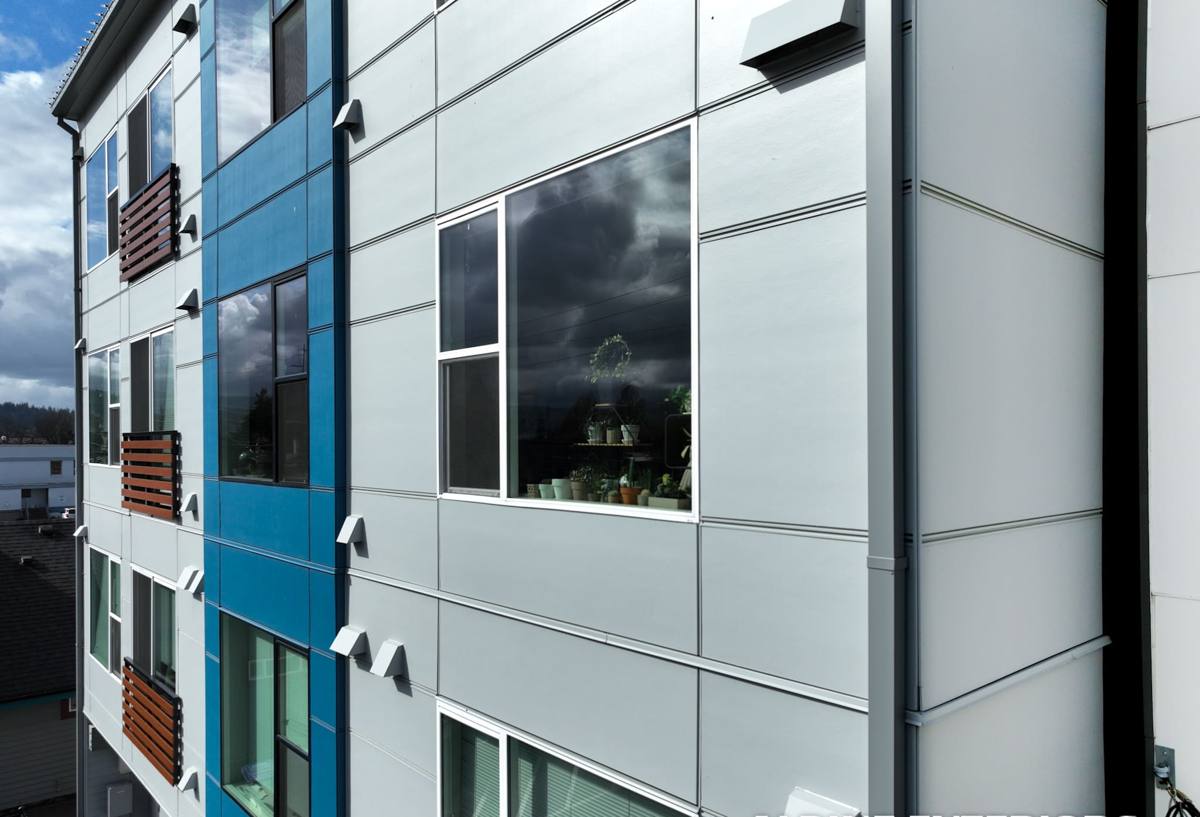
What Blaine's Climate Actually Does to a Window Assembly
Salt Air
Homes within a mile or two of Semiahmoo Bay and Drayton Harbor get airborne salt on everything — siding, flashing, and window hardware included. Standard steel fasteners and low-grade hinge or lock hardware corrode faster here than they would ten miles inland. It's slow and it's cosmetic at first — pitting on screws, streaking under hinges — but corroded fasteners in a flashing detail eventually mean a compromised seal.
Driving Rain
Storms coming off the water hit this stretch of coastline sideways more often than straight down. A window that's rated fine for still-air rain but hasn't been tested or installed for wind-driven water can pass a dry-day inspection and still fail during a January storm. The flashing details around the window — not just the window unit itself — are what actually stop wind-driven rain from getting behind the cladding.
Moss Season
Whatcom County's wet season runs long, and Blaine's marine exposure stretches it further. Moss and algae don't just grow on roofs and north-facing siding — they colonize window sills, trim, and any horizontal surface that stays damp. Beyond appearance, sustained moisture sitting against wood trim or an improperly flashed sill is exactly what starts rot underneath a window that looks fine from the outside.
What a Correct New-Construction Window Install Actually Involves
On a new build, the window opening is bare framing and a weather-resistive barrier (WRB) — there's no old window or old flashing to work around, which is an advantage if the crew uses it correctly. The sequence matters more than the window brand:
- WRB (house wrap) lapped and taped correctly before the opening is flashed
- Sloped sill pan installed at the rough opening so any water that gets past the window drains back outward, not into the wall
- Self-adhered flashing tape at the jambs, lapped over the sill pan — never under it
- Window set square, plumb, and shimmed correctly so the sash operates and seals evenly for its service life
- Head flashing installed last, lapping over the WRB above the opening in proper shingle-style order
- Fasteners rated for coastal/corrosive exposure, not standard interior-grade hardware
- Interior and exterior sealant joints backed up by flashing — never used as the sole water barrier
Every step in that list follows the same principle: water that gets past one layer has to be directed back out by the layer behind it, never trapped. That's true on any build, but it matters more in Blaine because there's simply more water hitting the wall, more often, than most of Whatcom County sees.
Choosing a Frame Material for a Coastal Build
Frame material affects how a window holds up to salt air and constant moisture cycling over time, not just how it looks. There's no single right answer for every project — it depends on budget, the home's design, and how close the lot sits to the water.
| Frame Material | Coastal/Salt-Air Performance | Maintenance | Typical Fit |
|---|---|---|---|
| Vinyl | Good — won't corrode or rust; UV-stable modern formulations hold up well | Low — occasional cleaning | Most cost-conscious new builds |
| Fiberglass | Very good — dimensionally stable, resists moisture-driven expansion/contraction | Low | Higher-end new construction, larger openings |
| Wood-clad | Depends heavily on cladding integrity and detailing around the clad joint | Higher — cladding and interior wood need upkeep | Traditional or high-end designs where interior wood look matters |
| Aluminum | Prone to corrosion in salt air unless properly coated/anodized | Moderate to high near the water | Commercial or large-format glazing, used selectively here |
For a lot within close range of Drayton Harbor or Semiahmoo Bay, we lean homeowners toward vinyl or fiberglass unless there's a specific design reason to go another direction — both handle salt exposure and constant damp/dry cycling with the least long-term fuss.
Hardware Matters As Much As the Frame
Locks, hinges, and cranks that aren't rated for coastal exposure are usually the first thing to show wear on a Blaine home, often within a few years. It's worth asking specifically about hardware corrosion resistance, not just the frame material, when a window package is being specified for a coastal lot.
Performance Ratings That Actually Matter Here
Window spec sheets list a lot of numbers, but three of them are worth understanding before you sign off on a window package for a Blaine build:
- U-factor — how well the window resists heat loss. Washington's energy code sets minimums by climate zone, and Whatcom County falls in the marine zone where lower U-factors are required than in drier parts of the state.
- Design Pressure (DP) rating — how much wind and structural load the window and its installation can handle. Open, water-exposed lots benefit from a higher DP rating than a sheltered inland site would need.
- Water penetration resistance — tested specifically under wind-driven rain conditions, not just static water. This is the number that correlates most directly with how a window performs in the kind of sideways storms Blaine gets off the water.
None of these numbers matter if the flashing and sill pan details aren't done correctly — a high-DP window installed without a sloped sill pan will still leak. The rating and the installation have to both be right.
How We Work With Builders and Homeowners on New Builds
Most of our new-construction window work in Blaine comes through coordination with a general contractor or framing crew, though we also work directly with owner-builders. The window install has to land at the right point in the sequence — after the WRB is up and taped, before siding starts — and it has to be coordinated with whoever is doing the house wrap and siding so the flashing laps are continuous instead of pieced together by two different trades guessing at each other's details.
Our process on a new build typically looks like:
- Review the window schedule and rough opening sizes against the plans before delivery
- Confirm WRB is installed and taped correctly before we start flashing openings
- Install sill pan flashing and jamb flashing at each opening
- Set and shim windows, checking square and operation on every unit
- Install head flashing and tie it into the WRB above
- Walk the openings with the builder or homeowner before siding starts, since flashing details are far easier to correct before they're covered
That last step matters more than people expect. Once siding goes on, a bad flashing detail is invisible until it fails — usually years later, and usually as a repair that costs far more than it would have to fix during framing.
Mistakes We See on New Builds in This Area
Most window problems we get called out to look at on newer Blaine homes trace back to a handful of repeatable mistakes, not a bad window unit:
- Flashing tape lapped in the wrong order (jamb flashing over the sill pan instead of the sill pan draining under it)
- No sloped sill pan at all — a flat sill that lets water pool at the lowest point instead of draining outward
- Sealant used as the primary water barrier instead of a backup to proper flashing
- Standard hardware specified without accounting for the site's salt-air exposure
- Window and siding trades not coordinating, leaving gaps in the WRB continuity at the rough opening
Every one of these is preventable with the right sequence and a crew that's paying attention to a coastal site's specific demands, not just following a generic install checklist written for a drier, more sheltered part of the county.
Why It Matters to Hire a Crew That Already Works in Blaine
A window install that would hold up fine in a sheltered inland yard can fail within a few seasons on an exposed Blaine lot facing the water. A crew that installs windows across Whatcom County but doesn't regularly work this specific stretch of coastline can miss how much more aggressive the combination of salt air, wind-driven rain, and near-constant moss-season dampness is here compared to more sheltered parts of the county. Knowing to spec corrosion-resistant hardware, choose the right DP rating for an open water-facing lot, and slow down on flashing sequencing on a site like this comes from having done it here before, not from a general new-construction background alone.
We'd rather walk a rough opening with a builder before siding goes on than get a callback two winters later for a leak that a five-minute flashing check would have caught. If you're building new in Blaine and want windows installed to hold up to what this coastline actually throws at a house, we're happy to take a look at your plans and give you a straightforward, no-pressure estimate.