 Bellingham Siding
 Composite Decking Built for Barkley's Weather, Not Against It
Barkley sits close enough to Bellingham Bay that salt-laden air reaches every exposed surface on a home, and that includes whatever material is holding up your deck. Add in the driving rain that blows through Whatcom County for months at a stretch, plus a moss season that can stretch from fall through spring, and you have a climate that is genuinely hard on outdoor structures. Composite decking handles that combination better than most materials, but only when it is specified and installed correctly for this specific environment. A board rated for a dry inland climate does not automatically perform the same way a few miles from saltwater.
Barkley includes a mix of newer construction and established homes, and we see both kinds of decking projects here: replacing an aging wood deck that finally gave out, and building new composite decks alongside a home addition. This page covers composite decking specifically for Barkley — what the local climate demands, what a correct installation actually involves, and how our process is built around this exact environment rather than a generic install.
What Bellingham's Marine Climate Does to a Deck
Salt Air and Metal Fasteners
Salt-laden air corrodes unprotected metal faster than most homeowners expect, and it travels further inland than people assume on breezy days off the water. On a deck, that means screws, joist hangers, post bases, and any exposed fastener hardware are under constant low-grade attack. Composite boards themselves do not corrode, but the structure holding them up is almost always wood framed with metal connectors — and that is where salt air does its real damage if the wrong hardware gets specified.
Driving Rain and Standing Water
Rain in this part of Washington rarely just falls straight down. Storms pushing in off the water tend to drive rain sideways, forcing it into ledger connections, under fascia boards, and into any gap in the flashing. Composite boards shed surface water fine, but water that gets trapped underneath a deck or behind a poorly flashed ledger board is what leads to rot in the framing — even when the visible decking on top still looks brand new.
A Long Moss Season
Whatcom County's combination of shade, moisture, and mild year-round temperatures gives moss and algae a long window to establish themselves, often for most of the year on decks that do not get much direct sun. North-facing decks and ones shaded by mature trees are the worst affected. Moss on a deck is not just a cosmetic problem — it holds moisture against the board surface and turns walking surfaces slick, which is a real slip hazard on stairs and landings.
What a Correct Composite Deck Build Involves
The Substructure Comes First
The composite boards get the attention because they are what you see, but the framing underneath determines whether the deck actually lasts. That means properly sized joists, correct spacing for the specific composite product being used — composite typically needs tighter joist spacing than wood — and ledger flashing that sheds water away from the house rather than channeling it behind the siding. As a siding contractor first, we pay particular attention to that ledger-to-house connection, since a poorly flashed deck ledger is one of the more common ways water ends up behind exterior siding.
Fasteners, Flashing, and Footings
Every piece of metal on a deck in this climate should be rated for corrosion resistance — stainless steel or heavy coated hardware, not standard galvanized, especially within a few miles of the water. Footings also need to go below the local frost line and account for how long our clay-heavy local soils hold moisture after a wet stretch, since a footing that shifts even slightly will eventually show up as a bounce or gap in the decking above it.
Railing and Fascia Details
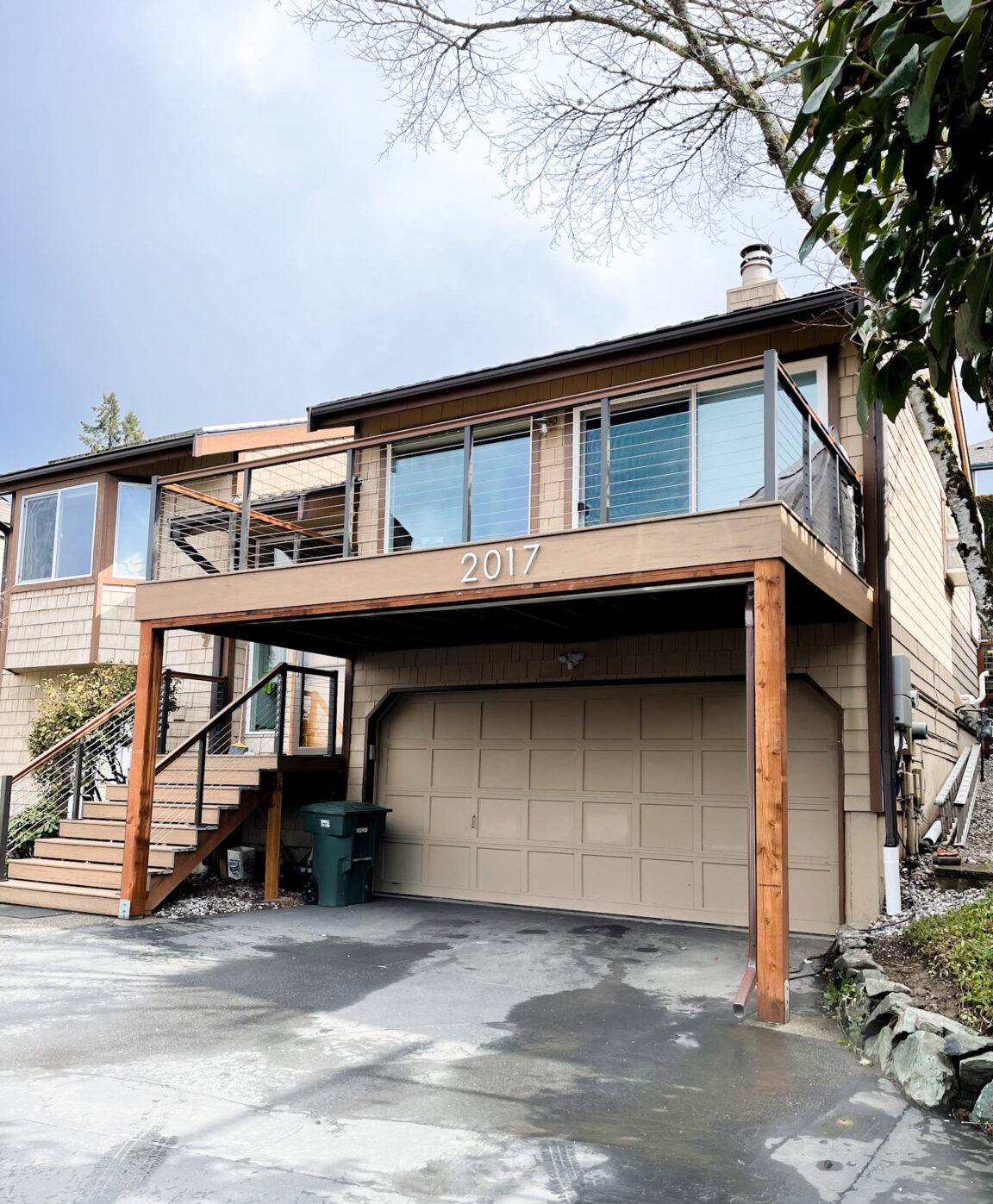
Composite decking is often paired with matching composite fascia boards and either composite, aluminum, or cable railing. In a climate this wet, railing hardware deserves the same corrosion-resistant treatment as the structural fasteners underneath the deck — a railing post that rusts at its base a few years in is a common callback on decks built without that in mind.
Drainage and Airflow Underneath
A deck that traps moisture underneath stays wet longer after every storm, which speeds up both hardware corrosion and moss growth on the underside of boards. Grading the ground below the deck so water runs away from the house, keeping vegetation clear of the underside, and leaving proper airflow gaps all matter more here than they would in a drier climate.
Choosing a Composite Board That Fits Barkley Homes
Not all composite decking is built the same way, and the differences matter more in a wet, shaded, salt-air climate than they would somewhere dry. The table below lays out the general trade-offs between the decking materials most Barkley homeowners are weighing against each other.
| Material | Upfront Cost | Maintenance in Our Climate | Moss & Algae Resistance |
|---|---|---|---|
| Pressure-treated wood | Lowest | Highest — annual cleaning, sealing, and eventual board replacement | Low — porous surface holds moisture |
| Uncapped composite | Mid-range | Moderate — can absorb some surface moisture over many wet seasons | Moderate |
| Capped composite | Higher | Low — polymer shell resists moisture absorption and staining | Good, with occasional rinsing |
| PVC decking | Highest | Low — fully synthetic, does not absorb moisture | Good, with occasional rinsing |
For most Barkley homes, capped composite is the practical middle ground: it resists the moisture absorption that drives moss growth and staining, it never needs sealing or staining the way wood does, and it costs less than full PVC. Homes with heavily shaded decks — common wherever mature trees sit close to the house — sometimes do better with PVC or a composite line that carries a stronger algae-resistant cap, since those spots stay damp the longest after every storm.
Cost on any given project also depends on more than just the board material — deck size, whether an old deck needs to be torn out first, how many levels or stairs are involved, and railing style all move the number. We walk through those specifics on-site rather than quoting a price before seeing the actual conditions.
Our Process for a Barkley Composite Deck
- On-site evaluation. We look at sun exposure, drainage patterns, proximity to mature trees, and the condition of any existing deck or ledger connection before recommending anything.
- Design and material selection. Board color, profile, and railing choices get matched to your home and to how much shade and moisture that specific spot in the yard actually receives through the year.
- Permitting. Deck projects that change footprint, height, or structural attachment to the house typically need a permit; we handle that step so it does not fall on you.
- Demo and substructure build. Old decking and, where needed, old framing comes out. New joists, ledger flashing, and corrosion-resistant hardware go in to spec before a single composite board is placed.
- Composite installation. Boards are installed with proper spacing and fastening for the specific product, including expansion gaps that account for our seasonal temperature swings.
- Final walkthrough. We go over the finished deck with you, including what maintenance it actually needs — which for composite is far less than most homeowners expect after years of dealing with wood.
Keeping a Composite Deck Clean Through Moss Season
Composite decking needs far less upkeep than wood, but low-maintenance does not mean no maintenance in a climate like ours. A short seasonal routine keeps moss and algae from taking hold before they become a scrubbing project:
- Rinse the deck with a hose a few times through fall and winter to keep organic buildup from settling into the board texture
- Sweep leaves and debris out of board grooves and railing joints before they trap moisture against the surface
- Keep gutters and downspouts directing water away from the deck area rather than onto it
- Trim back overhanging branches where practical to let more light and airflow reach the deck surface
- Use a soft-bristle brush and a mild composite-safe cleaner on any established moss, rather than a high-pressure washer at close range, which can damage the board's cap layer
- Check railing posts and stair connections each fall for looseness before winter storms arrive
Why a Local Crew Matters for a Barkley Deck
A contractor who has actually built decks around Bellingham and Whatcom County knows which corners of a yard hold moisture the longest, which hardware holds up near the bay, and how local permitting works for deck projects — none of which shows up in a manufacturer's installation manual. That local knowledge is the difference between a deck that looks right on installation day and one that still looks right five wet winters later.
We are not installing composite decking in a climate we are guessing at. We deal with the same driving rain, the same salt air, and the same moss season on our own properties, and we build every deck to hold up against exactly that. That also means we are easy to reach afterward if a question comes up two or three years down the line, not just during the installation itself.
If you are weighing options for a deck in Barkley, we are glad to walk the site, talk through material choices honestly, and put together a straightforward estimate — no pressure, no obligation. Use the form below to get started.