 Bellingham Siding
 Siding Repair Built for Lynden's Weather, Not Just Patched Over
Lynden homes take a steady beating from the same weather pattern that defines this whole corner of Washington: driving rain that comes in sideways during winter storms, salt-tinged marine air drifting in off the Sound and Whatcom County's waterways, and a moss and algae season that can run most of the year in shaded, north-facing spots. Siding here doesn't fail all at once. It fails at the edges first — a cracked corner board, a gap where caulking gave out, a soft spot behind a downspout that nobody noticed until the paint started bubbling. Our job is to find those failure points before they become bigger problems and repair them correctly, not just cover them up.
This page is specifically about siding repair for homes in and around Lynden. It's not a general overview of siding replacement — it's what we look for, what a correct repair actually involves, and how we decide when a patch makes sense versus when it's time to talk about replacing a section for good.
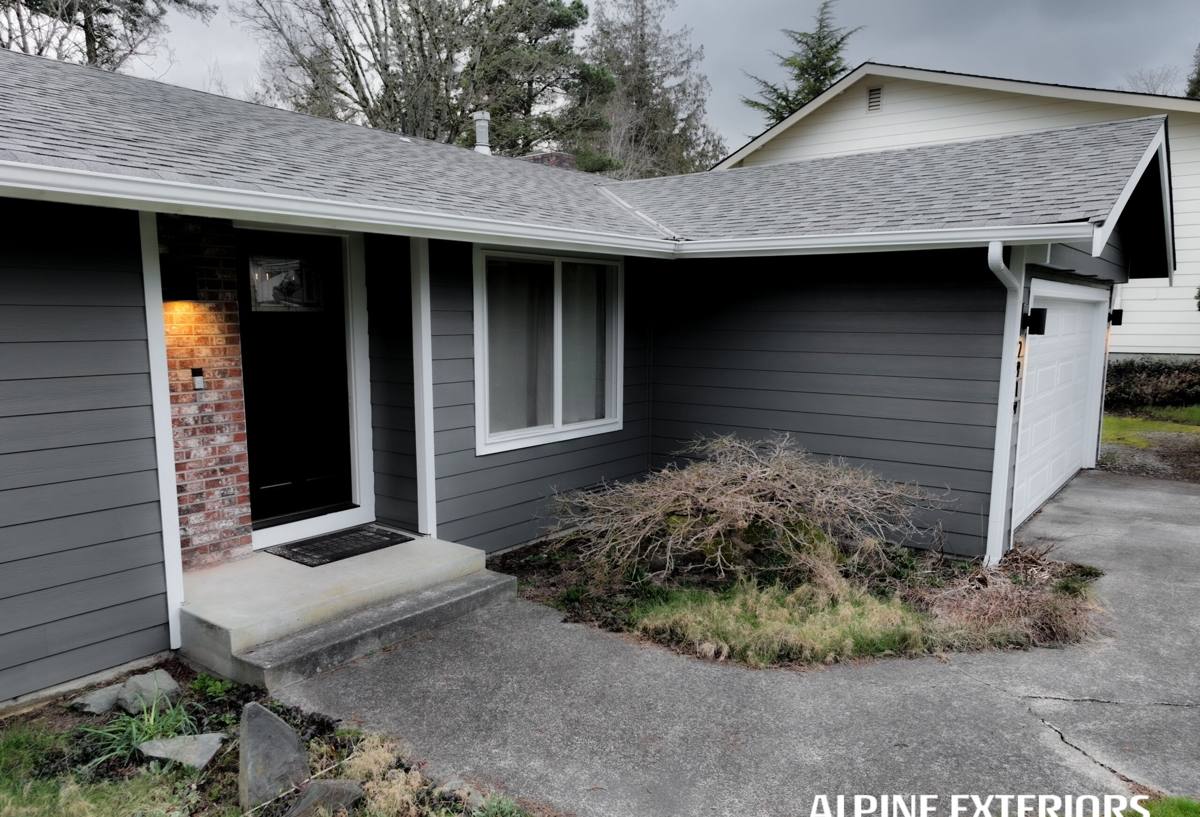
What Whatcom County's Climate Does to Siding Over Time
Driving Rain and Wind-Driven Moisture
Pacific storms don't just drop rain straight down here — they push it horizontally against exterior walls, especially on exposed gable ends and second-story walls with less roof overhang to shield them. Over years, wind-driven rain finds every unsealed seam, nail hole, and butt joint. Siding that was installed with tight, well-caulked joints holds up fine. Siding with gaps, or with caulking that's dried out and cracked, lets water behind the surface — and that's where the real damage starts.
Salt-Tinged Marine Air
Proximity to Puget Sound and the Strait of Georgia means much of Whatcom County deals with a marine-influenced climate — humid, mild, and slow to dry out compared to drier parts of the state. That moisture-heavy air keeps siding surfaces damp longer after a storm, which accelerates wear on paint, caulking, and any wood-based siding product, and speeds up corrosion on exposed fasteners and trim.
A Long, Damp Moss Season
Shaded walls, tree cover, and consistently damp conditions add up to a moss and algae season that can stretch across most of the year in the right (or wrong) spot. Moss holds moisture directly against the siding surface, and on older or lower-grade materials, that constant dampness is often what turns a cosmetic issue into a rot problem underneath.
Common Siding Repair Issues We See on Lynden Homes
- Soft or crumbling sections — usually where water has been getting behind the siding for a while, often near ground level, under windows, or behind downspouts.
- Cracked, warped, or delaminating boards — common on older wood-based and composite sidings that have absorbed repeated moisture cycles.
- Failed caulking and open joints — the single most common entry point for water intrusion we find on service calls.
- Moss and algae buildup — cosmetic on its own, but a warning sign when it's concentrated on one section, since it usually means that spot stays wetter than the rest of the wall.
- Impact damage — cracked or dented panels from storm debris, ladders, or landscaping equipment.
- Fastener and trim corrosion — rust streaks or loose trim where hardware wasn't rated for the marine air.
- Gaps from settling or thermal movement — small shifts over time that open seams and let moisture behind the wall.
What a Correct Siding Repair Actually Involves
A lot of "siding repair" is really just cosmetic patching — caulk over a crack, a dab of paint over a stain, call it done. That approach doesn't fix anything; it just hides the problem until it resurfaces, usually worse. A correct repair starts by figuring out why that section failed in the first place.
| Surface Patch | Proper Repair |
|---|---|
| Caulks over visible cracks | Removes damaged material and checks house wrap/flashing underneath |
| Paints over stains without checking for rot | Probes surrounding wood and sheathing for hidden moisture damage |
| Reuses failed fasteners | Replaces with corrosion-resistant fasteners rated for coastal conditions |
| Matches color only, not material behavior | Matches material so the repaired section weathers the same as the rest |
| Ignores the drainage path behind the siding | Restores proper flashing and water-shedding detail before closing the wall back up |
That last point matters more than most homeowners realize. Siding is really just the visible layer of a water management system. If the flashing, house wrap, or drainage gap behind it isn't repaired correctly, the new siding will fail again — sometimes faster than the original did, since the underlying problem was never addressed.
Repair or Replace? How We Make the Call
Not every damaged section needs to come off the house. But repair only makes sense when the underlying structure is sound and the damage is localized. Here's generally how we think through it:
| Factor | Favors Repair | Favors Replacement |
|---|---|---|
| Extent of damage | Isolated to one or two boards/panels | Spread across a wall or multiple elevations |
| Underlying sheathing/framing | Dry and solid when probed | Soft, stained, or shows active rot |
| Age of existing siding | Relatively recent, still performing well elsewhere | Nearing or past its expected service life |
| Cause of the damage | One-time event (impact, isolated caulk failure) | Systemic issue (chronic moisture, wrong material for the exposure) |
| Material match | Matching material is available and will weather consistently | Original product is discontinued, mismatched, or unreliable long-term |
We'll always give you the honest read on which category your situation falls into, with the reasoning behind it — not just a recommendation to replace everything.
Our Lynden Siding Repair Process
- On-site inspection. We look at the damaged area and the surrounding wall, not just the spot you called about — siding problems are rarely isolated to exactly where the symptom shows.
- Moisture and structural check. Where we suspect water intrusion, we check the sheathing and framing behind the siding before quoting anything.
- Honest repair-or-replace recommendation. You get a straight answer on what's needed and why, with photos of anything hidden behind the wall.
- Material sourcing. For repairs, we source matching material where a true match exists and performs well; where it doesn't, we'll explain the trade-off plainly.
- Correct installation. Proper flashing, weather-resistant barrier, fastener spacing, and sealant — the details that determine whether the repair lasts.
- Cleanup and walkthrough. We show you what was done and why, so you understand the work, not just see a finished patch.
When Repair Isn't Enough: Why We Rebuild Damaged Sections With James Hardie
We install and repair with James Hardie fiber cement exclusively — we don't install vinyl, LP SmartSide, Cemplank, Allura, or primed cedar or spruce siding. When a repair calls for replacing a damaged section, we're straightforward about what that means: if your home is currently sided in one of those materials and the damaged area is too far gone to patch reliably, we'll recommend rebuilding that section in Hardie rather than replacing like-for-like with a product that's likely to develop the same problem again.
That's not a sales pitch — it's a practical call based on what we see fail repeatedly in this climate. Wood and wood-composite products are vulnerable to rot cycles once moisture gets behind them repeatedly. Vinyl can warp, fade, and doesn't take paint if you want to change color later. James Hardie fiber cement is non-combustible, holds its factory ColorPlus finish for years without repainting, and its HZ product lines are engineered specifically for climate zones like ours — freeze-thaw cycling, sustained moisture, and coastal humidity. When we're already opening up a wall to make a repair, using a material built to handle the conditions that caused the original damage is the honest recommendation, and it comes backed by a strong transferable warranty.
If a straightforward repair to your existing siding is the right call, we'll do that — we're not going to talk you into a bigger job than you need.
Why It Matters to Hire a Crew That Already Works in Lynden
Siding repair is detail work, and the details that matter here are specific to this area's weather. A crew that mostly works drier climates may not think twice about a marginal caulk job or a fastener that's fine inland but corrodes within a couple of seasons near the coast. Working regularly in Whatcom County means we've seen how siding actually performs here over time — which repairs hold up through a wet winter and which ones come back with a callback the following spring. It also means faster response when you've got an active leak or storm damage that needs attention before the next system rolls through, rather than waiting on a crew that has to drive in from out of the area.
Between Repairs: Simple Maintenance That Extends Siding Life
A lot of repair calls are preventable with a little regular attention. Between service visits, it's worth keeping an eye on the following:
- Inspect caulked joints around windows, doors, and trim once a year and re-caulk any that have cracked or pulled away.
- Clear moss and algae buildup gently — a soft wash rather than high-pressure spraying, which can drive water behind the siding.
- Trim back vegetation and tree branches that keep a wall shaded and damp longer than the rest of the house.
- Check downspouts and gutters for leaks or overflow that could be soaking a specific section of wall.
- Look for paint bubbling, staining, or soft spots after major storms and have them checked before they spread.
- Keep sprinkler heads and irrigation aimed away from siding, not directly against it.
If you're seeing any of these signs on a Lynden home, or you're just not sure whether what you're looking at is cosmetic or something more, we're happy to take a look. Reach out for a free, no-pressure estimate using the form below — we'll give you a straight assessment of what's going on and what it would take to fix it right.