 Bellingham Siding
 Composite Decking Built for York's Weather, Not Just Its Looks
The York neighborhood sits close enough to Bellingham Bay to catch salt-tinged air off the water, and far enough into the Pacific Northwest's wet season to get months of steady, low-intensity rain every year. Add the mature tree canopy that shades a lot of older Bellingham streets and you get the third ingredient: moss and algae that thrive on damp, shaded wood and composite surfaces alike. A deck in this neighborhood isn't decorative furniture sitting in a backyard — it's a structure that has to shed water, resist organic growth, and hold its fasteners tight through freeze-thaw cycles and long stretches of gray, saturated air.
Composite decking earns its keep here because it doesn't absorb moisture the way wood does, doesn't need annual staining, and won't splinter or cup as it ages. But composite is not maintenance-free, and it is not installation-proof. A poorly built composite deck in Whatcom County will grow moss in the shaded corners, trap water at the ledger board, and loosen hardware within a few winters — the same problems a bad wood deck has, just hidden under a nicer surface. The material matters less than how it's framed, fastened, and drained.
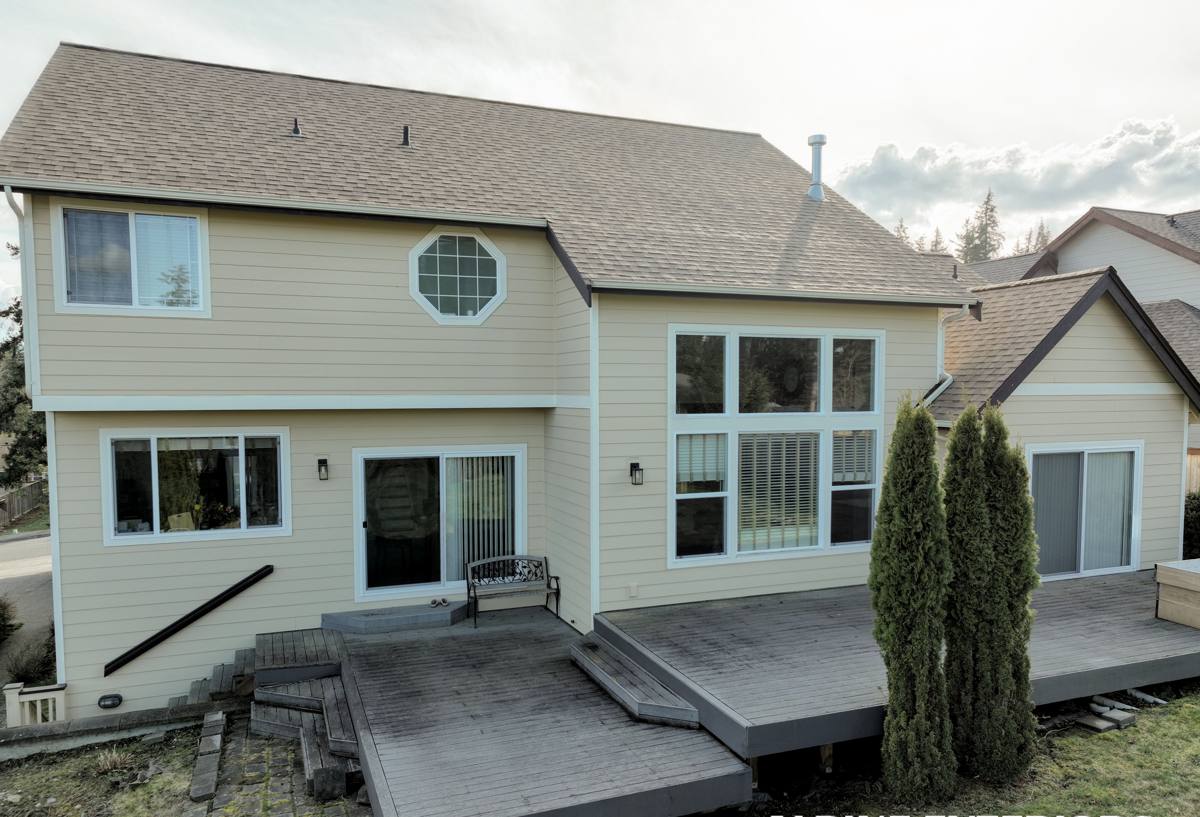
What Correct Composite Decking Looks Like in a Climate Like Ours
Framing and Substructure
Composite boards are only as good as what's underneath them. We frame with joist spacing tightened up from typical wood-deck standards — usually 12" on-center instead of 16" — because composite boards flex more than wood over time, especially in the temperature swings between a cold, damp morning and a warmer afternoon. Every joist gets a protective tape or coating before boards go down, because trapped moisture between a composite board and an untreated joist is exactly the setup that leads to hidden rot in the framing, even though the decking on top looks fine.
Fasteners and Hardware
We use stainless steel or coated fasteners rated for coastal and marine-influenced environments. Standard galvanized hardware can start showing corrosion faster near Bellingham Bay than it would further inland, and a rusting fastener under a composite board is a slow, invisible failure point. Hidden fastener clip systems are worth the extra labor on most jobs — fewer surface penetrations mean fewer places for water to sit and freeze.
Drainage and Ventilation
This is the step that gets skipped most often, and it's the one that matters most in a wet climate. Ledger boards need proper flashing so water is directed away from the house framing, not into it. The space under the deck needs enough airflow that the ground beneath doesn't stay saturated all winter, which is what feeds moss and mildew growth up into the deck structure from below. On low-clearance decks or ground-level patios, we grade and drain the substrate itself, not just the visible surface.
Choosing a Composite Board for a Whatcom County Deck
Not every composite product handles this climate the same way. The biggest distinction is capped versus uncapped composite.
Capped Composite
Capped boards have a plastic polymer shell wrapped around a wood-plastic composite core. That shell is what actually resists moss, staining, and moisture intrusion — it's the difference between a board that wipes clean and one that slowly darkens and pits over a few wet seasons. For a shaded, damp lot like much of York, we recommend capped composite as the standard, not the upgrade.
Uncapped Composite
Older-style uncapped composite is more exposed wood fiber at the surface, which means it can absorb moisture and support algae growth more readily. It costs less up front but tends to need more frequent cleaning and shows staining sooner in a climate this wet. We'll install it if that's what a homeowner wants, but we're upfront that it's the wrong pick for a heavily shaded, rain-exposed deck.
| Material | Moisture Behavior | Moss/Algae Resistance | Maintenance |
|---|---|---|---|
| Capped composite | Sheds water at the surface, low absorption | Best of the group | Occasional wash, no staining or sealing |
| Uncapped composite | Some surface absorption | Moderate — needs regular cleaning | Periodic scrubbing to prevent staining |
| Pressure-treated wood | Absorbs and releases moisture constantly | Low — grows moss readily in shade | Annual staining/sealing recommended |
| Cedar | Absorbs moisture, more dimensionally stable than PT pine | Low to moderate | Regular sealing to hold color and resist rot |
Moss, Algae, and Staining: What Actually Works
Even the best composite board will pick up surface grime in a climate that stays damp for months at a stretch. The difference between a deck that stays clean-looking and one that turns green in the shaded corners usually comes down to three things: board selection (capped composite resists this far better), airflow underneath and around the deck, and a simple seasonal cleaning routine. We don't recommend pressure washing composite decking at high pressure — it can etch or dull the surface finish on some products. A soft-bristle brush, mild soap, and a garden hose handle most moss and algae buildup without damaging the board.
Deck sections that sit under heavy tree cover or against the shaded side of a house will always need more attention than open, sun-exposed sections. That's just physics, not a product failure — and it's worth planning for at the design stage by keeping planting and structures from creating dead-air pockets where moisture lingers.
Our Process for a Composite Decking Project in York
- On-site assessment — we look at sun/shade exposure, existing drainage, ledger condition if it's an attached deck, and any moss or rot already present in an old deck being replaced.
- Board and layout selection — matched to the site's shade and moisture exposure, not just the homeowner's color preference, though we work within that too.
- Framing and flashing — joists spaced and protected for composite's flex and weight, ledger flashed to keep water out of the house structure.
- Installation — hidden or face-fastened per the product's specification, with attention to expansion gaps so boards aren't installed too tight for seasonal movement.
- Final walkthrough — we go over basic care so the deck stays looking right through its first wet season and beyond.
Maintenance Checklist for Composite Decking in a Wet Climate
- Sweep debris and leaves off the deck regularly, especially in fall, so organic matter doesn't sit and hold moisture against the boards.
- Clean shaded or low-airflow sections more often than sun-exposed areas — moss takes hold fastest where boards stay damp longest.
- Use a soft brush and mild soap rather than a high-pressure washer on composite surfaces.
- Check the gap between boards periodically to make sure debris hasn't packed in and blocked drainage.
- Inspect fasteners and any visible hardware once a year for corrosion, especially on decks closer to the bay.
- Keep gutters and downspouts near the deck clear so runoff isn't dumping extra water onto or under the structure.
Why Hiring a Crew That Already Works in York Matters
A lot of what separates a composite deck that holds up for twenty years from one that starts showing problems in five comes down to decisions made before a single board is installed — joist spacing, flashing details, drainage grading, fastener selection. Those decisions should be shaped by the actual site conditions, not a generic install checklist. A crew that regularly works in Bellingham neighborhoods like York already knows how shaded, tree-covered lots behave through a wet winter, how close proximity to the bay affects hardware choices, and where moss tends to establish itself first on a new deck. That's not something you get from a manufacturer's install manual — it's something you get from building decks in this specific climate, on this specific kind of lot, season after season.
We also know what a Whatcom County building permit and setback review typically involves for a residential deck project, which helps keep a project moving instead of stalling on paperwork.
What This Costs and What Drives the Price
Composite decking costs more up front than pressure-treated wood, but less over time once you account for staining, sealing, and board replacement that wood typically needs. Actual pricing depends heavily on deck size, height off the ground, railing style, and site access — a ground-level deck with simple framing costs meaningfully less than an elevated deck with stairs, custom railing, or difficult access for materials and equipment. We give straight numbers after we've actually seen the site, not a generic square-footage estimate that ignores your yard's specific drainage and shade conditions.
If you're planning a new composite deck or replacing an aging wood deck in York, we're happy to come take a look and give you a straightforward, no-pressure estimate — just fill out the form below.