 Bellingham Siding
 A roof in Blaine takes a different kind of beating than one twenty miles inland. Storms here arrive off Semiahmoo Bay and Drayton Harbor with wind that drives rain sideways instead of straight down, and the salt-laden air that comes with living this close to the water accelerates corrosion on anything metal long before a homeowner notices a leak. Add in a moss season that runs longer here than in drier parts of Whatcom County, and a storm-damaged roof in Blaine is rarely a simple case of "a few shingles blew off." This page covers what storm damage actually looks like on a Blaine roof, what a correct repair involves, and how our process works from the first call to the final walk-through.
Why Storms Hit Blaine Roofs Harder
Three conditions specific to this part of Whatcom County shape how storm damage develops and how it should be repaired.
Wind Off the Water
Blaine sits at the northern edge of the county, close enough to open water that wind gusts during a storm often arrive with less to slow them down than they would further inland. That wind gets under loose or aging shingle edges, peels flashing away from chimneys and vent stacks, and can lift entire sections of roofing in a way that a sheltered inland roof rarely experiences from the same storm.
Driving Rain
Wind-driven rain doesn't behave like a normal downpour. It finds its way sideways into laps, seams, and any flashing detail that isn't sealed and integrated correctly, which means storm damage often shows up as a leak somewhere well away from the actual point of entry. A missing shingle three feet from a chimney can end up producing a stain on a ceiling on the opposite side of the room.
Salt Air and Moss
The airborne salt off Semiahmoo Bay and Drayton Harbor speeds up rust on fasteners, flashing, and vent hardware, so storm-loosened metal that would hold up a few more years inland can already be compromised by the time a storm finishes it off. Layer on a moss season that runs long in this climate, and any storm damage that isn't repaired promptly gives moss a foothold at the exposed edge, which holds moisture against the roof and speeds up further deterioration.
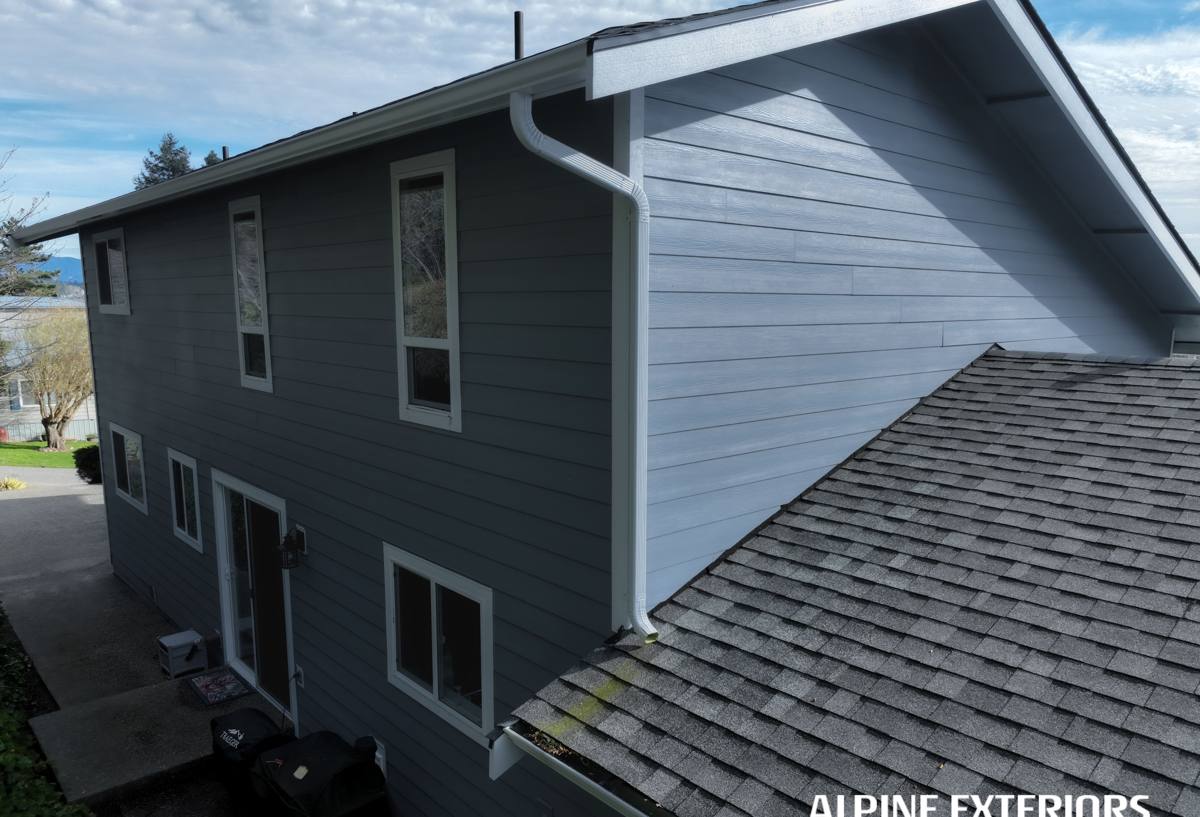
Signs Your Roof Has Storm Damage
Some storm damage is obvious from the ground. A lot of it isn't, and the damage that isn't obvious is often what leads to the worst leaks if it sits unaddressed.
- Shingles that are missing, cracked, curled, or visibly out of alignment with the surrounding roof plane
- Granules collecting in gutters or at downspout outlets in amounts beyond normal light shedding
- Bent, lifted, or missing flashing at chimneys, skylights, and roof-to-wall transitions
- Dents or creases in metal roofing, vent caps, or gutter hardware
- New or worsening moss growth concentrated at one section rather than spread evenly
- Water stains on ceilings or interior walls that appeared after a specific storm event
- Soft spots in the roof deck felt underfoot during inspection
- Debris, branches, or visible impact marks on the roofing surface
Common Types of Storm Damage We See Here
Not all storm damage repairs the same way, and the table below covers the patterns we see most often on Blaine roofs.
| Damage Type | Typical Cause | What It Looks Like |
|---|---|---|
| Wind-lifted or missing shingles | Gusts off open water catching a loose or aging edge | Bare patches, exposed underlayment, shingles found in the yard |
| Flashing failure | Wind plus corrosion weakening the seal at penetrations | Leaks near chimneys, skylights, and vent stacks, often delayed |
| Wind-driven rain intrusion | Rain forced sideways into laps and seams | Interior staining without any obviously missing material |
| Impact damage | Falling branches or wind-blown debris | Cracked or punctured shingles, dented metal panels |
| Accelerated moss intrusion | Storm-lifted edges giving moss a new entry point | Localized moss growth at one section rather than the whole roof |
What to Do Right After a Storm
What a homeowner does in the first day or two after a storm affects how much a repair ends up costing. These are the basics worth following before a crew ever arrives.
- Stay off the roof. Storm-damaged roofing is unstable underfoot, and wet, mossy surfaces are more dangerous than they look.
- Photograph visible damage from the ground and from inside at any active leak, including the date if the camera allows it.
- Move furniture and belongings away from active leaks and place a container to catch dripping water.
- Avoid patching the roof yourself with tape or sealant — a poor DIY patch can trap moisture and make the actual repair more involved.
- Call for an inspection promptly. Delayed repair is one of the most common reasons a manageable repair turns into a full section replacement.
What a Correct Storm Repair Actually Involves
Storm repair isn't just replacing what's visibly missing. Done right, it addresses everything the storm compromised, including the parts a homeowner can't see from the ground.
Emergency Mitigation
When a roof has active water intrusion, the first priority is stopping further damage — temporary tarping or emergency sealing over the affected area to keep water out until permanent repairs can be made.
Full Damage Assessment
We inspect beyond the obviously damaged section, since wind and driving rain often affect flashing, fasteners, and underlayment in areas that look fine from the ground. A repair limited only to the visible damage frequently misses the actual point of leak entry.
Matching and Material Selection
Where shingles or panels need replacing, we match material, color, and profile to the existing roof as closely as possible. On older roofs where an exact match isn't available, we'll be upfront about that rather than promising a seamless result we can't deliver.
Flashing and Fastener Repair
Because salt air corrodes standard hardware faster here, storm repairs are a good opportunity to upgrade compromised flashing and fasteners to corrosion-resistant material rather than replacing like-for-like with hardware that will fail again in a few years.
Underlayment Repair
Any underlayment exposed or compromised during the storm gets replaced, not just covered over — underlayment is the roof's second line of defense against wind-driven rain, and skipping it undermines the whole repair.
Our Storm Repair Process
- Initial call and photo review. We ask what happened and, when possible, review photos to prioritize urgent cases with active leaks.
- On-site inspection. We assess the full roof, not just the reported damage area, and check flashing, fasteners, and deck condition.
- Emergency tarping if needed. Active leaks get a temporary stop-gap before anything else.
- Written estimate. We document the damage and provide a clear, itemized estimate, with photos included for insurance purposes.
- Repair work. Damaged materials, flashing, and underlayment are replaced to match the existing roof and correct spec.
- Final walk-through. We review the completed repair with the homeowner and confirm there are no remaining problem areas.
Working With Your Insurance Claim
Most storm damage repairs in this area involve an insurance claim, and how the documentation is handled affects how smoothly that process goes. We provide a detailed, itemized estimate with photos of the damage that homeowners can submit directly to their adjuster. We're glad to answer an adjuster's questions about the scope of repair or meet on-site if that's useful, but we don't inflate estimates or guarantee claim outcomes — coverage decisions belong to the insurance company, and we'd rather give an honest number than a padded one that creates problems later.
Repair vs. Replace: What Actually Drives the Decision
Not every storm-damaged roof needs full replacement, but some do. These are the factors that actually move that decision, not a fixed age cutoff.
| Factor | Leans Toward Repair | Leans Toward Replacement |
|---|---|---|
| Extent of damage | Isolated to one section or a handful of shingles | Widespread across multiple roof planes |
| Roof age | Well within its expected service life | Already near or past typical service life for its material |
| Underlying deck condition | Deck is sound once damaged material is removed | Rot or soft sheathing found in multiple areas |
| Material availability | A close match to existing shingles or panels is available | Original material discontinued and a patch would look mismatched |
| Storm history | First significant damage event on this roof | Repeated storm damage suggesting the roof is at the end of its useful life |
Why Hire a Crew That Already Works Blaine
A roofer who mainly works inland jobs isn't wrong about roofing in general — they're working from a different set of defaults. Fastener and flashing specs that hold up fine on a sheltered inland roof are often undersized for what a storm coming off Semiahmoo Bay and Drayton Harbor actually does to a roof. A crew that already works in Blaine has seen which repairs hold up here and which ones come back as callbacks a year later, not just which ones pass in a textbook.
There's also a response-time factor with storm damage. When water is actively getting into a home, how quickly a crew can get out for emergency tarping matters as much as the quality of the eventual permanent repair. A contractor who already works this part of Whatcom County is in a better position to respond fast than one coming from further away.
Reducing Storm Damage Risk Going Forward
A correctly repaired roof still benefits from some ongoing attention given the conditions here:
- Have loose or lifted shingles addressed before the next storm rather than after
- Keep gutters and downspouts clear so storm water isn't backing up under roof edges
- Trim back tree limbs that could come down on the roof in high wind
- Address moss growth before it spreads across a full slope
- Schedule a flashing check after any major storm, even without a visible leak
- Keep a record of storm dates and any related roof work for future insurance reference
If a recent storm left your roof with missing shingles, a new leak, or damage you're not sure about, we're glad to take a look and give you an honest read on what it needs. Reach out for a free, no-pressure estimate using the form below.