 Bellingham Siding
 Why Barkley Homes Need Siding Built for This Climate
Barkley sits close enough to Bellingham Bay and the surrounding waterways that salt-laden air is a real factor in how exterior materials age here, not just a coastal talking point. Add in Whatcom County's long wet season, wind-driven rain off the water, and the shade and dampness that keep moss going for most of the year, and you have a climate that's genuinely hard on siding. Homes in this neighborhood need a siding system that was engineered for exactly this combination of moisture, salt exposure, and low sun angle — not a product that merely tolerates it.
This page covers what fiber cement siding installation looks like specifically for Barkley homes: what the climate does to a wall assembly over time, what a correct installation involves, and why we've standardized on James Hardie fiber cement rather than offering a menu of siding brands.
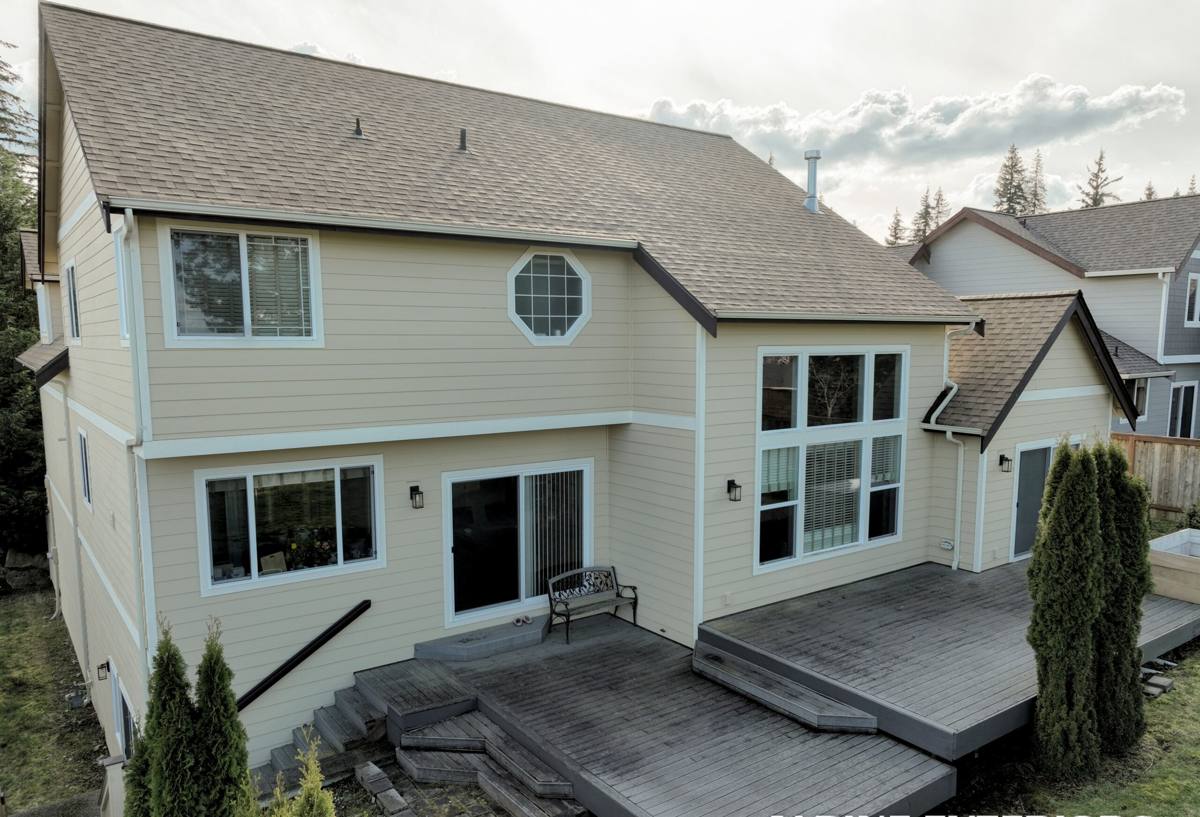
What Salt Air, Driving Rain, and Moss Actually Do to Siding
Salt Air and Moisture Cycling
Salt air doesn't just corrode metal fasteners and flashing faster — it also changes how a wall surface holds moisture. Salt is hygroscopic, meaning it pulls moisture out of the air and holds it against the surface it's on. On a siding material that isn't dimensionally stable, that constant low-grade dampness accelerates swelling, checking, and paint failure.
Wind-Driven Rain at Seams and Trim
Bellingham's storms regularly push rain sideways, not straight down. That matters because most siding failures don't start on the flat field of a wall — they start at seams, butt joints, window and door trim, and anywhere water can be forced upward or sideways past a lap. A siding job that looks fine on a calm day can fail during the first real driving-rain event if the flashing and joint details weren't done right.
Shade, Moss, and Constant Dampness
North-facing walls and anything shaded by mature trees or neighboring structures stay damp far longer after a rain event than a wall in full sun. That extended dry-time window is exactly what moss and algae need to establish. Over years, a siding material that absorbs moisture or has a rough, porous surface will host more growth than one that sheds water and resists organic buildup.
Why We Install Only James Hardie Fiber Cement
We don't install vinyl, LP SmartSide, cedar, primed spruce, or other fiber cement brands. That's a deliberate standard, not a limitation in what we're capable of installing. In a climate like Bellingham's, the material differences that seem minor in a showroom become the difference between a wall that ages gracefully and one that needs repainting, patching, or replacing trim within a decade.
James Hardie's HZ5 product line is engineered specifically for regions like ours — cold, wet, and humid — with a formulation designed to resist moisture-related damage better than wood-based or engineered-wood alternatives. The ColorPlus factory finish is baked on under controlled conditions, which holds color and resists the chalking and fading that field-applied paint goes through faster under repeated rain-and-UV cycling. Fiber cement is also non-combustible and dimensionally stable, so it doesn't cup, warp, or swell at the edges the way wood-based products can once moisture gets into a cut end or fastener hole. For a neighborhood dealing with salt air, sideways rain, and long damp stretches, those aren't marginal advantages — they're the whole reason the product exists.
What a Correct Installation Involves in Barkley
Water Management Comes First
The siding itself is the least important part of keeping a wall dry. A correctly lapped, back-primed, properly flashed water-resistive barrier behind the siding is what actually keeps bulk water out of the wall assembly. Skipping or rushing this step is the single most common cause of hidden rot behind siding that looks perfect from the curb.
Fastening, Clearances, and Expansion Gaps
James Hardie publishes specific fastener spacing, nailing patterns, and minimum clearances from grade, roof lines, and other siding — these exist because fiber cement expands and contracts slightly with temperature and moisture, and because ground splashback is a real moisture source. Installers who treat these numbers as optional produce a wall that looks fine at handoff and shows problems years later.
Caulking and Paint Lines
Caulk is a maintenance item, not a substitute for correct flashing — but where it's used, it needs to be the right product at the right joints, not applied everywhere as a catch-all. Cut ends and field-touched trim need proper sealing so moisture can't wick into the fiber cement at exposed edges.
- Weather-resistive barrier installed and lapped correctly, with all penetrations flashed
- Window and door flashing integrated with the barrier, not just caulked over
- Manufacturer-specified fastener type, spacing, and embedment depth followed exactly
- Minimum clearance maintained from grade, decks, roof lines, and walkways
- Butt joints and corners flashed or sealed per manufacturer detail, not left to caulk alone
- Cut edges sealed before installation to prevent moisture wicking
- Final inspection of caulk lines, paint touch-up, and fastener finish before job close-out
Matching the Right Hardie Product to Your Home
James Hardie makes several product profiles, and the right one depends on the home's existing architecture, exposure, and the look you're after. Most Barkley homes end up choosing between a horizontal lap profile and a panel or shingle profile for accent areas.
| Product | Best For | Look |
|---|---|---|
| HardiePlank lap siding | Most full-home re-sides; traditional and modern homes alike | Classic horizontal lap, multiple width and texture options |
| HardiePanel vertical siding | Modern facades, gable accents, board-and-batten style | Clean vertical lines |
| HardieShingle siding | Craftsman and cottage-style homes, accent gables | Staggered or straight-edge shingle profile |
| HardieTrim boards | Corners, window and door surrounds, fascia | Crisp, paintable trim that won't rot like wood |
Cost Factors for Barkley Homeowners
Every quote is specific to the home, but the same handful of factors drive most of the variation we see on Barkley projects.
| Factor | Why It Matters |
|---|---|
| Home size and wall complexity | More corners, dormers, and trim detail mean more cutting and labor time |
| Condition behind the old siding | Rot or moisture damage found during tear-off requires repair before new siding goes on |
| Removal and disposal of existing siding | Some materials, like old cedar or certain composite products, take longer to strip and haul away |
| Accessibility | Steep grades, tight side yards, or multi-story sections affect staging and labor |
| Product line and trim package | Panel width, texture, and trim detail all affect material cost |
Our Process When We Work in Barkley
- On-site assessment. We walk the exterior, check for existing moisture damage, and evaluate trim, window flashing, and grade clearance before quoting anything.
- Tear-off and inspection. Old siding comes off and we inspect sheathing for hidden rot or damage before anything new goes up — this is where problems get caught while they're still fixable.
- Water-resistive barrier and flashing. Correct lapping, flashing at every penetration and opening, and integration with window and door details.
- Installation to manufacturer spec. Fastener pattern, clearances, and expansion gaps follow James Hardie's published requirements, not shortcuts.
- Final walkthrough. We review caulk lines, touch-up paint, and fastener finish with you before calling the job done.
Maintenance and Long-Term Care in a Wet Climate
Fiber cement is low-maintenance compared to wood, but "low-maintenance" doesn't mean zero-maintenance, especially in a climate that stays damp as much of the year as ours does. A yearly rinse-down of shaded, moss-prone areas keeps organic growth from getting a foothold, and it's worth doing before the wet season sets in rather than after moss has already spread. Check caulk lines at trim and joints periodically — caulk is the one component in the system that has a shorter service life than the siding itself, and catching a failed bead early is a lot cheaper than dealing with what happens if water gets behind it.
ColorPlus-finished siding holds its color far longer than field-painted siding under our repeated rain-and-UV cycle, but if any area was ever cut, drilled, or field-painted, keep an eye on those spots specifically — they're the most likely place for a finish to wear unevenly first. Done right, a James Hardie installation in this climate is measured in decades, not years, but that long service life still depends on the same basic upkeep any exterior material needs: keep water moving away from the wall, and don't ignore small problems at the trim and joints.
If you're planning a re-side in Barkley or anywhere else in the Bellingham area, we're happy to walk your home, look at what's actually going on behind the existing siding, and give you a straightforward, no-pressure estimate — use the form below to get started.