 Bellingham Siding
 Why Siding Repair Looks Different in Barkley
Most siding problems we see in Barkley don't call for a full replacement. A section of trim has softened, a few boards have separated at a seam, moss has taken hold on a shaded wall, or a storm knocked something loose — and the rest of the siding is still doing its job. Repair is the right call far more often than homeowners assume, but only if it's diagnosed and done correctly. Done wrong, a repair just delays the same failure by a season or two.
Barkley sits within Bellingham, close enough to Bellingham Bay that its homes take on the same marine weather pattern that shapes exterior work across Whatcom County: salt-tinged air drifting in off the water, rain that comes in sideways as often as it falls straight down, and a moss season that can run nearly year-round on shaded roof and wall surfaces. That combination doesn't just affect new installations — it determines how a repair should be scoped, what's actually failing underneath a visible symptom, and how long a fix will actually hold.
This page is about siding repair specifically — what causes it in Barkley, how to tell a cosmetic issue from a real one, what a correct repair job involves, and when repair stops making sense and replacement takes over.
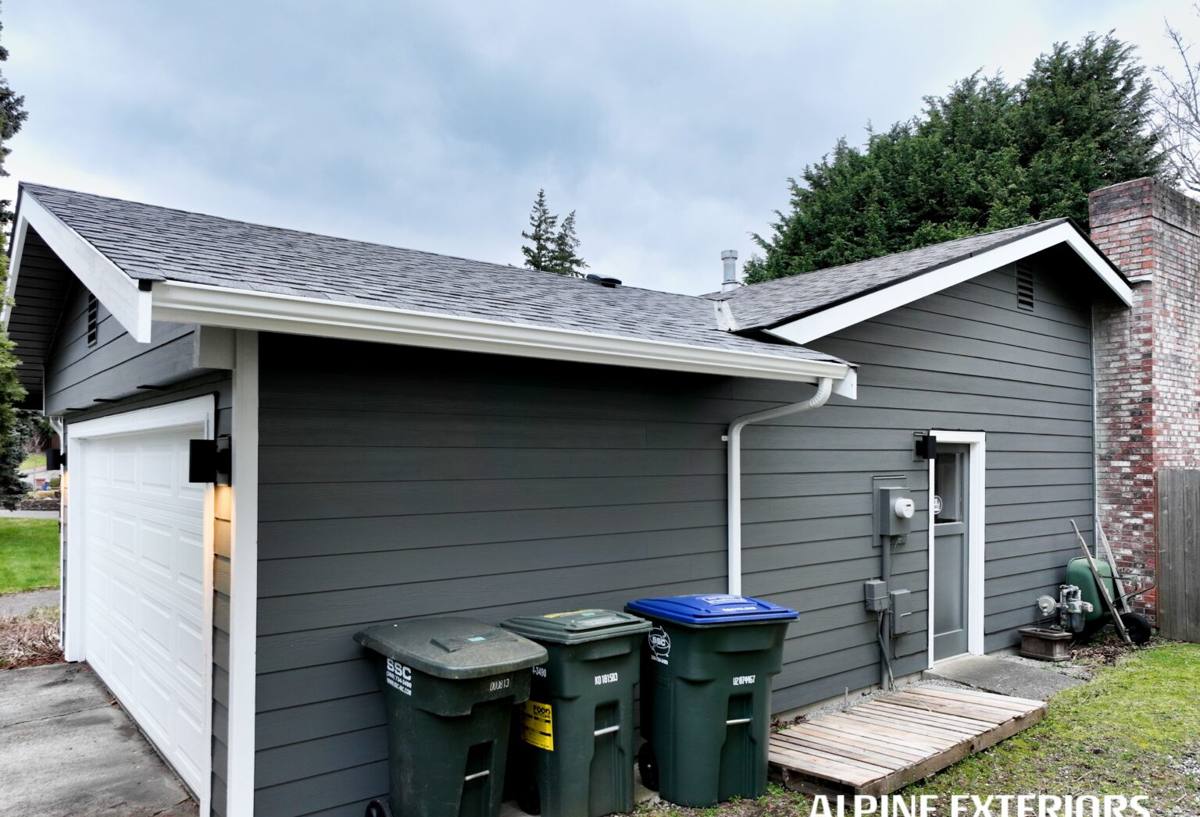
What Barkley's Climate Actually Does to Siding
Salt Air and Fastener Corrosion
Salt-laden air moving off Bellingham Bay accelerates corrosion on exposed fasteners, flashing, and trim hardware faster than an inland climate would. That corrosion rarely announces itself early — a nail head rusts, loses some of its holding strength, and a board starts to work loose or a seam opens slightly, well before anyone notices from the ground. By the time rust streaks are visible on the siding face, the fastener behind them has usually been failing for a while.
Driving Rain Finding Its Way Behind the Siding
Storms here typically arrive with wind pushing the rain sideways, not straight down. That matters for repair work because wind-driven rain gets forced into laps, seams, and fastener points that a calm, dry-climate installation was never tested against. Most of the siding failures we're called out to repair in Barkley trace back to water that got in behind the cladding through a gap or a failed flashing detail, not water that came through the siding material itself.
A Moss Season That Doesn't Really End
Cool temperatures, high humidity, and heavy tree cover across Bellingham give moss a growing window that runs close to year-round on shaded, north-facing walls. Moss holds moisture against a surface far longer than open air would, and on a moisture-sensitive substrate that constant dampness is what eventually turns a cosmetic green tint into soft, rotting trim underneath.
Cosmetic Wear vs. Damage That Needs Repair Now
Not every mark on a wall means something is failing. Telling the difference correctly is the first real job of a repair estimate, and it's where a lot of unnecessary cost — or, worse, unnecessary delay — gets decided.
| Symptom | Usually Cosmetic | Often Needs Repair |
|---|---|---|
| Light green staining on a shaded wall | Yes — surface moss, cleanable | Only if the surface underneath is also soft |
| Faded or chalky paint on older wood trim | Yes — UV and weathering | If paint keeps failing in the same spot repeatedly |
| Soft or spongy spot when pressed | No | Yes — moisture has already reached the substrate |
| Rust streaking below a fastener | Cosmetic if isolated and dry underneath | Often — the fastener itself may be losing grip |
| Boards cupping, warping, or gapping at seams | Rarely | Usually — moisture or movement behind the seam |
| Cracked or missing caulk at trim joints | No | Yes — an open path for wind-driven rain |
Cosmetic issues can usually wait for routine cleaning or maintenance. Anything involving softness, gapping, or an open joint tends to get worse through another wet season, not better, so it's worth having someone actually look rather than assuming it'll hold.
How We Diagnose a Problem Before Recommending Repair
A repair estimate that's worth anything starts with an actual inspection, not a guess from the driveway. For a Barkley home, that typically includes:
- Pressing along suspect boards and trim to find soft spots that aren't visible from a distance
- Checking behind the siding at the failure point where possible, since the visible damage is rarely the whole story
- Looking at fasteners and flashing near the problem area for corrosion or gaps that let water in
- Assessing how much sun, shade, and wind exposure that specific wall gets, since it changes both the cause and the fix
- Checking whether the surrounding siding and trim are still sound enough to repair into, or whether the damage has spread further than it first appears
- Confirming what material is currently installed, since repair options differ meaningfully between fiber cement, vinyl, engineered wood, and solid wood siding
We walk through what we actually find — not just what's visible — before recommending a scope of work or a price.
Repair vs. Replace: How That Decision Actually Gets Made
Homeowners sometimes assume any visible siding problem means a full replacement, and just as often assume a repair will always be the cheaper, equally durable option. Neither assumption holds up consistently. The honest factors that actually drive this call:
- How far the moisture damage has spread. A soft section at one window or corner is usually a straightforward repair. Widespread softness across multiple walls often means the damage got ahead of anyone noticing, and chasing it board by board stops making financial sense.
- What's underneath the siding. If sheathing or framing behind the damaged section has also been compromised, the repair scope grows regardless of how the siding itself looks.
- Age and material of the existing siding. Older wood or engineered-wood siding nearing the end of its practical life may only have limited repair cycles left before replacement is the more cost-effective path.
- Whether a color or profile match is realistically available. A structurally sound repair that ends up looking visibly patched isn't always the right trade-off, especially on a highly visible wall.
We'll give a straight answer on which category a given problem falls into, including when a repair is genuinely all that's needed — we don't upsell a full replacement when a targeted fix will hold.
What a Correct Siding Repair Actually Involves
Fixing the Cause, Not Just the Symptom
A soft board or a gapped seam is a symptom. Trapped moisture, a missing flashing detail, or a failed caulk joint is usually the cause. A repair that swaps in a new board without correcting whatever let water in tends to fail again in the same spot — often faster the second time, since the underlying path for water was never actually closed.
Matching Material, Profile, and Finish
Repairing into existing siding means working with whatever's already on the wall — matching board width, texture, and finish closely enough that the repair doesn't stand out as an obvious patch. On factory-finished products, that also means using the manufacturer's matched touch-up system at cut edges rather than field-mixed paint, which weathers differently and shows over time.
Fastening and Flashing to the Same Standard as New Work
A repair section still has to survive the same wind-driven rain and salt exposure as the rest of the wall, so it gets the same fastener spacing, corrosion-resistant hardware, and flashing detail a full installation would use — not a lighter-duty shortcut because the scope is smaller. Cutting corners on a repair because it's "just a patch" is exactly how the same failure comes back within a year or two.
Repairing James Hardie Siding vs. Other Materials
We install only James Hardie fiber cement on new and replacement work, and we repair it to that same manufacturer specification — correct fastener type, proper clearance, and Hardie's matched touch-up product for the ColorPlus finish where a cut edge is exposed. For homes in Barkley with other existing siding materials, repair is still often possible, but the trade-offs are worth knowing upfront.
| Material | Repair Considerations |
|---|---|
| James Hardie fiber cement | Straightforward board or section replacement; ColorPlus touch-up product keeps a repaired seam from weathering differently than the rest of the wall |
| Vinyl siding | Panels can be unsnapped and replaced individually, but sun-faded older panels are hard to color-match exactly to a newer replacement piece |
| LP SmartSide / engineered wood | Repairable at isolated spots, but cut edges and seams are the most moisture-sensitive part of the product and need careful sealing to avoid a repeat failure |
| Solid wood or primed spruce | Individual boards can be replaced, but ongoing repainting and caulking is part of keeping any repair from becoming a recurring job |
None of this means an existing non-Hardie siding system is a lost cause — plenty of these repairs hold up fine when they're diagnosed and done correctly. It's simply the honest picture of what each material asks of a homeowner going forward, and part of why we recommend Hardie when a homeowner is facing enough repeat repair work that replacement starts to make more sense.
Keeping a Repair From Needing Another Repair
- Rinse siding periodically, especially on shaded or north-facing walls where moss establishes first
- Keep gutters clear so overflow doesn't run down the wall face or pool at the base of a repaired section
- Trim back vegetation that keeps a section of wall in constant shade and dampness
- Check caulking at trim joints and around the repair itself every year or two, since a small gap is what let water in the first time
- Look at ground-level courses periodically for softness, since consistently damp soil is the most common repeat failure point
- Address a new soft spot or loose piece of trim right away rather than waiting — it's cheap to fix early and expensive to ignore
Why a Crew That Already Works Barkley Matters
A lot of what makes a siding repair actually last comes down to details a crew unfamiliar with this specific area tends to miss: which walls in a given part of Barkley take the worst of the wind-driven rain, where moss establishes first based on tree cover and shade, and how much clearance a repaired section needs above grade given how consistently damp the ground stays through a Whatcom County winter. A crew that works this climate regularly starts to recognize these patterns from one property to the next, and that familiarity shows up in decisions a homeowner rarely notices directly — where flashing is required versus where caulk is enough, what fastener grade actually holds up here — but absolutely feels in whether the repair is still holding a few winters later.
It also means someone who's easy to reach if a repair needs a follow-up look, rather than an out-of-area crew that's hard to get back on the phone once the job is done.
If a section of your Barkley home's siding is showing soft spots, moss, gapping, or storm damage, we're glad to take an honest look and tell you plainly whether it's a repair, a replacement, or nothing urgent at all. Reach out using the form below to schedule a free, no-pressure estimate.