 Bellingham Siding
 Metal Roofing for Birchwood Homes
Birchwood sits close enough to Bellingham Bay and the surrounding wetlands that homes here deal with a specific combination of weather stress: salt-tinged air moving in off the water, long stretches of driving rain through fall and winter, and a moss season that can run most of the year in shaded, tree-lined yards. A roof in this neighborhood works harder than a roof twenty miles inland, and it shows in gutters that clog faster, fasteners that corrode sooner, and shingle roofs that grow moss almost as soon as they're cleaned. Metal roofing is one of the more effective answers to that combination, but only when it's specified and installed with this exact climate in mind.
We work on homes throughout Bellingham and Whatcom County, and Birchwood's mix of older single-family houses and newer infill construction gives us a good cross-section of what actually holds up here versus what looks good on a spec sheet. This page covers what a metal roof needs to do in this specific setting, what a correct installation looks like, and how our process runs from first look to final walkthrough.
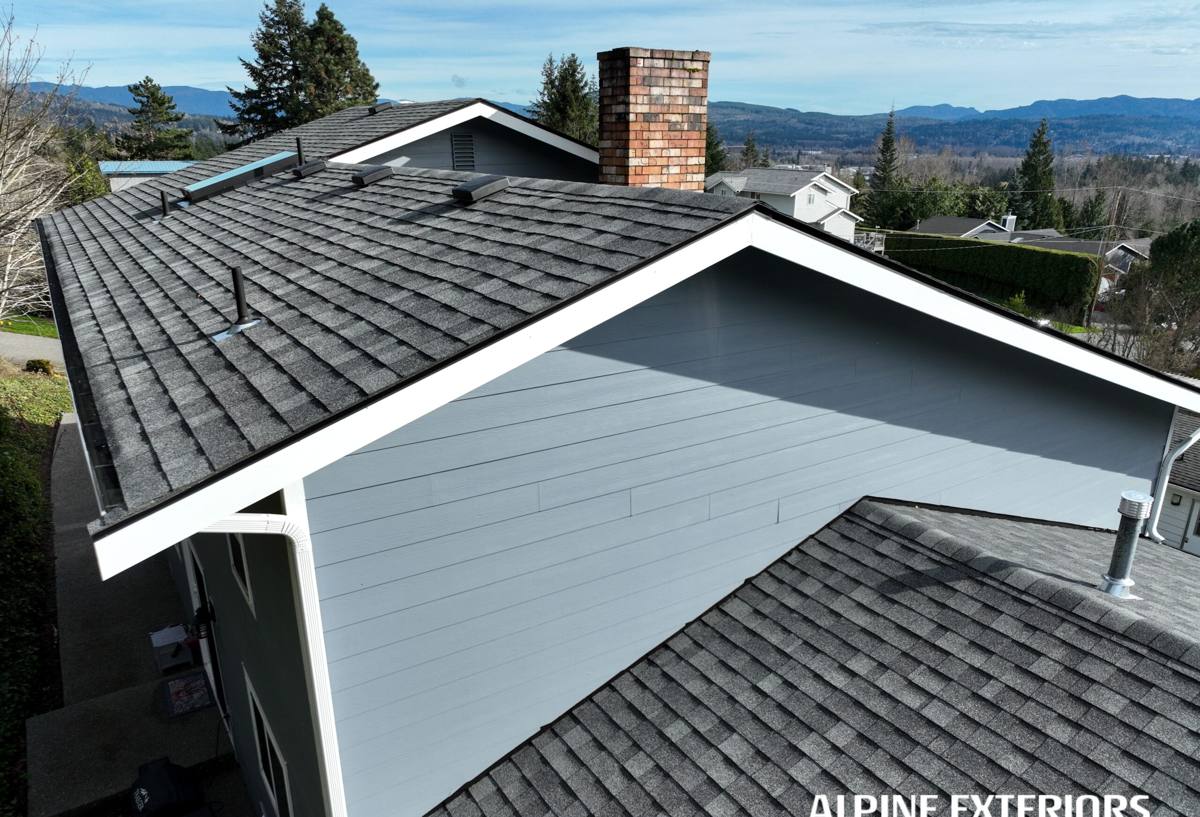
Why Metal Roofing Suits This Climate
Metal roofing isn't the right call for every home or every budget, but for Birchwood's conditions it solves several problems at once that other materials only partially address.
Moss and moisture resistance
Moss needs a rough, porous surface and consistent moisture to take hold. Standing-seam metal panels give it almost nothing to grip, and the smooth, sloped surface sheds water fast instead of holding it against a mat of granules or shingle tabs the way asphalt does. That doesn't mean a metal roof never sees moss or debris — north-facing slopes under overhanging trees still need occasional attention — but the growth is far slower to establish and far easier to remove without damaging the roofing material underneath.
Wind and driving rain
Storms coming off the Strait of Georgia and Bellingham Bay tend to bring rain sideways, not straight down. That's a real test for any roof's underlayment and flashing details, since wind-driven rain finds gaps that vertical rain never would. A correctly installed metal roof with properly lapped panels, sealed seams, and continuous underlayment handles that kind of weather better than most roofing systems, because water is directed off the surface quickly rather than given time to work its way under a lap joint.
Salt air and corrosion
This is the detail that gets overlooked most often. Not every metal roofing product is built for coastal-adjacent exposure, and not every fastener or flashing accessory is either. Bare or poorly coated steel, mismatched metals at flashing joints, and standard fasteners can all start showing corrosion within a few years in a salt-air environment. The fix isn't complicated, but it does require choosing the right coatings and hardware up front rather than treating every metal roof installation as identical regardless of where the house sits.
What a Correct Metal Roofing Job Involves
A metal roof is only as good as the assembly underneath it. The visible panels get all the attention, but the layers and details below them are what determine whether the roof performs for its expected lifespan or starts causing problems in five to ten years.
- Tear-off and deck inspection — checking the sheathing for soft spots, rot, or prior water damage before anything new goes down
- Ice-and-water shield or high-quality synthetic underlayment at eaves, valleys, and penetrations, sized for our rain volume, not a minimum-code amount
- Proper panel or shingle-style metal selection matched to the roof's slope and exposure
- Corrosion-resistant, coating-matched fasteners — not generic hardware pulled from a general supply bin
- Correctly lapped and sealed seams, with attention to wind-driven rain at low-slope sections
- Flashing at every valley, wall intersection, chimney, and vent — the single most common source of roof leaks regardless of material
- Balanced ventilation (intake at the eaves, exhaust at the ridge) so moisture doesn't collect in the attic space
- Gutter and downspout tie-in sized to actually keep up with our rainfall, not just meet a minimum spec
Skipping or shortcutting any one of these doesn't usually show up as a problem on install day. It shows up two, five, or ten years later as a leak, a corroded fastener streaking down a panel, or moisture damage in the attic — the kind of failure that's expensive to trace back to its actual cause.
Metal Roofing Options: What Fits Birchwood Homes
"Metal roofing" covers a range of products with different price points, appearances, and maintenance needs. Here's how the common options compare for this climate specifically.
| Type | Typical Look | Coastal/Moisture Performance | Maintenance |
|---|---|---|---|
| Standing seam panels | Clean vertical lines, concealed fasteners | Excellent — fewest exposed fastener points, best water-shedding | Low |
| Exposed-fastener panels | Ribbed, more affordable | Good, but fastener seals need periodic checking | Moderate — gaskets age and need eventual replacement |
| Metal shingles/shakes | Mimics wood shake or slate | Good, with more seams and laps than standing seam | Low to moderate |
| Stone-coated steel | Mimics tile or shake | Good, coating protects against moss and UV | Low |
For a house sitting closer to the bay or under heavy tree cover, we typically steer clients toward standing seam because of its fastener count alone — fewer penetration points mean fewer places for salt air and driving rain to find a way in over time. For homes further from direct salt exposure, exposed-fastener systems can be a reasonable way to get metal roofing's durability at a lower upfront cost, as long as the fastener gaskets are checked periodically.
Our Process for Birchwood Roofing Projects
Assessment and estimate
We start with a walk of the roof and attic, not just a look from the ground. That means checking current ventilation, deck condition, existing moss or moisture staining, and how exposed the roof is to prevailing wind and rain direction. From there we put together a written estimate that spells out material, underlayment, flashing, and ventilation scope — not a single lump-sum number with no breakdown.
Material selection
We'll walk through panel type, gauge, and coating options based on what we found during the assessment, factoring in how close the home is to the water and how much shade and moss pressure the roof deals with.
Installation
Tear-off, deck repair if needed, underlayment, panels, and flashing — done in that order, with flashing details getting the same attention as the panels themselves. We don't consider a metal roof finished until every valley, wall tie-in, and penetration is properly flashed and sealed.
Final walkthrough
We go over the finished roof with the homeowner, confirm ventilation is balanced, and make sure gutters and downspouts are tied in and clear before we consider the job done.
Why Local Experience Matters for This Job
Metal roofing installation isn't uniform across regions, and a crew that mostly works drier inland climates can make choices that are fine there and wrong here. Whatcom County's rain volume, Bellingham Bay's salt air, and Birchwood's tree cover all push toward specific decisions — heavier underlayment at eaves and valleys, coastal-rated fasteners, and ventilation sized for a wetter attic environment. A crew that already works this neighborhood has seen which details actually cause callbacks locally and builds around them from the start, instead of learning it on your roof.
We also know what existing Birchwood roofs tend to look like underneath — common deck conditions, typical prior roofing layers, and the kind of moss and moisture patterns that show up on homes with mature tree cover. That familiarity speeds up the assessment and helps us give an accurate estimate instead of a padded one built around uncertainty.
Maintaining a Metal Roof in This Climate
Metal roofing is lower-maintenance than asphalt or wood, but "lower-maintenance" isn't "no maintenance," especially here.
- Clear gutters and downspouts at least twice a year — fall leaf drop and late winter are the two times debris tends to build up fastest
- Rinse off any accumulated debris or moss growth on shaded slopes rather than letting it sit against the panel surface
- Have flashing and seams visually checked every couple of years, especially after a hard windstorm
- Watch for any streaking or discoloration at fastener heads, which can be an early sign of a coating or gasket issue worth addressing before it becomes a leak
None of this requires a specialist visit every season, but a quick annual look — either by the homeowner or as part of a gutter cleaning — catches small issues while they're still small.
Get a Straight Answer for Your Roof
Every Birchwood roof faces this climate a little differently depending on tree cover, slope orientation, and how close it sits to the water. If you're weighing metal roofing against a repair or replacement of what you have now, we're happy to take a look and give you a straightforward, no-pressure estimate — what your roof actually needs, what it would cost to do right, and why.