 Bellingham Siding
 Why Storms Hit Lynden Roofs Differently
Lynden sits inland in the Nooksack River valley, which spares it the direct salt air that coats roofs closer to Bellingham Bay and the Strait. That doesn't mean Lynden roofs get an easy ride. The open farmland and valley terrain around Lynden let wind move differently than it does in town — gusts funnel across exposed fields and hit roofs at angles that can drive rain sideways under shingle tabs, ridge caps, and flashing that would stay dry in a more sheltered setting. Add in a moss season that stretches from fall well into spring across Whatcom County, and a roof with no obvious storm damage can still be quietly losing ground under a mat of moss nobody's looked under in years.
Wind and driving rain
Wind-driven rain doesn't need a hole to get into a roof system — it just needs a lifted tab, a gap in flashing, or a nail that's backed out half an inch. Storms that come through the valley tend to hit roofs from a consistent direction, which is why we usually see damage concentrated on one or two slopes rather than spread evenly across the whole roof.
Moss season aftermath
Many Lynden properties sit on larger lots with mature fir, cedar, and maple trees, which keep roofs shaded and damp long after a storm passes — exactly the conditions moss needs. A storm can tear loose a moss mat that's been quietly holding moisture against the decking for a season or more, and what looks like storm damage on the surface is often storm damage revealing a moisture problem that was already there.
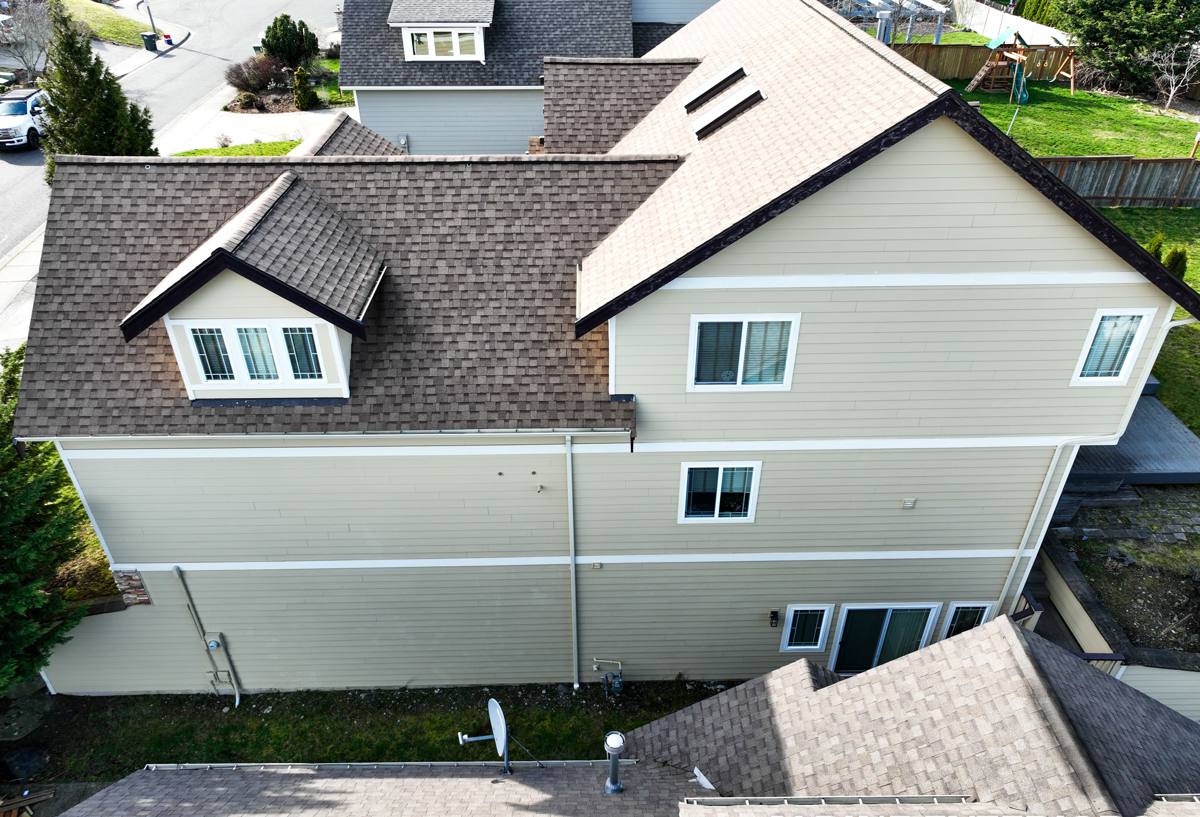
What Actually Counts as Storm Damage
Not every roof problem after a storm is storm damage in the insurance or repair sense, and it's worth knowing the difference before you call anyone out.
- Shingles that are torn, creased, or missing entirely, usually on the windward slope
- Flashing around chimneys, vents, and skylights that's been bent, lifted, or pulled away from its seal
- Concentrated granule loss from hail impact or wind-driven debris, not the gradual thinning you'd expect from age
- Gutters or downspouts torn loose or crushed, which backs water up under the roof edge instead of away from it
- Cracked or punctured decking from a falling limb
- Moss mats torn loose by wind, exposing decking that's been softening underneath for longer than anyone realized
The last one is the trickiest, because homeowners often assume the storm caused all the damage they see, when the storm actually just uncovered damage that moss and moisture had already started.
What a Correct Repair Actually Involves
A storm repair that only replaces the shingles you can see from the ground is a patch, not a repair. Doing it correctly means checking what's underneath before anything goes back on the roof.
Decking and underlayment first
Once damaged shingles are pulled, the decking underneath gets checked for soft spots, delamination, or rot — not assumed to be fine because it's not visibly sagging. Underlayment gets inspected too, since a torn or saturated underlayment defeats the point of putting new shingles on top of it.
Matching materials, not just covering the gap
We try to match your existing shingle brand, line, and color as closely as it's still available. A mismatched patch doesn't just look off — different shingle profiles can shed water slightly differently at the seams, which matters more on a valley or hip than it does on a flat run.
Flashing done right, not caulked over
Bent or lifted flashing gets reinstalled and properly integrated with the shingle courses around it, not just resealed with a bead of caulk. Caulk is a short-term fix that tends to fail again within a season or two, especially with the amount of driving rain this area sees.
Repair Approaches Compared
Not every storm-damaged roof needs the same scope of work. The right approach depends on how widespread the damage is and how much life is left in the rest of the roof.
| Approach | Best for | What it doesn't fix | Cost factor |
|---|---|---|---|
| Spot patch | Isolated damage — a few shingles, one flashing point | Underlying moss or moisture issues elsewhere on the roof | Lowest |
| Full slope repair | Damage concentrated on one wind-exposed slope | Age-related wear on slopes that weren't hit | Moderate |
| Full replacement | Roofs already near end of life, or with widespread moss/rot damage the storm exposed | Nothing structural, but it's a bigger upfront decision | Highest, but resets the clock |
We'll tell you honestly which category your roof falls into rather than defaulting to the most expensive option. A lot of storm calls end up being spot patches, and we say so.
Our Process for Lynden Storm Repairs
- You call or send photos, and we schedule an inspection — ideally within a few days of the storm, before more rain gets under any lifted shingles
- We inspect the full roof, not just the area you noticed damage on, since wind damage often extends past what's visible from the ground
- We document everything with photos, including decking and flashing condition once shingles are pulled back
- You get a written scope of repair with a clear cost range, not a verbal number that changes later
- If you're filing an insurance claim, we can walk the roof with your adjuster or provide documentation they can work from
- We complete the repair, matching materials where possible, and clean up debris and old material before we leave
Working With Your Insurance Adjuster
If the damage is significant enough to file a claim, the paperwork matters as much as the repair itself. We document what we actually find — no exaggerating scope to inflate a claim, and no downplaying real damage to save time. Adjusters generally respond well to a contractor who shows up with clear photos and a specific scope rather than a vague estimate. If your policy or adjuster has questions about matching materials or code-required upgrades, we can speak to that directly since we're the ones who'll be doing the work.
Moss, Trees, and Long-Term Roof Health in Lynden
A storm repair is a good moment to deal with the conditions that made the damage worse in the first place. If moss was part of what the storm exposed, we'll talk through options like zinc or copper strips near the ridge, which reduce future moss growth as rainwater runs over them, and whether nearby tree limbs should be trimmed back to cut down on both debris and the shade that keeps a roof damp. None of this is required, but skipping it usually means dealing with the same moss problem again in a year or two.
Gutters matter more than people think
A gutter system that's clear and properly pitched moves storm water off the roof edge instead of letting it back up under the shingles. If your gutters took damage in the same storm, it's worth addressing at the same time rather than as a separate call later.
Checklist: What to Do After a Storm
- Walk the yard and check for shingle pieces, granules, or flashing on the ground — a sign of what's missing on the roof
- Look at the roof from the ground with binoculars rather than climbing up yourself
- Check inside the attic or top-floor ceilings for new water stains, especially after driving rain
- Photograph any visible damage right away, including debris in the yard, in case you need it for a claim
- Clear gutters and downspouts if it's safe to do from the ground so water isn't backing up while you wait for an inspection
- Call for an inspection sooner rather than later — a small lifted shingle becomes a bigger repair after a few more rounds of rain
Why a Crew That Already Works in Lynden Matters
Storm damage repair rewards local familiarity. A crew that already works in Lynden knows the difference between the older homes near the city center and the newer builds on larger rural lots at the edges of town, and how roof age, pitch, and tree cover tend to line up with each. That familiarity also means faster response after a storm, since we're not routing a crew in from somewhere else in Whatcom County first. Permitting works a little differently depending on whether a property falls inside city limits or unincorporated county land, and knowing which applies before we start avoids delays once work is underway.
Whatcom County sees enough wind and rain events that most local roofers have seen a wide range of storm damage — but the pattern in an open valley town like Lynden is genuinely different from what shows up on a roof a few miles away in Bellingham. Treating it that way, instead of applying a one-size approach, is what gets the repair done correctly the first time.
Get a Straight Answer on Your Roof
If a recent storm left you with lifted shingles, a leak, or just a nagging feeling that something's not right up there, it's worth getting a real inspection before the next round of rain makes it worse. We'll give you an honest read on what happened, what it'll take to fix it, and what it won't cost you — no pressure, no upsell. Use the form below to request a free estimate.