 Bellingham Siding
 Siding That Actually Holds Up in Lynden
Lynden sits far enough inland to escape some of the worst coastal weather, but it still gets the full Whatcom County treatment: long stretches of driving rain off the Pacific, damp air that lingers into the growing season, and enough shade and moisture on the north side of most lots to keep moss and algae established year-round. Add in the salt-tinged air that rides in off Bellingham Bay and the Strait, and you've got a climate that is genuinely hard on exterior building materials. Siding here isn't just cosmetic — it's the first line of defense against moisture intrusion, and the wrong product or a sloppy install shows its age fast.
We install James Hardie fiber cement siding exclusively. Not because it's the only decent product on the market, but because after years of servicing homes in this specific climate, it's the one system we're willing to stand behind without hedging. This page covers what a Lynden home actually needs from its siding, what correct installation looks like, and how we run the job from estimate to cleanup.
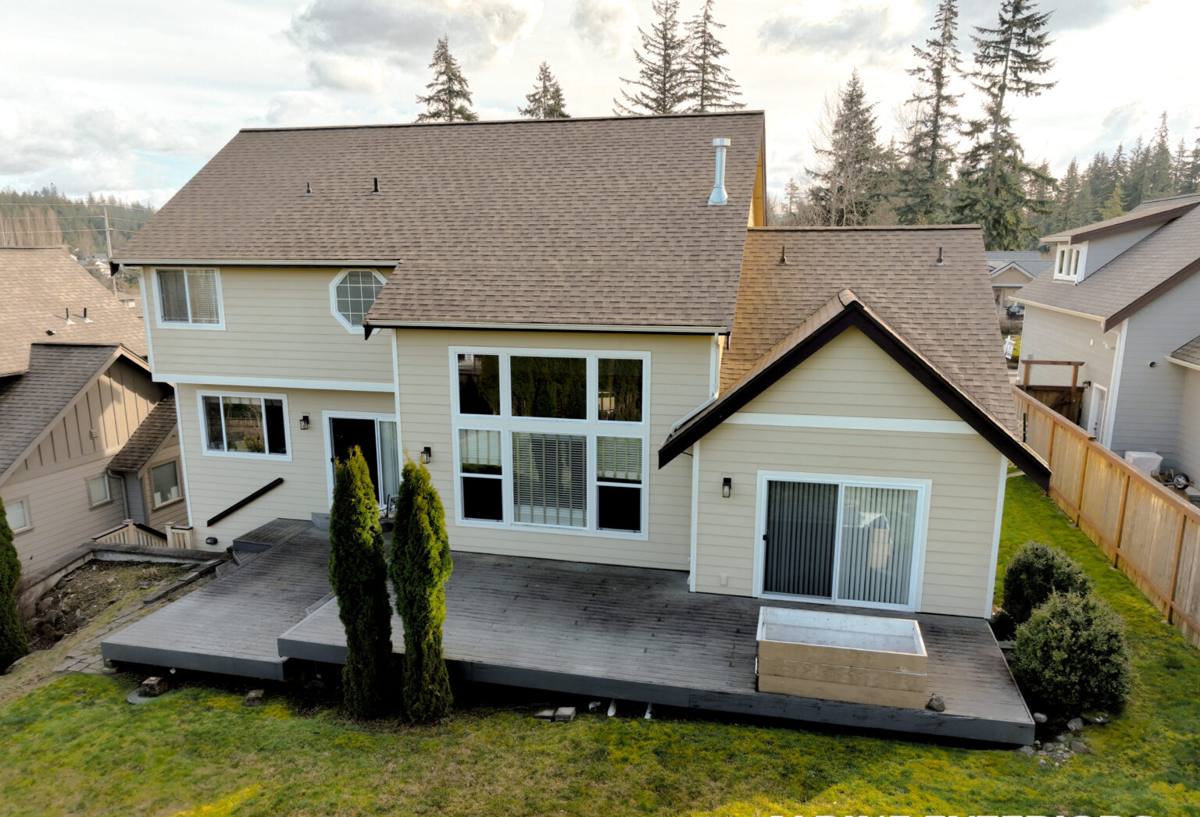
What Lynden's Climate Does to Siding Over Time
Moisture Load
Whatcom County gets a long wet season, and Lynden's mix of open farmland and tree-lined residential lots means houses see both wind-driven rain and prolonged damp shade depending on orientation. Siding that can't manage bulk water at the seams, or that swells and holds moisture in the substrate, ends up with soft spots, paint failure, and eventually rot in the wall assembly behind it — often before it's visually obvious from the street.
Moss and Algae
North- and east-facing walls, anything shaded by mature trees or a neighboring structure, and lower courses near landscaping all stay damp longer after a rain. That's exactly where moss and green algae staining take hold on porous or textured surfaces. It's mostly a maintenance and appearance issue, but on materials with a poor factory finish it can accelerate coating breakdown over the years.
Salt Air
Lynden is inland compared to Bellingham's waterfront, but salt-laden air still moves through the Nooksack valley and settles on building surfaces, especially with prevailing westerly winds. Salt exposure is harder on unprotected fasteners and lower-grade coatings than most homeowners expect — it's a slow, cumulative effect rather than a dramatic one.
Freeze-Thaw Cycling
Whatcom County's winters aren't brutal, but Lynden does see enough freeze-thaw swings to stress any siding material that absorbs water. Repeated freezing of trapped moisture is one of the more common ways marginal siding installations fail at the seams and cut edges over a five-to-ten-year window.
Why We Standardized on James Hardie for This Area
James Hardie fiber cement is engineered specifically around moisture and climate performance, which is the exact set of problems Lynden homes face. A few specifics that matter locally:
- Non-combustible core — fiber cement doesn't feed a fire the way wood-based products can, which matters given wildfire smoke seasons are becoming a regular part of the Pacific Northwest summer.
- HZ5 engineered product line — Hardie's HZ5 formulation is built for climates with prolonged moisture exposure and freeze-thaw cycling, which describes Whatcom County well.
- ColorPlus factory finish — a baked-on, multi-coat finish applied under controlled conditions, which resists the fading and moss-holding texture breakdown you get with field-applied paint over time.
- Dimensional stability — fiber cement doesn't swell and contract with moisture the way wood or wood-composite products do, so seams and fastener lines stay tighter longer.
- Transferable warranty — a real factor for resale in a market like Lynden, where a chunk of buyers are evaluating exterior condition and remaining product life as part of the offer.
We used to quote whatever a homeowner asked for. We stopped installing vinyl, LP SmartSide, Cemplank, Allura, and primed wood species like spruce or cedar as our standard offering — not because every one of those products is bad, but because we got tired of watching a subset of them underperform in this specific climate and then eating the callback. Standardizing on one product line we trust means we can also standardize our installation detailing around it, which is where a lot of siding failures actually originate.
What Correct Installation Involves
Fiber cement siding is only as good as the install behind it. Hardie's own installation instructions are specific for a reason — deviating from them is the single biggest cause of premature failure, callbacks, and voided warranty claims we see when we're called in to fix someone else's work.
Before the Siding Goes On
- Inspect and repair any existing sheathing or framing damage — you don't cover up rot, you fix it first.
- Install a code-compliant water-resistive barrier (weather barrier) over the sheathing, lapped correctly from bottom to top.
- Flash every window, door, and penetration so water sheds outward and down, never behind the barrier.
- Maintain proper clearance between the siding's bottom edge and grade, decks, roof lines, and other horizontal surfaces — this single detail prevents most of the moisture-wicking failures we see.
During Installation
- Fasten per Hardie's specification for the exposure and product type — over- or under-driven nails both cause problems down the road.
- Maintain correct joint gaps and use the specified joint treatment so panels can move slightly without cracking the finish.
- Field-cut edges get sealed or primed per spec — an exposed raw edge is a moisture entry point waiting to happen.
- Caulk only where Hardie's details call for it — over-caulking traps moisture just as reliably as under-caulking lets it in.
Finish Details
- Trim, corners, and transitions get treated as part of the water management system, not as an afterthought.
- Touch-up paint matched to the ColorPlus system only where the manufacturer allows it, so the factory finish warranty isn't compromised.
Our Process for a Lynden Job
- On-site walkthrough — we look at your current siding, sheathing condition where accessible, drainage patterns around the foundation, and problem areas like north-facing walls or heavy tree shade.
- Written estimate — product line, color, trim details, and a clear scope, so you know exactly what's being installed and why.
- Tear-off and inspection — removing old siding lets us actually see the sheathing and framing underneath instead of guessing.
- Repair before cover — any rot, soft sheathing, or damaged framing gets addressed and documented before new siding goes up.
- Barrier and flashing — the weather-resistive barrier and flashing details go in correctly, since this is the layer that does the real waterproofing work.
- Hardie installation — installed to manufacturer spec, with the fastening, clearances, and joint details that keep the warranty valid.
- Final walkthrough — we go over the finished work with you before calling the job done.
Comparing Siding Options for This Climate
| Factor | James Hardie Fiber Cement | Vinyl | Wood / Engineered Wood |
|---|---|---|---|
| Moisture response | Dimensionally stable, doesn't swell | Doesn't absorb water, but can warp/buckle with heat and poor install | Absorbs moisture, prone to swelling and rot at edges |
| Moss/algae resistance | Factory finish resists staining longer | Smooth surface, moss less likely to grip but still occurs | Textured surface holds moisture, moss-prone |
| Fire performance | Non-combustible core | Combustible, can melt/deform under heat | Combustible |
| Finish longevity | Baked-on ColorPlus finish, long fade resistance | Color molded through, but can fade and chalk | Field-applied paint or stain, needs recoating |
| Install sensitivity | Moderate — must follow manufacturer spec | Low — but poor install still causes issues | High — moisture management is critical |
Signs Lynden Homeowners Should Watch For
- Soft or spongy spots when you press on the siding, especially near the bottom courses or under windows
- Persistent moss or dark streaking that comes back quickly after cleaning
- Paint that's peeling, bubbling, or chalking heavily rather than just fading evenly
- Visible gaps, warping, or buckling panels, particularly after a stretch of heavy rain or a hot spell
- Rising energy bills that might point to a compromised weather barrier behind the siding
- Nail pops or fastener staining, which often signals a fastening or moisture issue underneath
Any one of these is worth a closer look before it turns into a sheathing or framing repair.
Why Hire a Crew That Already Works This Area
Lynden's mix of open agricultural land, mature residential neighborhoods, and proximity to the Nooksack River floodplain means drainage and moisture patterns vary block to block in ways a crew unfamiliar with the area won't necessarily catch on a first walkthrough. A contractor who regularly works Whatcom County knows which orientations tend to hold moss, which lots have drainage quirks, and how the local weather pattern actually behaves across the seasons — not just what a spec sheet says in theory.
There's also a practical side: a crew based near Bellingham and working Lynden regularly can respond quickly if a warranty question or minor issue comes up after the job, instead of you waiting on someone who has to travel in from out of the area.
Get a Straight Answer for Your Home
If your siding is showing its age, or you're just trying to figure out whether repair or full replacement makes more sense, we're happy to take a look and give you a straightforward assessment — no pressure, no upsell to a product we don't believe in. Request a free estimate using the form below and we'll get you scheduled.