 Bellingham Siding
 Edgemoor's Climate Puts Real Demands on Siding
Edgemoor sits on the bluffs and shoreline above Bellingham Bay, and that setting cuts both ways. The views are part of what makes the neighborhood, but the same water that makes the setting is also what wears down exterior siding faster than it would a few miles inland. Salt-laden air off the bay works into seams, fasteners, and any exposed wood fiber over time. Add Whatcom County's long wet season — driving rain that comes in sideways off the Strait, months of low sun angle, and a tree canopy that keeps a lot of Edgemoor's lots shaded and damp well into what would be "dry season" elsewhere — and you get a climate that's genuinely tough on siding.
None of this is unique to Edgemoor, but the combination is more pronounced here than in drier, more open parts of Bellingham. Homes tucked under mature trees stay damp longer after a storm. Homes closer to the water pick up more salt exposure. A lot of Edgemoor properties get both at once, which is exactly the kind of environment where the wrong siding material — or the right material installed poorly — starts showing problems years before it should.
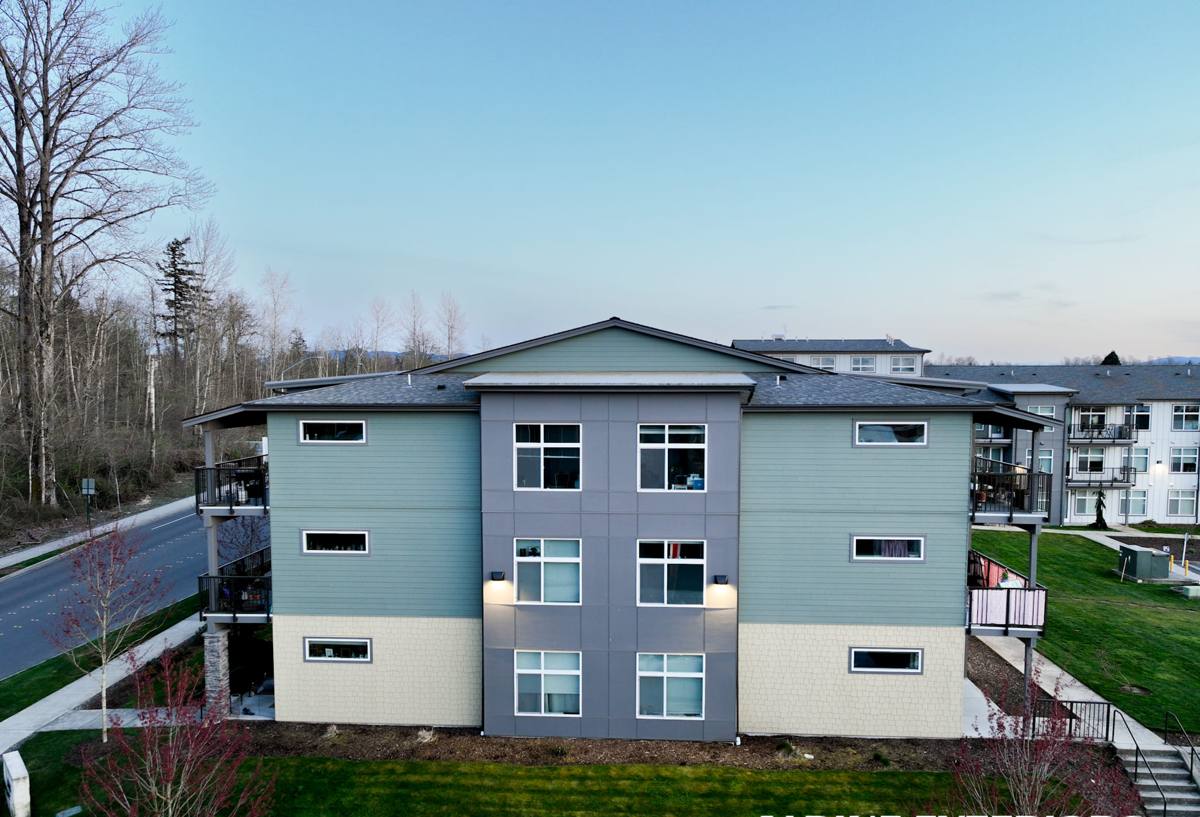
What Edgemoor Homes Specifically Need From Their Siding
Given that setup, siding on an Edgemoor home has a specific job to do. It needs to:
- Shed driving rain without letting moisture track behind the cladding into the wall assembly
- Resist salt-air corrosion at fasteners, trim, and butt joints
- Dry out reasonably fast after a storm, even on a shaded, north-facing wall
- Hold paint or factory finish through repeated wet-dry cycles without failing at the seams
- Discourage the moss and algae growth that Whatcom County's damp, shaded lots are famous for
That last point matters more here than in most Bellingham neighborhoods. Heavy tree cover keeps siding surfaces shaded and slow to dry, which is exactly the environment moss and algae need to take hold. Siding that holds moisture at the surface — through a porous finish, absorbent substrate, or failed caulk joints — gives moss something to grip. Siding that sheds water and dries quickly gives it nothing to work with.
Why We Install Only James Hardie Fiber Cement
We install James Hardie siding exclusively — not vinyl, not LP SmartSide, not Cemplank or Allura, not primed spruce or cedar. That's a deliberate standard, not a limitation in what we're capable of installing. Fiber cement handles the specific stresses Edgemoor throws at siding better than the alternatives, and James Hardie is the manufacturer whose product line, factory finish, and warranty structure we trust enough to put our name behind.
A few reasons that standard holds up:
- Non-combustible core. Hardie's fiber cement doesn't feed a fire the way wood-based or vinyl products can, which matters both for insurance conversations and for straightforward peace of mind.
- ColorPlus factory finish. The color is baked on at the factory under controlled conditions, rather than field-applied. That finish holds up to UV and moisture cycling far longer than site-applied paint, which means fewer repaints over the life of the siding.
- Climate-engineered product lines. Hardie doesn't sell one generic board everywhere — it engineers different formulations for different climate zones, which matters a lot in a place like ours.
- A warranty that's actually transferable. That matters in a neighborhood like Edgemoor where homes change hands and buyers care about documented exterior condition.
We're not going to tell you vinyl or LP SmartSide are junk — both have legitimate uses. But we've made the call that on Bellingham exteriors, especially in a demanding microclimate like Edgemoor's, fiber cement done right is the product that holds up with the least maintenance drama over the decades homeowners actually keep their siding.
The Alternatives, and Why We Passed on Them
LP SmartSide is a wood-strand product with a resin-saturated overlay — it performs reasonably well when detailing is perfect, but any breach at a cut edge, fastener, or joint gives moisture a path into wood fiber, and wood fiber that stays wet in a shaded, salt-air environment is a slow-motion problem. Vinyl is low-maintenance in the sense that it doesn't need painting, but it expands and contracts significantly with temperature, can crack in impact, and doesn't offer the same fire performance. Cedar is a beautiful, legitimate material, but it demands an ongoing maintenance commitment — staining or sealing on a real schedule — that most homeowners underestimate until the siding starts showing it. In a neighborhood with this much shade and this much moisture, that maintenance gap shows up faster than it would elsewhere.
HardieZone HZ5: Engineered for Weather Like Ours
James Hardie makes region-specific formulations under its HardieZone system, and homes in the Pacific Northwest fall under the HZ5 designation — engineered for wetter, cooler climates rather than the hot, arid formulations sold in the Southwest. HZ5 product is built with moisture behavior in mind from the start: the core composition and the way the boards handle wet-dry cycling are matched to a climate that looks a lot like Whatcom County's, not a generic national spec.
That matters more than it might sound like on paper. Fiber cement engineered for a dry climate can behave differently under sustained damp exposure than fiber cement engineered for a wet one. Installing the wrong regional formulation, or installing correctly-specified HZ5 product with detailing meant for a drier climate, is one of the more common ways a Hardie installation underperforms. Getting this right starts before a single board goes up — it's a specification decision, not just an installation one.
What a Correct Installation Involves
Fiber cement is only as good as the installation behind it. Most of the siding failures we get called out to inspect in this region aren't material failures — they're installation shortcuts that let water get where it shouldn't.
Water-Resistive Barrier and Flashing
Everything starts with what's behind the siding, not the siding itself. A continuous water-resistive barrier, properly lapped and taped, combined with correct flashing at every window, door, deck ledger, and roof-to-wall intersection, is what actually keeps a wall assembly dry when driving rain hits it. On a home like the ones in Edgemoor, where wind-driven rain off the bay is a real and recurring load, this layer is doing more work than the visible siding is.
Clearance, Fastening, and Caulking
James Hardie specifies minimum clearances from grade, roof lines, and decks for a reason — siding installed too close to the ground or to a horizontal surface stays wet longer and picks up splash-back moisture and debris that feeds moss growth. Fastener pattern and type matter too: the wrong nail, the wrong spacing, or fasteners driven at the wrong angle can crack boards or create moisture entry points that don't show up until years later. And any field-cut edge needs to be primed and sealed — an unsealed cut edge is one of the most common places we see fiber cement start absorbing moisture it was never designed to take on.
James Hardie vs. the Alternatives, Side by Side
| Factor | James Hardie HZ5 | Vinyl | LP SmartSide | Cedar |
|---|---|---|---|---|
| Moisture behavior | Engineered for wet climates; dries at a stable, predictable rate | Doesn't absorb, but traps moisture behind it if installed tight | Wood-based core vulnerable at any breached edge or fastener | Absorbs and releases moisture readily; needs a maintained finish to manage it |
| Salt air / coastal exposure | Fiber cement composition resists corrosion-driven breakdown | Can become brittle over time with UV and temperature swings | Salt-laden moisture accelerates wood fiber breakdown at weak points | Weathers naturally but finish fails faster near salt air |
| Fire performance | Non-combustible core | Melts/deforms under heat; can contribute to fire spread | Wood-based; combustible | Combustible |
| Finish & maintenance | Factory ColorPlus finish; long intervals between repaints | No paint needed, but color can fade unevenly | Field-applied or factory overlay; edges need ongoing attention | Requires regular staining/sealing to perform as intended |
| Moss & algae resistance | Dense, low-porosity surface sheds water and dries quickly | Sheds water but seams and J-channel trap organic debris | Textured surface can hold moisture and organic growth | Rough grain holds moisture; prone to moss in shaded settings |
This isn't a claim that every alternative is unusable — it's why, weighing all of it against Edgemoor's specific conditions, we standardized on Hardie and stopped installing the rest.
Our Process for an Edgemoor Project
Every home is different, but the sequence we follow doesn't change:
- On-site assessment. We look at sun and shade exposure, tree cover, proximity to the water, existing wall assembly, and any signs of past moisture intrusion before we talk product or price.
- Tear-off and substrate check. Removing the old siding tells us the real story — whether sheathing needs repair, whether prior flashing was done correctly, whether there's hidden rot that needs to be addressed before anything new goes up.
- Water-resistive barrier and flashing. This gets installed and inspected before a single piece of Hardie goes on the wall — it's the layer that actually keeps the house dry.
- HZ5 James Hardie installation. Correct clearances, correct fastening, sealed cut edges, and manufacturer-specified detailing at every penetration.
- Final walkthrough. We go over caulking, trim, and finish details with you before calling the job done, not after.
Living With Hardie Siding Through Bellingham's Moss Season
Correctly installed Hardie siding is genuinely low-maintenance, but "low-maintenance" doesn't mean "zero-attention" in a neighborhood with this much shade and moisture. A little seasonal upkeep goes a long way toward keeping it looking the way it did on day one:
- Rinse siding down once or twice a year, especially on shaded or north-facing walls, to keep organic buildup from getting a foothold
- Keep gutters clear so overflow isn't running down the siding face during heavy rain
- Trim back branches and foliage that keep a wall surface shaded and damp longer than it needs to be
- Check caulking at trim and joints every couple of years and touch it up before a gap turns into a moisture path
- Have any impact damage or cracked boards repaired promptly rather than left through another wet season
None of this is a heavy lift, but skipping it in a climate like ours is how even good siding starts to look tired early. The point of installing Hardie correctly in the first place is to make that seasonal upkeep the only thing you ever have to think about.
Why Hiring a Crew That Already Works Edgemoor Matters
A lot of what determines how well siding performs here has nothing to do with the product and everything to do with whether the installer understands the site conditions before they start. A crew that's worked Edgemoor's shaded, bluff-top lots knows to look harder at moisture history on north-facing walls, knows how much clearance to build in near mature trees, and knows what wind-driven rain off the bay actually does to a wall assembly that isn't detailed for it. That's the kind of judgment that doesn't come from a spec sheet — it comes from having already done the work in this exact setting.
If you're weighing a siding project on an Edgemoor home, we're happy to walk the property, look at what's there now, and talk through what a correct James Hardie installation would involve for your specific home — no pressure, no obligation. Use the form below to request a free estimate.