 Bellingham Siding
 Deck Repair Built for Happy Valley's Climate
Happy Valley sits close enough to Bellingham Bay and the surrounding hillside tree cover that decks here take a specific kind of beating. Salt-tinged air off the water accelerates corrosion on fasteners and hardware, driving rain gets pushed sideways into ledger boards and stair stringers, and the tree canopy that makes the neighborhood pleasant also means shade, damp leaf litter, and a long moss season that keeps deck surfaces wet for months at a stretch. None of that is unusual for Whatcom County, but it adds up faster on a deck than on almost any other part of a house, because a deck is horizontal, exposed on all sides, and built mostly from wood or wood-composite materials that were never meant to sit in standing water.
We work on decks throughout Bellingham, and Happy Valley's mix of older single-family homes and mature landscaping means we see a consistent pattern: decks that looked fine from a distance but had real structural problems underneath once we got a screwdriver into the framing. This page walks through what we actually check, what a proper repair involves, and how to tell a real fix from a cosmetic one.
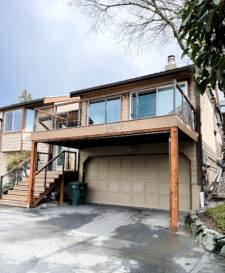
Why Decks Fail Faster in This Part of Bellingham
Moisture That Doesn't Dry Out
A deck in full sun sheds rainwater and dries between storms. A deck under tree cover, or on the shaded side of a house, can stay damp for days after the rain stops. In Happy Valley's tree-lined lots, that shade is common, and it's the single biggest reason we see rot and moss buildup on decks that are otherwise well-built.
Moss and Algae Aren't Just Cosmetic
Moss holds moisture directly against the wood or composite surface, which keeps the boards wet far longer than open air would. On wood decking, that constant dampness is what starts rot at the board's core, not just the surface. On composite decking, moss and algae buildup in the grain pattern can also make the surface dangerously slick, which is a safety issue independent of any structural concern.
Salt Air and Hardware Corrosion
Bellingham's proximity to the bay means homes closer to the water deal with a mild but steady salt content in the air. Over years, that corrodes lower-grade fasteners, joist hangers, and railing hardware faster than it would inland. We've opened up decks where the decking boards looked serviceable but the hidden hardware underneath had rusted to the point of losing real holding strength.
Freeze-Thaw Cycling
Whatcom County doesn't get brutal winters, but it gets enough freeze-thaw cycling that water trapped in a crack or a fastener hole expands and contracts repeatedly. That's how a small surface crack in a board becomes a split, and how a loose connection becomes a failed one.
What a Proper Deck Repair Inspection Covers
Before we quote a repair, we look at the whole system, not just the board you're worried about. A deck is only as sound as its weakest connection, and most of those connections are hidden.
- Ledger board attachment to the house — the single most safety-critical connection on most decks
- Joist and beam condition, checked by probing for soft spots, not just a visual look
- Post bases and footings for movement, rot, or inadequate ground contact
- Railing posts and connections, since these take direct lateral load from people leaning on them
- Stair stringers and treads, which see concentrated foot traffic and flex
- Fastener and hardware condition, including hidden joist hangers and bolts
- Surface board condition — cupping, splitting, soft spots, and moss or algae coverage
- Drainage and grading underneath the deck, which affects how fast the structure dries out
We probe suspect areas with an awl or screwdriver rather than relying on how a board looks. Wood can look weathered but sound, or look fine on the surface and be soft an inch below. The only way to know is to check.
Common Repairs We Handle
Rotted or Soft Board Replacement
Individual board replacement is usually the least invasive repair, but it's only a real fix if we also check the joist underneath the failed board. Rot rarely stays contained to one piece of wood — if a decking board failed from sustained moisture, the framing member under it has usually been exposed to the same conditions.
Ledger Board and Flashing Repair
The ledger board — where the deck attaches to the house — is the most common source of hidden water damage because it's a horizontal wood member bolted directly to the building, often without adequate flashing to shed water away from the house framing. If flashing is missing, damaged, or was never installed correctly, water works its way behind it and rots both the ledger and the rim joist of the house itself. This is not a repair to defer.
Railing and Guard Repair
Loose or wobbly railings are a safety issue, not a cosmetic one. We check post attachment down to the framing, not just whether the railing itself is tight, since a railing can feel solid at the top rail while its post connection underneath has failed.
Stair Repair
Stairs take more repeated stress than any other part of a deck. We look at stringer condition, tread attachment, and whether the stair structure has separated from the main deck frame over time.
Fastener and Hardware Replacement
Where we find corroded nails, screws, or joist hangers, we replace them with hardware rated for exterior and, where relevant, coastal-adjacent exposure. Using the same low-grade fasteners that failed the first time just resets the clock on the same problem.
Moss and Surface Treatment
Beyond structural repair, we clean and treat surfaces to remove moss and algae buildup and address the drainage or shade conditions contributing to it where that's practical. This isn't a substitute for structural repair, but it does slow how fast the problem comes back.
Repair vs. Replacement: How We Decide
Not every deck needs a full rebuild, and we don't default to recommending one. The honest answer depends on how much of the structure is still sound.
| Condition | Typical Approach | Why |
|---|---|---|
| Isolated soft boards, framing underneath is sound | Board replacement | Localized issue, no structural risk elsewhere |
| Rotted ledger board or missing flashing | Ledger repair/rebuild | Safety-critical connection; can't be patched partially |
| Widespread soft framing across multiple joists | Partial or full reframe | Individual board fixes won't address the underlying structure |
| Deck is structurally sound but surface is worn or mossy | Cleaning, treatment, selective board swap | Cosmetic and moisture-management issue, not structural |
| Original construction is decades old with outdated hardware and undersized framing | Full rebuild | Bringing it up to current standards board-by-board often costs more than a rebuild |
We'll tell you plainly which category your deck falls into, and we won't recommend a full rebuild when a targeted repair will genuinely hold up.
Our Process
- On-site inspection, including probing suspect areas and checking hidden connections, not just a walk-around
- Written explanation of what we found, in plain terms, including photos of anything hidden or hard to see
- A clear scope and price range before any work starts — no open-ended time-and-materials guessing on repair work
- Repair work, with attention to matching existing materials where that matters for appearance and structural compatibility
- A final walkthrough so you can see and understand what was fixed and why
We don't upsell repairs you don't need. If a deck needs one railing post reset and two boards replaced, that's the quote — we're not going to talk you into a rebuild to pad the job.
Why Local Experience in Happy Valley Matters
A deck repair crew that mostly works dry, sunny climates can miss the specific failure patterns that show up here. Knowing that Bellingham's tree-shaded lots keep decks wet longer, that hardware near the bay corrodes faster than the manufacturer's generic warranty assumes, and that moss isn't just an aesthetic nuisance but an active contributor to rot changes what we check and how we prioritize a repair. We've worked on enough decks in this part of Whatcom County to know where the problems tend to hide, which saves you from paying for an inspection that only looks at what's visible from the yard.
We're also familiar with the practical side of working in established neighborhoods like Happy Valley — mature trees and landscaping close to the structure, driveway and access considerations, and being respectful of a quiet residential area while work is underway.
Maintaining Your Deck Between Repairs
A few habits go a long way toward slowing the moisture and moss cycle that drives most of the repairs described above:
- Sweep leaves and debris off the deck surface regularly, especially in fall and under tree cover
- Keep gutters and downspouts near the deck clear so runoff isn't dumping directly onto or under it
- Check railing posts for movement once or twice a year by hand
- Address moss buildup before it spreads across the whole surface, not after
- Have the ledger board and flashing checked periodically, since it's the connection most likely to hide a serious problem
None of this replaces a professional inspection, but it does reduce how often you need one.
Get an Honest Look at Your Deck
If your deck has soft spots, a wobbly railing, persistent moss, or you just haven't had it checked in a few years, we're happy to take a look and give you a straight answer — repair, partial rebuild, or full replacement, whichever it actually is. Reach out for a free, no-pressure estimate using the form below.