 Bellingham Siding
 Siding Built for Columbia's Corner of Bellingham
Columbia is one of Bellingham's older, established neighborhoods, and that shows in the housing stock: a mix of early-to-mid-20th-century homes alongside later infill, many sitting under mature tree canopy on lots that stay shaded and damp for long stretches of the year. That combination — older wall assemblies, tree cover, and closeness to Bellingham Bay — puts a specific kind of stress on exterior siding that a generic product recommendation doesn't account for.
Whatcom County's marine climate means Columbia homes deal with three things at once: salt-laden air moving in off the bay, wind-driven rain that hits walls sideways rather than falling straight down, and a moss season that can stretch from early fall well into spring. Any siding installed here has to handle all three, not just resist rain in the abstract.
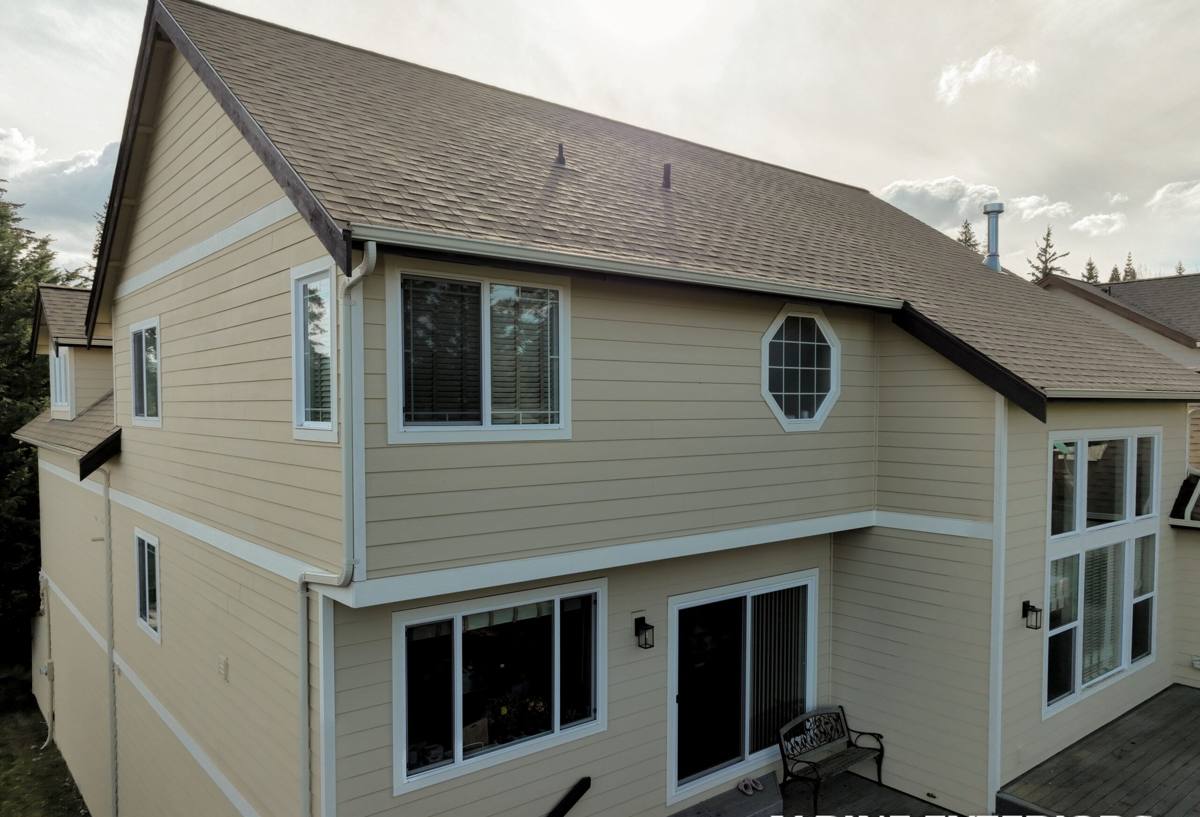
What Salt Air, Driving Rain, and Moss Actually Do to Siding
Salt Air Attacks Hardware and Finishes
Salt air is corrosive to exposed metal — fasteners, flashing edges, and hardware — and it accelerates the breakdown of lower-quality paint finishes over time. On a home a few miles from the water, that's a slow, cumulative problem rather than a dramatic one, which is exactly why it gets ignored until a wall assembly is already compromised.
Driving Rain Finds the Gaps
Wind-driven rain doesn't behave like a gentle shower running down a wall. It gets pushed sideways and upward into laps, seams, and anything cut into the siding field — window and door penetrations, hose bibs, light fixtures. A siding system that's only detailed for straight-down rain will eventually let water behind it on a west- or south-facing wall.
Moss Doesn't Just Sit on Top
A long moss season means more time with siding surfaces staying damp, especially on shaded walls facing mature trees, which is common throughout Columbia. Moss and algae growth on a wall surface isn't just cosmetic — it holds moisture against the siding longer than it would otherwise sit there, which matters most for any material that can absorb water or swell at cut edges.
Why We Install Only James Hardie Fiber Cement
We standardized on James Hardie fiber cement siding and don't install vinyl, LP SmartSide, Cemplank, Allura, primed spruce, or cedar. That's not a marketing position — it's a decision based on what actually holds up, wall after wall, in a climate like this one.
Vinyl siding is inexpensive and low-maintenance in mild climates, but it expands and contracts significantly with temperature swings, its seams rely on overlap rather than a sealed joint, and it's more prone to cracking on impact as it ages — none of which pairs well with wind-driven rain testing every seam on the wall. Wood-based products, including engineered wood siding like LP SmartSide, perform well when every cut edge is field-sealed and every detail is followed exactly, but they're wood at the core, and wood-based cores are the material most sensitive to the kind of prolonged surface moisture a long moss season creates. Real wood siding — cedar or primed spruce — can look excellent, but it asks for a repainting and recaulking cycle that most homeowners underestimate, and it moves with humidity in ways that open up hairline gaps over time.
Fiber cement is sand, cement, and cellulose fiber pressed into a stable board. It doesn't feed moss growth the way wood fiber can, it doesn't expand and contract like vinyl, and it holds a factory-applied finish instead of relying on job-site paint that has to cure in a climate with a short dry-weather window. That's the trade-off we're willing to make: a heavier, harder material to install correctly, in exchange for a wall assembly that's built for exactly the conditions Columbia gets every year.
The Hardie Product Lines That Fit This Neighborhood
James Hardie engineers its siding by climate zone, and the HZ5 formulation is built for regions with sustained moisture exposure and freeze-thaw cycling — which describes Whatcom County. Within that, a few product lines cover most of what Columbia's housing stock needs:
- HardiePlank lap siding — the most common choice, available in reveal widths that can match the narrower lap profiles common on older bungalow-era homes as well as wider modern reveals
- HardiePanel — vertical panel siding, often used for accent walls, gable ends, or a board-and-batten look on additions
- HardieTrim — matching trim boards for corners, window and door casings, and fascia, so the whole envelope is one consistent material
- ColorPlus Technology finish — a factory-baked finish that's more consistent and better protected against fading and moisture intrusion at the surface than field-applied paint, which matters in a climate where paint doesn't get much of a chance to cure between rain events
Matching the board profile to the existing house matters more in a neighborhood like Columbia than in a newer subdivision, since a mismatched reveal width or trim profile stands out next to older neighboring homes.
What a Correct Installation Actually Involves
Fiber cement siding fails less because of the material and more because of installation shortcuts. The details that matter most in this climate:
- A continuous weather-resistive barrier behind the siding, lapped correctly at every seam and penetration
- Flashing at every horizontal joint, window head, door head, and any place a fixture penetrates the field — not caulk used as a substitute for flashing
- Corrosion-resistant fasteners (stainless steel or hot-dip galvanized, per Hardie's fastening requirements) given the salt air exposure this close to the bay
- Correct clearance from grade, roof lines, decks, and patios so siding isn't sitting in a spot that stays wet longer than it should
- Factory-cut edges sealed where field cuts expose the raw material
- Proper expansion gaps at board ends and around penetrations, per manufacturer spec, not tight-fit installation
Every one of those is invisible once the job is finished, which is exactly why they're the details that get skipped by a crew that isn't used to installing this specific product to its written specifications.
Our Process, Start to Finish
We start with an on-site walkthrough of the home, not a drive-by estimate. That includes a look at the existing siding condition and, where old siding is coming off, an inspection of the sheathing underneath for hidden moisture damage — something more common on older Columbia homes than newer construction, simply because of age and past exposure. From there:
- Existing siding removal and sheathing assessment, with any rot or damage addressed before new material goes up
- Weather-resistive barrier installation, lapped and taped at every seam
- Flashing installed at all horizontal joints and penetrations
- HardiePlank, HardiePanel, and HardieTrim installed to manufacturer fastening and clearance specifications
- Final detail work — caulking only where specified, touch-up on any field cuts, cleanup
- Walkthrough with the homeowner and warranty paperwork
Cost Factors for Fiber Cement Siding in Columbia
Every home is priced individually after a walkthrough, but the factors that move the number are consistent:
| Factor | Why It Affects Cost |
|---|---|
| Home size and number of stories | More wall area and higher access needs (ladders, scaffolding) on multi-story homes |
| Condition of existing sheathing | Hidden rot found on older homes adds repair scope before new siding can go on |
| Board style | Lap siding vs. panel siding vs. mixed accents changes material and labor |
| Trim complexity | Homes with more corners, dormers, and window/door detail take more trim work |
| Site access | Tight lots, mature trees, and limited driveway access (common in Columbia) slow staging and material handling |
| Finish selection | Standard ColorPlus color options vs. custom color requests |
Living with Fiber Cement Siding in This Climate
Fiber cement is genuinely low-maintenance compared to wood, but "low-maintenance" doesn't mean "no maintenance," especially with a moss season this long and salt air in the mix. A simple annual routine keeps a correctly installed job performing the way it should for the long haul:
- Rinse siding surfaces (garden hose pressure, not a pressure washer) once or twice a year to clear salt residue and organic buildup
- Keep shrubs and low tree limbs trimmed back from the wall so shaded sections dry out between rain events
- Check and clear gutters before the fall rains start, since overflowing gutters are one of the most common causes of localized water damage at the top of a wall
- Look over caulk lines and trim joints once a year for cracking or gaps and have them addressed before the wet season
- Watch for moss or algae staining on shaded walls and address it early rather than letting it build up over multiple seasons
Why a Crew That Already Works in Columbia Matters
A contractor who works this neighborhood regularly already knows what's typically hiding behind siding on a home of this era, understands how wind and rain patterns actually hit walls on tighter, tree-covered lots, and isn't guessing at board profiles that will look right next to the house next door. That local familiarity shows up in fewer surprises during tear-off and a finished job that fits the neighborhood instead of looking like it was dropped in from a catalog.
If you're weighing a siding replacement on a Columbia home, we're happy to walk the property, look at what's underneath the current siding, and give you a straightforward, no-pressure estimate for James Hardie fiber cement done to spec. There's no cost or obligation to have a look — use the form below to get started.