 Bellingham Siding
 Ferndale's Roofs Take a Different Kind of Beating
Ferndale sits close enough to Bellingham Bay and the Strait of Georgia that its roofs deal with a combination of stresses most inland homes never see. Wind off the water drives rain sideways under shingle tabs and around flashing that would stay dry in a calmer climate. Salt-laden air accelerates corrosion on exposed fasteners, vents, and flashing metal. And Whatcom County's long, wet, mild winters give moss and algae months to establish themselves on north-facing slopes and shaded valleys. None of this shows up as one dramatic event most of the time — it shows up as a roof that ages faster than its warranty says it should, and then fails hard during a storm because it was already compromised.
That's the pattern we see over and over on storm damage calls in Ferndale: the storm didn't create the vulnerability, it exposed one that had been building for a season or two. Understanding that is the difference between a repair that actually holds and one that's just a patch until the next windstorm.
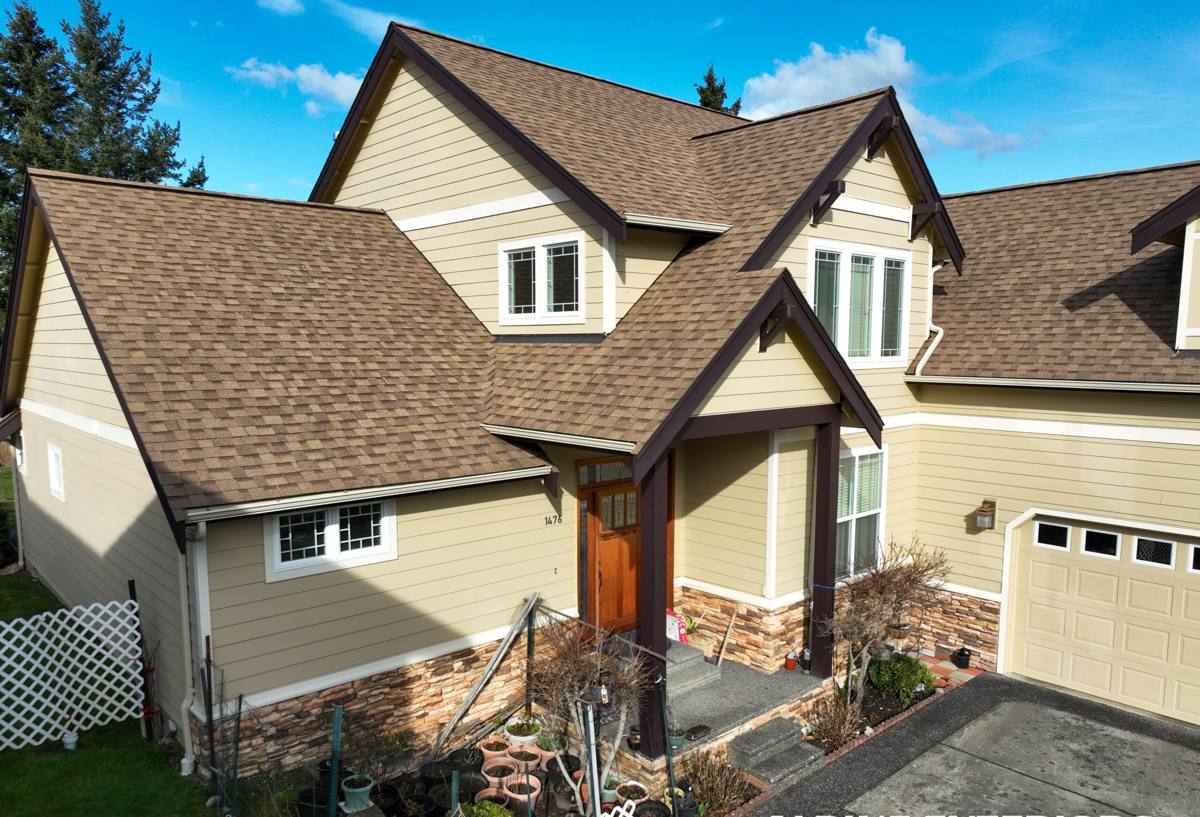
What Actually Counts as Storm Damage Here
Storm damage isn't always a missing shingle you can see from the driveway. In this area, the damage that causes the most trouble is often the kind you can't see without getting on the roof or into the attic.
Wind Damage
Sustained wind and gusts off the water can lift shingle tabs enough to break the sealant bond without tearing the shingle off entirely. The shingle looks fine from the ground but no longer seals against wind-driven rain. Repeated wind events loosen it further until it eventually creases, cracks, or blows off.
Wind-Driven Rain Intrusion
Rain that's being pushed sideways finds its way under ridge caps, around chimney and vent flashing, and along valleys where two roof planes meet. This is one of the most common sources of hidden leaks after a storm — the roof surface can look intact while water is already tracking into the attic along a rafter or down a wall cavity.
Impact Damage
Falling limbs and wind-blown debris are a real factor around Ferndale's tree-lined properties. Impact damage can range from an obvious puncture to a bruise on the shingle mat that doesn't show a leak until months later, when granule loss at that spot lets water through.
Flashing and Fastener Failure
Salt air speeds up corrosion on exposed nail heads, vent boots, and metal flashing. A storm doesn't have to be severe to finish off flashing that's already thinned or a fastener that's already backed out — it just has to apply enough wind load at the right moment.
Moss-Weakened Areas
Moss holds moisture against the roof surface long after the rest of the roof has dried, softening the mat underneath and lifting shingle edges as it grows. A section of roof that's been colonized by moss for a season or two is far more likely to fail in a storm than a clean section nearby, simply because the material underneath is already compromised.
Why It's Worth Fixing Promptly, Not Eventually
A small storm-related opening in the roof surface doesn't stay small. Bellingham-area winters mean months of steady moisture with few real drying windows, so a leak that starts in November can be feeding rot, mold, and insulation damage well before spring. Sheathing that stays wet loses its ability to hold fasteners. Insulation that gets soaked loses most of its R-value and can take weeks to dry even after the leak is fixed. And once water is inside a wall or ceiling cavity, the repair stops being a roofing job and becomes a roofing-plus-interior job, which costs more and takes longer no matter who does the work.
None of this is meant to create urgency for its own sake — it's just how water behaves in this climate. Getting storm damage assessed and closed up while it's still a roof-only problem is almost always the cheaper, faster outcome.
Our Storm Damage Inspection and Repair Process
- Stabilize first. If there's an active leak or an open section of roof, our first priority is a proper tarp or temporary seal to stop water intrusion — not a sales pitch.
- Full roof and attic inspection. We check the whole roof, not just the area you noticed, because wind and impact damage often shows up in more than one spot. We also check the attic for moisture staining, which tells us how long an issue has actually been there.
- Photo documentation. Every finding gets photographed — this matters for your own records and for insurance if you're filing a claim.
- Written scope and options. We explain what's damaged, what caused it, and what the repair actually involves, including whether it's a targeted repair or something that points to a larger issue.
- Repair execution. Matching materials where possible, correct flashing detail work, and fastener patterns built for wind exposure — not just replacing what's visibly missing.
- Cleanup and final check. Debris removed, gutters cleared of anything the storm knocked loose, and a final walk-through so you know exactly what was done.
Repair or Replace? What Actually Drives That Decision
Storm damage repair calls sometimes reveal a roof that's better off being replaced rather than patched again. Here's how we think through that with homeowners, honestly:
| Factor | Points Toward Repair | Points Toward Replacement |
|---|---|---|
| Roof age | Under roughly 12-15 years, still within expected lifespan | Nearing or past manufacturer's expected service life |
| Extent of damage | Isolated to one or two areas | Spread across multiple slopes or recurring in the same spots |
| Underlying material condition | Sheathing and underlayment still sound | Soft sheathing, widespread moss staining, or brittle shingles elsewhere |
| Storm history | First significant damage in years | Second or third storm-related repair in a short span |
| Budget and timeline | Repair addresses the actual problem, not just a symptom | Repeated repairs are starting to add up to replacement cost anyway |
We won't push a full replacement when a proper repair will genuinely hold — but we also won't patch a roof that's clearly telling us it's done, because that just costs you twice.
Materials and Methods We Use for a Repair That Holds
A storm damage repair is only as good as the details underneath it. On a Ferndale roof, that means:
- Matching shingle type, and as close a color match as the existing roof's age allows
- Ice-and-water shield or equivalent self-adhering membrane at valleys, eaves, and around penetrations — the areas most exposed to wind-driven rain
- Corrosion-resistant flashing and fasteners suited to a salt-air environment, not the cheapest option on the shelf
- Correct nail placement and pattern, since improper fastening is one of the most common reasons a "repaired" roof fails again in the next windstorm
- Addressing any moss or organic growth in the repair area before closing it up, so the fix isn't sitting on top of a problem that's still active underneath
We treat every storm repair as an opportunity to leave that section of roof more storm-resistant than it was before, not just visually restored.
Insurance Claims: What's Generally True
We're not insurance adjusters and every policy is different, so we won't tell you what your specific coverage says. What we can do is give you clear, dated photo documentation of the damage and our professional read on the likely cause — wind, impact, or otherwise — which is what most adjusters ask for. A few general things worth knowing:
- Most policies distinguish between sudden storm damage and gradual wear, so documentation and timing matter
- Getting an inspection soon after a storm creates a clear record, rather than damage getting muddled with unrelated wear by the time you file
- You're generally entitled to choose your own contractor for repairs, regardless of who the insurance company suggests
We're happy to walk your adjuster through what we found and answer their questions directly.
What to Do Right After a Storm
- Check the attic for water staining or drips before assuming the roof is fine
- Look at the ground and gutters for shingle granules, pieces of flashing, or shingle fragments
- Note any obvious sagging, missing sections, or debris impact from the ground — avoid getting on the roof yourself
- Take photos of anything visible, dated if possible, for your own records
- If there's an active leak, contain it with a bucket or tarp indoors and call for an inspection rather than waiting to see if it stops
- Avoid DIY roof patches with tape or sealant products not rated for roofing — they often trap moisture and complicate the real repair later
Why a Crew That Already Works Ferndale Matters
Storm damage repair goes better with a crew that already knows the conditions. That means knowing which parts of Ferndale catch the worst of the wind off the water, recognizing moss and algae patterns typical to Whatcom County's climate before they become structural problems, and having relationships with local suppliers so a repair isn't delayed waiting on material that has to come from out of the area. It also means faster response after a storm, when a lot of contractors from farther away are stretched thin across a wider service area. A local crew has a reputation in the area to protect — that's a real incentive to do the repair right the first time, not just fast.
If you've got storm damage — or you're just not sure whether that roof noise during the last windstorm means anything — we're glad to take a look. The estimate is free, there's no pressure to move forward, and you'll get a straight answer about what we found and what it would take to fix it. The form below is the easiest way to get started.