 Bellingham Siding
 Why Edgemoor Homes Wear Out Siding Differently
Edgemoor sits close to Bellingham Bay, tucked against the bluff with mature tree cover and water views that make the neighborhood one of the most desirable in Whatcom County. That same setting is hard on exterior materials. Homes here deal with a combination most inland Bellingham neighborhoods don't see in the same intensity: salt-laden air moving off the bay, driving rain pushed sideways by wind off the water, and deep shade from established trees that keeps north and east walls damp long after a storm passes.
None of that is unusual for coastal Whatcom County. But it does mean siding on an Edgemoor home is working harder than siding on a similar house a few miles inland. Salt air accelerates corrosion on fasteners and trim. Wind-driven rain finds its way into laps and joints that would stay dry in calmer conditions. And shaded, moisture-retentive walls are exactly where moss and algae take hold first and stay latest into the season. If your siding was installed without those specific conditions in mind, it's going to show problems years before it should.
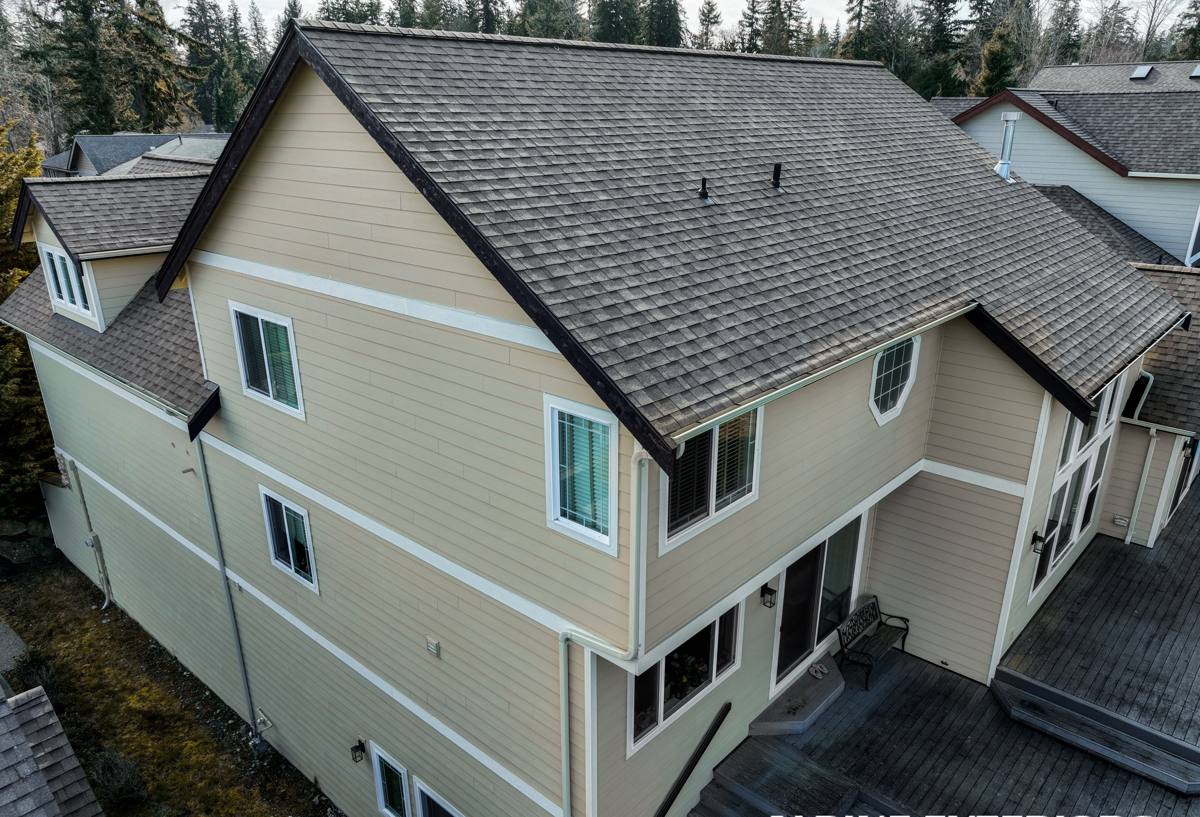
What Edgemoor's Climate Actually Does to Siding
Salt Air and Corrosion
Proximity to saltwater means airborne salt settles on every exterior surface, including siding, trim, fasteners, and flashing. Over time this speeds up corrosion in anything that isn't rated for coastal exposure — cheap fasteners rust and streak the face of the siding, uncoated trim pits and fails early, and paint film breaks down faster than the manufacturer's warranty assumes it will.
Driving Rain and Wind Exposure
Open water nearby means wind gusts arrive with more force and less obstruction than they would further inland. Wind-driven rain doesn't just fall on siding, it gets pushed up and under laps, into butt joints, and around penetrations. Siding systems and installation details that rely on gravity alone to shed water don't hold up under that kind of pressure.
Shade, Moisture, and Moss Season
Bellingham's long wet season already runs from fall through spring, and Edgemoor's tree canopy extends how long walls stay damp after each rain event. Shaded siding dries slowly, and slow-drying surfaces are where moss, algae, and mildew establish themselves. Once moss gets a foothold in a lap joint or behind a poorly sealed trim piece, it holds moisture against the substrate continuously, which is a much bigger problem than surface discoloration.
What a Correct Siding Replacement Involves Here
A siding job done right for an Edgemoor property isn't just about swapping old panels for new ones. It has to account for the specific exposure of the lot — how close to the water it sits, how much shade it gets, and which walls take the worst of the wind-driven rain.
- Full inspection of sheathing and framing once old siding is off, since hidden moisture damage is common on shaded, wind-exposed walls
- Correct water-resistive barrier installation with properly lapped and taped seams, not just stapled housewrap
- Flashing at every window, door, and penetration, integrated with the barrier so water is directed out, not trapped behind the cladding
- Corrosion-resistant fasteners rated for coastal/salt-air exposure, installed to the manufacturer's exact spacing and depth
- Proper clearance at the base of the wall and around grade, decks, and planting beds so moisture doesn't wick into the bottom courses
- Factory-finished siding and trim so the protective coating isn't compromised by field-cutting exposed edges without back-sealing
Skip any one of these steps and the siding might look fine for a season or two, but the underlying wall assembly is set up to fail early — usually in the form of soft trim, streaking, or moss creeping in at joints within a few years rather than a couple decades.
Why We Install James Hardie Fiber Cement Only
We standardized on James Hardie fiber cement siding for every home we touch, including Edgemoor, and we don't install vinyl, LP SmartSide, cedar, primed spruce, Cemplank, or Allura. That's not a marketing position, it's a practical one shaped by exactly the conditions described above.
Vinyl expands and contracts more with temperature swings, can warp or crack in wind exposure, and its seams and J-channels give wind-driven rain more opportunities to get behind the cladding. Wood-based products like cedar or primed spruce need consistent maintenance to keep their finish intact, and in a shaded, moisture-heavy environment like Edgemoor, that maintenance window shrinks fast — a missed repaint cycle can mean rot starting underneath before it's visible on the surface. Engineered wood products carry their own moisture-management requirements that are unforgiving if installation isn't precise.
James Hardie fiber cement is non-combustible, doesn't swell or rot when it takes on moisture, and its ColorPlus factory finish is baked on under controlled conditions rather than applied on site — which matters a lot when you're dealing with salt air and prolonged dampness. Hardie's HZ5 product line is engineered specifically for harsher climate zones, including freeze-thaw cycling and moisture exposure typical of the Pacific Northwest coast. It carries a strong transferable warranty on both the substrate and the finish, which is a meaningful difference from products where the coating and the board are warrantied separately, or not at all.
How Hardie Compares to What We Don't Install
| Factor | James Hardie Fiber Cement | Vinyl | Wood / Engineered Wood |
|---|---|---|---|
| Moisture behavior | Doesn't rot or swell; engineered for wet climates | Resists water itself, but seams allow intrusion | Absorbs moisture if finish fails; can rot |
| Salt air / coastal durability | Factory finish holds up well; HZ5 built for harsher exposure | Can become brittle and discolor over time | Finish breaks down faster near saltwater |
| Combustibility | Non-combustible | Combustible | Combustible |
| Maintenance | Low; factory finish, no repainting cycle needed for years | Low, but cracks/warps are not repairable, only replaceable | Higher; regular repainting/sealing required |
| Warranty structure | Strong transferable warranty covering substrate and finish | Varies widely by manufacturer and grade | Often finish-only, separate from substrate |
Our Process for an Edgemoor Siding Replacement
1. On-Site Assessment
We walk the property and look specifically at exposure — which walls face the water and prevailing wind, which stay shaded longest, where moss and staining are already showing, and where drainage or grading issues could be feeding moisture into the wall assembly.
2. Tear-Off and Substrate Check
Old siding comes off and we inspect the sheathing and framing before anything new goes up. This is the step that catches hidden rot or moisture damage from years of a compromised water-resistive barrier or missing flashing — problems that are common on older Bellingham-area homes near the water.
3. Water Management Rebuild
We install a correctly lapped water-resistive barrier, flash every window, door, and penetration, and set up drainage so any water that does get behind the cladding has somewhere to go rather than sitting against the sheathing.
4. Hardie Installation to Spec
Panels and trim go up using coastal-rated fasteners, correct nailing patterns, proper clearances, and back-sealed cut edges. This is where a lot of Edgemoor's climate-specific requirements actually get satisfied — not in the product choice alone, but in how precisely it's installed.
5. Final Walkthrough
We review the finished work with the homeowner, cover care and maintenance expectations, and make sure warranty registration is handled correctly.
What This Kind of Job Typically Costs
Every Edgemoor property is different — lot size, number of stories, amount of trim detail, and how much of the existing wall assembly needs repair once old siding comes off all affect the final number. In general terms, homeowners should expect the following factors to move the price the most:
| Cost Factor | Why It Matters |
|---|---|
| Home size and wall complexity | More square footage and more corners, dormers, or trim details mean more labor |
| Substrate condition | Hidden rot or moisture damage found during tear-off adds repair work before new siding goes on |
| Siding profile and trim selection | Lap width, trim style, and accessory choices affect material cost |
| Access and site conditions | Bluff-adjacent lots, mature landscaping, and limited access can add time |
| Existing siding removal | Multiple layers of old siding or extensive prep work add to the scope |
We don't quote a number without seeing the house, because guessing on a property with Edgemoor's specific exposure risks underestimating what the substrate actually needs.
Why Hire a Crew That Already Works This Neighborhood
Siding installation isn't one-size-fits-all across Whatcom County. A crew that mostly works drier, inland neighborhoods may not think twice about fastener corrosion resistance or wind-driven rain detailing, because it simply hasn't been a problem on their other jobs. On a property this close to the bay, those details are the difference between siding that looks good for two years and siding that performs for decades. Working in and around Edgemoor regularly means we already know to check the shaded walls first, to detail flashing for wind-driven rain rather than just vertical rainfall, and to spec fasteners that won't streak or fail from salt exposure.
If your current siding is showing moss buildup, staining, soft spots, or fastener corrosion, it's worth having it looked at before those issues spread further into the wall assembly. We offer free, no-pressure estimates for Edgemoor homeowners — use the form below to get a straightforward assessment of what your home actually needs.