 Bellingham Siding
 Edgemoor's Waterfront Exposure Puts Extra Stress on Siding
Edgemoor sits close enough to Bellingham Bay that homes here deal with a combination of weather stresses that inland Whatcom County neighborhoods don't see nearly as often. Salt-laden air off the water accelerates corrosion on fasteners, trim, and any exposed metal flashing. Driving rain, pushed sideways by wind coming off the bay, finds every gap in caulking, every lifted seam, and every spot where old paint has started to crack. And the deep shade from mature trees that gives Edgemoor its character also means siding here holds moisture longer after a storm, which is exactly the condition moss and algae need to take hold.
None of this means Edgemoor homes are somehow flawed or poorly built — it means the siding on them works harder than siding on a home ten miles inland, and it shows wear in specific, recognizable ways. A repair job that doesn't account for that exposure is a repair that fails again within a year or two.
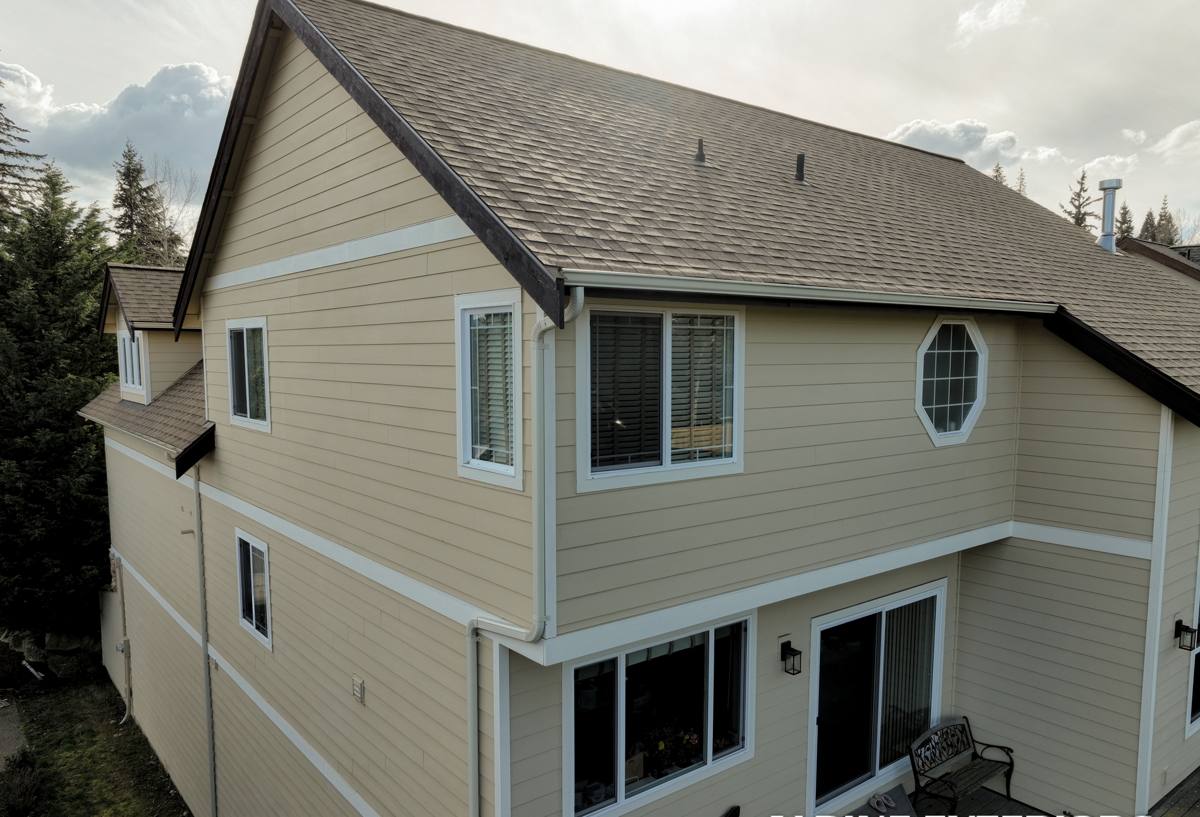
Signs Your Siding Needs Repair — Not Just a Cleaning
Homeowners often call about "dirty siding" when the real issue is deeper. Here's what actually signals a repair need versus a simple wash:
- Soft or spongy spots when you press on a board — usually trapped moisture breaking down the material underneath
- Persistent black or green streaking that comes back within weeks of cleaning
- Visible gaps or separation at seams, corners, or around window and door trim
- Bubbling, peeling, or flaking paint that keeps returning in the same spots
- Rust staining below nail heads or metal flashing
- Warping or cupping boards, especially on the north or shaded side of the house
- Cracks that follow a straight line along a board's length, usually from impact or age
If you're seeing more than one or two of these, it's worth having someone look before the damage spreads to the wall assembly behind the siding — sheathing and framing repairs cost far more than siding repairs.
What a Correct Siding Repair Actually Involves
Diagnosis Before Demolition
A repair that just swaps a damaged board without asking why it failed is a repair that will fail the same way again. Before any material comes off the wall, we check for the actual moisture source — a failed flashing detail, a caulk joint that opened up, a gutter overflow point, or grade that pushes water toward the foundation and splashes back onto the lower courses of siding.
Matching the Water Management System, Not Just the Surface
Siding is a system: the visible board, the house wrap or weather-resistive barrier behind it, the flashing at every penetration, and the fasteners holding it together. A patch that looks fine from the driveway but doesn't restore the drainage plane behind it will trap moisture rather than shed it — which is often worse than leaving the damage alone.
Fastening and Sealing to Spec
Nail placement, caulk selection, and gap tolerances matter more on a repair than on new construction, because you're tying new material into an existing wall that has already moved and weathered. Rushed repairs tend to over-caulk gaps that should be left to breathe, which locks moisture in rather than letting it escape.
Repair vs. Replacement: How We Help You Decide
Not every damaged section needs a full re-side, and not every "small" repair is actually small once the wall is opened up. Here's the general breakdown we walk Edgemoor homeowners through:
| Situation | Usually a Repair | Usually Points to Replacement |
|---|---|---|
| Damage location | Isolated to one wall or a few boards | Spread across multiple sides of the house |
| Underlying material | Sheathing and framing still sound | Rot has reached studs or sheathing in several spots |
| Age of existing siding | Under 10-15 years, otherwise in good shape | Original siding is at or past its expected service life |
| Cause of damage | One-time event — impact, isolated flashing failure | Systemic moisture intrusion from ongoing wall assembly issues |
| Material match | Matching product still available or blends acceptably | Discontinued product, no reasonable color/profile match |
We'll always tell you honestly which category your home falls into. There's no benefit to us talking a homeowner into a full replacement when a targeted repair will genuinely hold up — but there's also no point patching a wall that's going to need replacing again in two years.
Why Material Choice Matters More on a Repair Than People Expect
We install exclusively James Hardie fiber cement siding, and that shapes how we approach repair work too. Fiber cement doesn't absorb and swell with moisture the way wood-based products can, it's non-combustible, and Hardie's HZ5 product line is engineered for exactly the freeze-thaw, damp-climate conditions the Pacific Northwest produces. When we're repairing an existing Hardie installation, we're typically dealing with a flashing, caulking, or fastener issue rather than the board material itself breaking down — which is a much more straightforward and permanent fix.
When we're called to repair other siding materials, we'll still do the work well and give you an honest assessment. But it's worth knowing why we made fiber cement our standard: vinyl can warp and crack in cold snaps and doesn't hold paint if you ever want to change color; primed wood species and engineered wood products are more vulnerable to the kind of sustained moisture exposure Edgemoor's tree cover and bay-side humidity create. If a repair on one of these materials turns into a recurring problem, that's usually the underlying material working against you, not a workmanship issue — and it's worth knowing that before you decide whether to repair again or transition the wall to something more durable during your next exterior project.
Our Process for Edgemoor Repair Calls
1. On-Site Assessment
We look at the damaged area, the surrounding wall, gutters, grading, and any flashing details nearby — because the failure point is rarely exactly where the damage is visible.
2. Straight Answer on Repair vs. Replacement
You get an honest read on which category the job falls into, using the same factors in the table above, along with a written estimate before any work starts.
3. The Repair Itself
We open up only what needs to come off, correct the underlying cause where one exists, and reinstall or replace material to the same fastening and clearance standards as new construction.
4. Final Check for Water Management
Before we call a repair done, we confirm flashing laps correctly, caulk joints are placed where they belong (and left open where they shouldn't be sealed), and the repaired section drains the way the rest of the wall does.
Why Hiring a Crew That Already Works Edgemoor Matters
Siding repair in a bay-adjacent, tree-shaded neighborhood is a different diagnostic problem than repair work in a dry, open subdivision across town. A crew that regularly works Edgemoor and similar Bellingham neighborhoods has already seen how salt air behaves on fasteners and trim, how moss establishes itself under specific shade and moisture conditions, and how driving rain off the bay finds the weak points in a wall. That pattern recognition shortens the diagnosis and reduces the odds of a repair that looks right on day one but fails again the next wet season.
It also means realistic timing. Whatcom County's wet months make certain repairs harder to do correctly — you don't want new caulk or a fresh seal going in during a saturated stretch of weather if it can be scheduled for a drier window instead. Local experience means knowing when to push a repair up the schedule and when it's fine to wait a few weeks for better conditions.
Maintenance Steps That Extend a Repair's Life
A good repair only stays good if a few basic things happen around it:
- Keep gutters clear so overflow doesn't run down the wall behind the siding
- Trim back vegetation that keeps a wall section shaded and damp longer than the rest of the house
- Rinse moss and algae growth before it's thick enough to hold moisture against the surface
- Walk the exterior once or twice a year and look for the early signs listed above, especially after a hard windstorm
- Address caulk failures at trim and penetrations promptly rather than waiting for the next full inspection
If you're noticing soft spots, staining, moss buildup, or gaps in your siding, it's worth having it looked at before the next round of Pacific Northwest storms makes the problem bigger. We offer free, no-pressure estimates for Edgemoor homeowners — use the form below to get one scheduled.