 Bellingham Siding
 Decks Built for Blaine's Waterfront Climate
Blaine sits right on the water at the northern edge of Whatcom County, and that location shapes everything about how a deck should be built here. Homes near Semiahmoo Bay and Drayton Harbor deal with salt-laden air blowing in off the water, driving rain that comes in sideways during winter storms, and a moss and algae season that can stretch from October through May. A deck design that works fine in a drier inland town doesn't hold up the same way a few blocks from the shoreline. We build decks in Blaine with that reality in mind from the first stake in the ground, not as an afterthought once problems show up.
This page covers what a correctly built deck looks like for this specific area — the materials, the framing details, the fastener choices, and the process we follow — so you know what to expect and what questions to ask any contractor bidding the job.
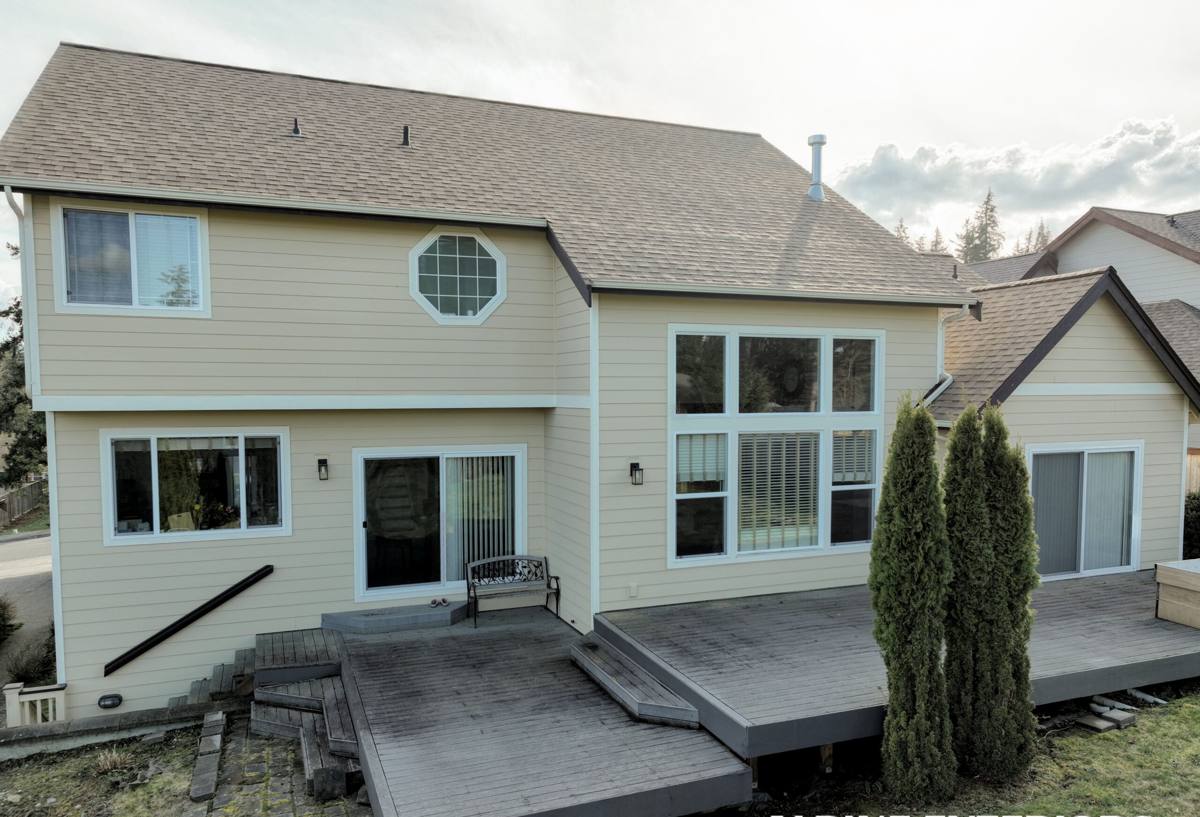
What Blaine's Weather Actually Does to a Deck
Three climate factors drive almost every deck failure we see in this part of Whatcom County:
Salt Air
Airborne salt from the bay accelerates corrosion on anything metal — fasteners, joist hangers, railing brackets, and structural screws. Standard hardware that would last decades inland can start showing rust streaks and pitting within a few years this close to the water. Once a fastener starts corroding, it loses holding strength long before it looks obviously bad, which is part of why hidden hardware failures are a real concern on older waterfront decks.
Driving Rain
Blaine gets wind-driven rain that pushes water into places a straight-down rainstorm never would — under railing caps, behind ledger boards, into end-grain cuts on joists and beams. Water that gets trapped instead of shedding is what rots framing lumber from the inside, often while the deck surface still looks fine.
Moss and Algae Season
Long stretches of damp, shaded, cool weather are ideal growing conditions for moss and algae. On deck boards, that growth holds moisture against the surface, makes stairs and walkways slick, and on wood decking, feeds the kind of surface decay that shortens board life. Decking choice, board spacing, and how much sun a deck actually gets all factor into how much of a moss problem a homeowner will be dealing with.
Choosing Decking Material for This Location
There's no single "best" decking material — the right call depends on budget, how much maintenance a homeowner wants to do, and how exposed the deck is to salt air and standing shade. Here's how the common options compare for a Blaine property specifically.
| Material | Moisture & Salt Behavior | Maintenance | Typical Lifespan |
|---|---|---|---|
| Pressure-treated wood | Prone to cupping, splintering, and moss growth if not sealed regularly; treatment protects against rot but not surface weathering | Annual cleaning and re-sealing recommended | 15-20 years with upkeep |
| Cedar | Naturally rot- and insect-resistant, but softer and more prone to graying and moss in constant shade near the water | Periodic cleaning and staining to hold color and resist moisture | 20-25 years with upkeep |
| Composite decking | Does not absorb moisture the way wood does; resists rot, but lower-quality composites can still grow surface algae in shaded, damp spots | Occasional washing, no sealing or staining | 25-30+ years |
| PVC / capped polymer decking | Fully sealed surface, best resistance to moisture, salt exposure, and moss buildup of the common options | Lowest maintenance — occasional rinse | 25-30+ years |
We don't push one product on every job. A shaded, water-facing deck that stays damp most of the year is a strong argument for composite or PVC decking simply because it removes moss and moisture absorption from the equation. A sunnier, more sheltered spot might do perfectly well with wood at a lower upfront cost, as long as the homeowner is realistic about the maintenance commitment.
Framing and Substructure: Where Decks Actually Fail
Homeowners tend to focus on the decking surface because that's what they see and walk on, but the framing underneath is what determines whether a deck is safe and how long it lasts. In a climate like Blaine's, the substructure is doing the hard work of shedding water and resisting corrosion where nobody's looking.
Joists, Beams, and Posts
We use lumber rated for ground contact and exterior exposure where it's required, and we pay close attention to end cuts — every cut end on treated lumber needs to be sealed with an approved end-cut sealant, because factory treatment doesn't penetrate a cut made on site. Skipping that step is a common shortcut that lets rot start exactly where the wood was cut to fit.
Post Bases and Footings
Posts that sit directly on or near grade in a wet climate are vulnerable to moisture wicking up from the ground. We set posts on proper concrete footings with metal post bases that hold the wood above standing water and splash-back, rather than burying posts directly in the ground.
Ledger Board Attachment
The ledger board — where the deck attaches to the house — is the single most common source of serious deck failures nationwide, and it's a bigger risk here because of how much wind-driven rain gets pushed against exterior walls. A correctly flashed ledger keeps water from tracking behind the siding and into the house's wall framing, not just off the deck itself.
Fasteners, Flashing, and Hardware That Actually Hold Up
Given the salt air along the bay, hardware choice is not a place to cut corners. We use fasteners and structural connectors rated for coastal or salt-exposed environments — typically stainless steel or heavy-duty coated hardware — rather than standard galvanized fasteners that corrode faster this close to the water. The cost difference on hardware is small relative to the total job; the cost of hardware failing early is not.
Flashing is the other piece that gets overlooked. Proper ledger flashing, along with flashing tape or membrane at any point where framing penetrates a water-shedding surface, is what actually keeps moisture out of the structure long-term. A deck can look well-built and still fail in five years if the flashing details were skipped to save time.
Our Deck Building Process
Every deck we build in Blaine follows the same sequence, adjusted for the specific site conditions:
- Site assessment — we look at sun exposure, prevailing wind and rain direction, drainage, and how close the deck will be to salt air, since all of that affects material and hardware decisions.
- Design and material selection — we walk through decking, railing, and fastener options honestly, including trade-offs on maintenance and cost, so the choice fits the homeowner's budget and how much upkeep they want to do.
- Permitting — we handle the permit application and inspection scheduling with Whatcom County or the City of Blaine as required for the project.
- Demolition or prep — removal of an old deck if applicable, and grading or drainage correction underneath the new one.
- Framing — footings, posts, beams, joists, ledger attachment and flashing, built to current code for the span and load.
- Decking and railing installation — proper board spacing for drainage and airflow, correct fastening method for the chosen material, and code-compliant railing height and baluster spacing.
- Final walkthrough — we go over the finished deck with the homeowner, including maintenance expectations for the material chosen.
Permits and Code in Whatcom County
Most new decks and many deck replacements require a building permit, and that requirement is often tied to deck height, size, and whether it's attached to the house. Guardrail height, baluster spacing, stair geometry, and footing depth are all governed by code, and inspectors will check ledger attachment and framing before the decking goes on. We handle the permit process as part of the job rather than leaving it to the homeowner to sort out, and we build to pass inspection the first time, not to the bare minimum that might squeak by.
Signs an Existing Deck Needs Attention
Before deciding between repair and full replacement, it's worth checking for these warning signs, which show up faster on decks exposed to salt air and constant moisture:
- Soft or spongy spots when walking across the decking
- Rust staining around fasteners or metal connectors
- Gaps opening up between the ledger board and the house
- Persistent moss or algae that comes back within weeks of cleaning
- Wobble or movement in railings or posts
- Visible splitting or cracking concentrated near fastener locations
What Drives Deck Building Cost in Blaine
Every deck project is different, but the same handful of factors typically move the price up or down:
| Cost Factor | Why It Matters |
|---|---|
| Size and shape | Larger decks and complex shapes with multiple levels or angles need more framing and labor |
| Decking material | Pressure-treated wood costs less upfront; composite and PVC cost more but reduce long-term maintenance |
| Height and footing depth | Taller decks and sites needing deeper footings for slope or soil conditions add structural cost |
| Railing style | Basic wood or metal railing costs less than cable, glass, or custom composite railing systems |
| Site access and demolition | Removing an old deck, tight site access, or difficult grading adds labor time |
| Hardware grade | Salt-air-rated stainless or coated fasteners cost more than standard hardware but last significantly longer this close to the water |
We give straightforward, itemized estimates so homeowners can see where the money is going and where there's room to adjust — for example, choosing a mid-range composite over premium PVC, or simplifying a railing design, without compromising the structural work that actually keeps the deck safe.
Maintenance Checklist for a Blaine Deck
Whatever material a deck is built from, a little seasonal attention goes a long way in this climate:
- Sweep off debris and standing leaves regularly, especially in fall
- Wash the surface at least once a year to knock back moss and algae before it takes hold
- Check and re-seal wood decking on a regular schedule — don't wait until it's visibly gray and dry
- Inspect fasteners and railing connections annually for rust or looseness
- Confirm gaps between boards stay clear so water and debris keep draining
- Look underneath the deck periodically for signs of moisture pooling or framing damage
Why Hire a Crew That Already Works in Blaine
A deck built to a generic spec sheet can still fail early in a coastal Whatcom County climate if it wasn't built with salt air, driving rain, and moss season specifically in mind. We work throughout Bellingham and the surrounding Whatcom County communities, including Blaine, and we build to the conditions this area actually produces — not just the minimum code requirement. That means the right hardware grade, real attention to flashing and ledger details, and honest material recommendations based on how exposed a given site is, rather than whatever's easiest to install.
If you're planning a new deck or need an honest opinion on whether an existing one needs repair or replacement, we're happy to take a look. Request a free, no-pressure estimate using the form below.