 Bellingham Siding
 Why Decks in Blaine Wear Out Faster Than the Rest of Whatcom County
Blaine sits right on the water, close to the international border, and that location comes with a specific set of problems for anything built outdoors. Salt-laden air moves inland off the coastline and settles on every exposed surface, including your deck. Combine that with the driving, sideways rain that comes through this corner of Whatcom County in the fall and winter, and you get a wood or fastener assembly that's under near-constant moisture load for months at a stretch. Add a moss season that can run from October into May in shaded or north-facing yards, and you have three separate forces working against a deck's lifespan at the same time.
None of that means a deck in Blaine is doomed — it means it needs to be built and replaced with those conditions in mind, not with a generic approach borrowed from a drier inland region. A deck that would hold up fine in eastern Washington can fail in half the time here if the fasteners, flashing, and ventilation aren't specified for coastal exposure.
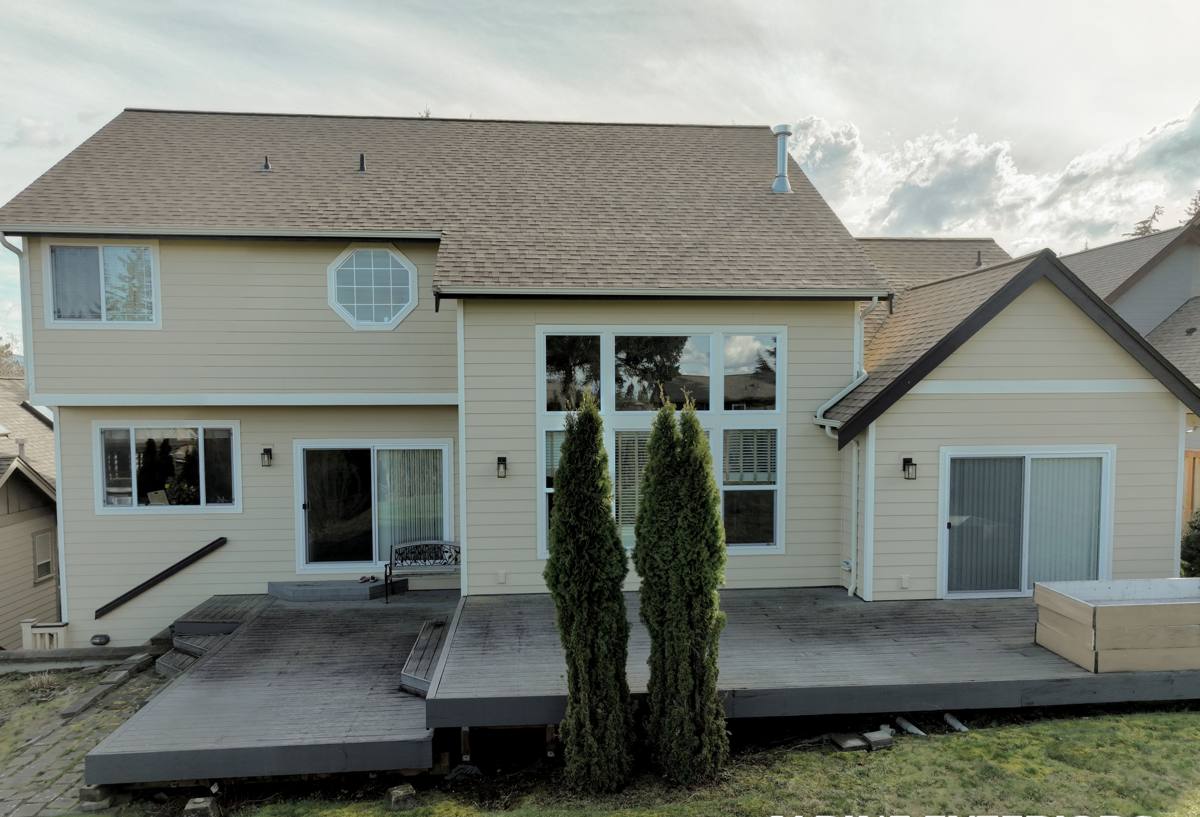
Salt Air, Rain, and Moss: What Each One Actually Does to a Deck
Salt Air
Salt in the air isn't just a nuisance — it accelerates corrosion in any metal component: nails, screws, joist hangers, and structural connectors. Once a fastener starts to rust, it loses holding strength long before the wood around it looks bad. A deck can look structurally sound on the surface while the hardware underneath is failing.
Driving Rain
Wind-driven rain doesn't just fall straight down — it gets pushed sideways and upward into ledger connections, under railing posts, and into any gap where flashing wasn't done correctly. Water that gets trapped rather than shed is what causes rot, not rain in general. Most premature deck failures we see trace back to a moisture path that was never properly sealed off in the first place.
Moss and Organic Growth
Moss holds moisture directly against decking boards, keeps surfaces from drying between rain events, and creates a slip hazard on stairs and walking surfaces. Left unaddressed, it also stains and etches into the surface of some wood and composite products over time.
Repair or Replace? How to Tell
Not every tired-looking deck needs a full rebuild, but in this climate, cosmetic problems often point to structural ones underneath. Here's a general checklist we use when evaluating a Blaine deck:
- Soft or spongy spots underfoot, especially near the house or stair stringers
- Rust streaking around fasteners or visibly corroded hardware
- Gaps or separation where the deck meets the house (ledger board area)
- A screwdriver that sinks easily into joists or posts near ground contact
- Railings that flex or wobble more than a firm push should cause
- Persistent moss or algae that returns within weeks of cleaning
- Boards cupping, splitting, or graying unevenly across the deck surface
If the problems are limited to a handful of boards and the substructure tests solid, repair can make sense. Once the framing, ledger connection, or footings are compromised, patching individual boards is a short-term fix on a structure that's already failing — full replacement is the honest recommendation at that point.
What a Correct Deck Replacement Actually Involves
A deck replacement done right isn't just pulling old boards and screwing down new ones. In a coastal, high-moisture area like Blaine, the parts you don't see matter more than the parts you do.
Ledger Board and Flashing
The ledger board — where the deck attaches to the house — is the single most common failure point on any deck, coastal or not. Proper flashing here, installed so water is directed away from the house rather than behind the ledger, is non-negotiable. This is also where corrosion-resistant fasteners matter most, since this connection carries a significant share of the deck's structural load.
Framing and Fasteners
All structural hardware — joist hangers, post bases, structural screws — should be rated for the exposure. In salt-air conditions, that generally means stainless steel or a coating rated for coastal/marine use rather than standard galvanized products, which corrode faster here than they would inland.
Footings and Posts
Footings need to be sized and set to current code for the load and soil conditions, with posts isolated from direct ground contact where possible to reduce rot risk. This is also the stage where we address drainage under the deck, so water isn't pooling against posts or footings year-round.
Ventilation
Low or ground-level decks with poor airflow underneath trap moisture and encourage rot and moss growth from below, not just above. Where the design allows it, we build in airflow rather than sealing the underside off completely.
Material Options for a Coastal, Wet Climate
There's no single "best" decking material — every option is a trade-off between upfront cost, maintenance, and how it handles this specific climate. Here's how the common choices stack up for a Blaine property:
| Material | Upfront Cost | Maintenance | How It Handles Salt Air & Moisture |
|---|---|---|---|
| Pressure-treated wood | Lowest | Annual cleaning, periodic sealing | Good if fasteners and sealing are kept up; neglect shows fast in this climate |
| Cedar | Moderate | Regular sealing or staining | Naturally rot-resistant but still needs upkeep against moss and gray-out |
| Composite decking | Higher | Occasional washing, no sealing | Resists rot and moisture absorption well; still needs cleaning to prevent moss buildup on the surface |
| Tropical hardwoods | Highest | Periodic oiling | Very durable but demanding installation; not something we take shortcuts on |
We're honest with clients that composite costs more upfront but removes the sealing and staining cycle that wood requires in a climate where you're often racing the next rain system to get a coat down. For clients who want the look and feel of real wood and are willing to keep up with maintenance, cedar or treated lumber remains a solid, more affordable choice — as long as it's installed and fastened correctly for coastal exposure.
Our Deck Replacement Process in Blaine
- On-site assessment — We inspect the existing deck's framing, ledger connection, footings, and hardware condition, not just the surface boards, so the recommendation is based on what's actually underneath.
- Scope and material discussion — We walk through material options, realistic maintenance expectations, and a straightforward cost range before any demolition starts.
- Permitting — Deck replacements of significant scope typically require a permit through the local jurisdiction; we handle that process rather than leaving it to the homeowner.
- Demolition and disposal — Full removal of the old structure, checking the ledger and house framing for hidden moisture damage once it's exposed.
- Structural rebuild — Footings, framing, ledger flashing, and corrosion-resistant hardware installed to current code, sized for the deck's actual use and load.
- Decking, railing, and stairs — Installed with attention to drainage, fastener spacing, and airflow underneath where the design allows it.
- Final walkthrough — We go over basic care for whatever material was installed so it holds up through the first wet season and beyond.
Permits and Local Considerations
Deck work in Blaine typically falls under Whatcom County or City of Blaine building requirements depending on the property's location, and most structural deck replacements need a permit — especially anything involving new footings or a change in size or height. Skipping this step can create real problems later, from failed inspections during a home sale to insurance complications after storm damage. We factor permitting into the project timeline upfront so it isn't a surprise mid-project.
Being this close to the water also means wind exposure is a real design factor, particularly for railings and any elevated deck structure. We size and anchor accordingly rather than building to the bare minimum.
Maintaining a New Deck Through Blaine's Wet Season
Even a correctly built deck needs some ongoing attention in this climate. A short seasonal routine goes a long way:
- Sweep debris and standing leaves off the surface regularly, especially in fall
- Clean moss and algae off boards and stairs before it has a chance to establish
- Check railing posts and stair connections for movement once or twice a year
- Inspect fasteners near ground level and around the ledger for early rust signs
- Reseal or restain wood decking on the manufacturer's recommended cycle, not "when it looks bad"
- Keep gutters and downspouts near the deck clear so runoff isn't draining directly onto it
These steps take a few hours a year and meaningfully extend the life of whatever material you choose, whether it's a full composite system or traditional wood.
Why It Matters to Hire a Crew That Already Works in Blaine
A contractor based farther inland may not build in the same corrosion-resistant hardware or flashing detail by default, because it isn't necessary where they normally work. In Blaine, those aren't optional upgrades — they're the difference between a deck that lasts and one that needs attention again in a few years. Crews who regularly work this stretch of the Whatcom County coastline already know which fasteners hold up, how local permitting works, and where water actually causes problems on a deck exposed to salt air and driving rain, rather than learning it on your project.
If your deck is showing its age or you're planning ahead for a replacement, we're happy to take a look and give you a straightforward, no-pressure estimate — just fill out the form below.