 Bellingham Siding
 Building Decks for Sunnyland's Climate
Sunnyland is a quiet, established neighborhood, and a lot of the homes here have decks that were built decades ago — some well, some not. Whatcom County's marine climate is hard on outdoor structures in ways that don't show up right away. Salt-laden air off Bellingham Bay accelerates corrosion on fasteners and hardware. Driving rain, often coming sideways in a windstorm, finds its way into any gap in flashing or decking. And our long, mild, wet season means moss and algae have months to get established on any surface that stays damp and shaded. A deck built without those three factors in mind will look fine for a year or two, then start showing soft spots, rust streaks, and green film exactly where you don't want them.
We build and repair decks throughout Bellingham, and Sunnyland is one of the neighborhoods we're in regularly. That matters because deck problems here tend to repeat house to house — the same north-facing shade patterns, the same drainage headaches on sloped lots, the same fastener failures on older builds. When we already know what tends to go wrong in this specific area, we can design around it instead of finding out the hard way after the fact.
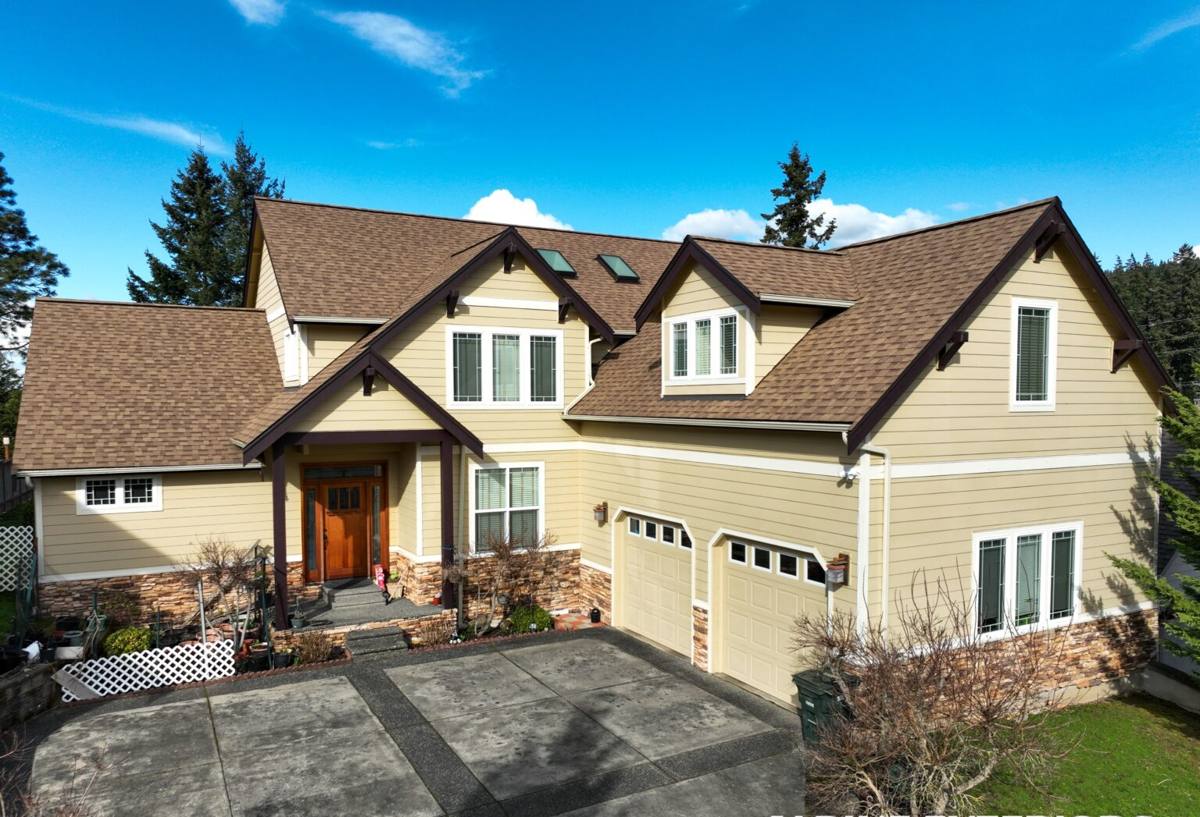
What a Sunnyland Deck Actually Needs
Every deck project starts with the same question: what is this specific site going to throw at the structure over the next 20 years? In Sunnyland, that usually comes down to a handful of recurring conditions.
- Persistent moisture from long stretches of rain rather than short heavy downpours — everything needs to dry out between storms, not stay saturated
- Shaded or partially shaded yards where moss and algae get a head start and never fully bake off in summer sun
- Salt-influenced air that speeds up corrosion on screws, bolts, brackets, and railing hardware
- Older homes with existing ledger boards, siding, or foundations that may need extra attention when a new deck ties into them
- Sloped or uneven lots common in established Bellingham neighborhoods, which affect footing depth and drainage planning
None of these are dealbreakers. They're just design inputs. A deck built around them lasts significantly longer than one built to a generic spec and hoped for the best.
Getting the Structure Right: Footings, Framing, and Flashing
The part of a deck nobody sees is the part that determines whether it's still solid in fifteen years. Whatcom County's frost depth and soil moisture mean footings need to be sized and set correctly for our conditions, not just poured to the minimum. On lots with heavier clay or poor drainage — not uncommon around Bellingham — we pay close attention to how water moves away from the footings rather than pooling against them.
Ledger Board Attachment
Where a deck attaches to the house is the single most common failure point we see on older decks, and it's almost always a moisture problem, not a structural one. Proper flashing — installed so water sheds outward and down, never into the band joist or wall assembly — is non-negotiable. We'd rather spend an extra hour getting this detail right than have a homeowner deal with hidden rot behind siding five years later.
Joist Spacing and Fasteners
Decking material choice affects joist spacing — some composite and PVC products require tighter spacing than natural wood to avoid deflection. We spec framing to the material going down on top of it, not the other way around, and we use corrosion-resistant fasteners and hardware rated for coastal exposure throughout, not just on the visible surface.
Choosing Decking Material for Coastal Moisture
There's no universally "best" decking material — there's the right material for your budget, your maintenance appetite, and how much sun and moss exposure your specific yard gets. Here's how the common options actually perform under Bellingham's conditions.
| Material | Moisture & Moss Behavior | Maintenance | Typical Lifespan |
|---|---|---|---|
| Pressure-treated wood | Absorbs moisture; needs sealing to resist moss and staining | Annual cleaning, re-staining every 2-3 years | 15-20 years with upkeep |
| Cedar | Naturally rot- and insect-resistant, but still needs sealing in our rain | Regular cleaning and periodic finish renewal | 15-20 years with upkeep |
| Composite decking | Doesn't absorb water or rot, but can still grow surface algae if shaded and unwashed | Occasional washing, no staining or sealing | 25-30+ years |
| PVC / capped polymer | Fully moisture-resistant surface, best resistance to moss staining | Lowest maintenance of the group | 25-30+ years |
Cost generally follows that order too — pressure-treated is the least expensive up front, PVC the most. We'll walk through the real trade-offs for your yard's sun exposure and your long-term maintenance plans rather than push one product line as a default.
Managing Moss and Algae Through a Long Wet Season
Bellingham's moss season isn't a few weeks — it's most of the year on shaded, north-facing decks. The fix isn't a one-time treatment, it's building the deck so moss has a harder time taking hold in the first place.
Airflow and Gapping
Correct board spacing lets air move underneath and between boards so surfaces actually dry between rain events. Decks built with boards too tight, or without adequate ventilation underneath, stay damp far longer and moss establishes faster.
Surface and Substructure Access
We design in reasonable access for cleaning both the deck surface and the framing underneath. A deck that can only be cleaned on top while the joists below stay wet and dark is a deck that will rot from underneath while looking fine from above.
Ongoing Care
Whatever material you choose, an annual cleaning before the wet season really sets in — clearing debris, washing off algae film, checking fastener heads for corrosion — does more to extend deck life than almost anything else a homeowner can do themselves.
Railings, Hardware, and Fasteners That Hold Up
Salt air doesn't need to be right on the waterfront to cause problems — it travels, and Bellingham's proximity to Bellingham Bay means most of the city gets some exposure. Standard zinc-coated hardware can start showing rust streaks down the face of a deck within a few years in this environment. We use stainless steel or coated fasteners and connectors rated for coastal or marine-grade exposure on every build, along with railing hardware chosen to match — because rust streaks bleeding down a light-colored deck board are one of the most common complaints we hear about older decks in this area.
How We Handle a Sunnyland Deck Project
Every project runs through the same core process, adjusted for your specific lot and home.
- On-site visit — we walk the yard, check sun and shade patterns, look at drainage and slope, and inspect the house connection point if it's a new attached deck
- Design and material discussion — honest talk about what fits your budget and how much upkeep you actually want to do
- Permitting — we handle the paperwork with the City of Bellingham or Whatcom County depending on your property's jurisdiction
- Footings and framing — built to local frost depth and drainage conditions, not a generic minimum spec
- Decking, railing, and hardware installation — using fasteners and connectors suited to coastal exposure
- Final walkthrough — we go over the finished deck with you and cover basic maintenance for whatever material you chose
Here's a quick checklist for anyone evaluating a deck build or replacement in Sunnyland:
- Does the quote specify footing depth and fastener type, or just "standard construction"?
- Is flashing at the house connection called out specifically, not just implied?
- Does the material recommendation account for how much shade your yard actually gets?
- Are permits included in the scope, or left for you to sort out?
- Does the contractor mention drainage and airflow under the deck at all?
Permits and Local Code
Most deck construction and replacement work in Bellingham and unincorporated Whatcom County requires a building permit, particularly for decks attached to the house or built above a certain height. Requirements shift over time and depend on your exact location and lot, so we handle the permit process as part of the job rather than leaving it for the homeowner to navigate. Skipping permitting on a deck project can create real problems later — at resale, at insurance claim time, or if the structure ever needs to be inspected.
Why Hire a Crew That Already Works Sunnyland
A deck contractor who's already worked in your neighborhood isn't guessing about how your yard behaves in February rain or which side of the house holds moss longest into summer. We've built and repaired decks across Bellingham neighborhoods with the same drainage patterns, shade exposure, and coastal air that Sunnyland has, and we bring that groundwork into every estimate — not generic advice pulled from a national playbook, but decisions shaped by what actually holds up here.
If you're planning a new deck, replacing a failing one, or just want an honest read on whether yours can be repaired instead of rebuilt, we're happy to come take a look. Reach out for a free, no-pressure estimate using the form below.