 Bellingham Siding
 Why Decks in Puget Wear Out Faster Than Homeowners Expect
Puget sits close enough to the water and low enough in the Bellingham weather pattern that decks here take a beating most inland homes never see. Salt-laden air off the Sound accelerates corrosion on anything metal — fasteners, joist hangers, railing brackets — long before the visible wood shows real damage. Layer on Whatcom County's driving rain, which doesn't fall straight down so much as blow sideways into ledger boards and rail posts, and you get moisture intrusion in spots a drier climate would never test. Then there's moss season, which in this part of Washington isn't really a season at all — it's most of the year. Moss holds water against the decking surface, keeps it from drying out between rains, and quietly rots boards from the top down while everything still looks structurally fine from underneath.
None of this means Puget is a bad place to have a deck. It means a deck built or replaced here has to be built for these specific conditions, not for a generic weather assumption. A deck that would last twenty-five years in a dry inland climate can start failing in twelve to fifteen here if it wasn't detailed correctly the first time.
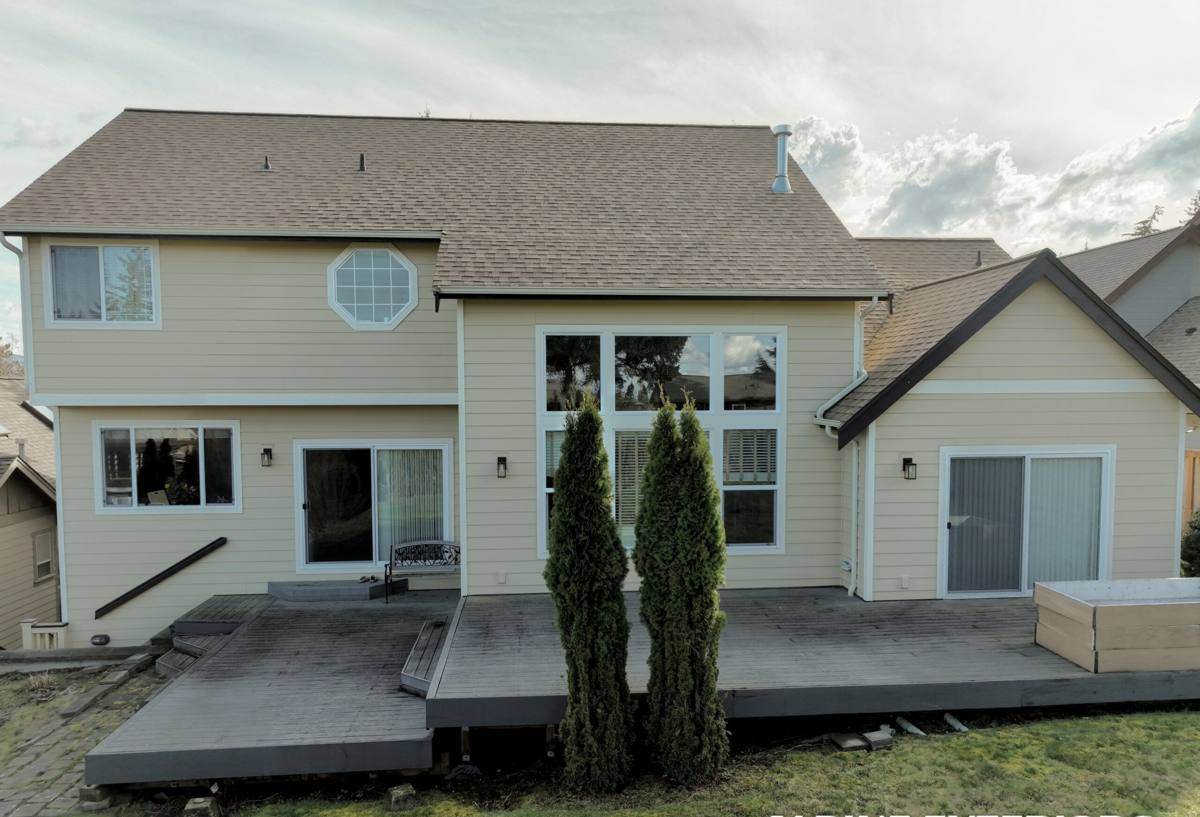
Signs a Deck Needs Replacement, Not Another Repair
We get calls for "a few loose boards" that turn out to be a structural problem, and we get calls for "the whole thing needs to go" that turn out to be fixable with new decking on a sound frame. The honest answer depends on what's happening below the surface, not just what you can see standing on top of it.
- Soft or spongy spots when you walk the deck, especially near the ledger board or stair stringers
- Visible rot, delamination, or crumbling at joist ends and post bases
- Rust streaking or corrosion on fasteners, hangers, and other hardware
- Persistent moss or algae that regrows within weeks of cleaning
- Gaps opening up between the ledger board and the house, or flashing that's pulled away
- Railings that flex or feel loose under normal pressure
- A deck more than 15-20 years old that has never had the substructure inspected
If the framing, ledger attachment, and footings are sound, resurfacing with new decking can be a legitimate option. If any of those structural elements are compromised, patching the surface just hides the problem for another season or two. We'll tell you honestly which situation you're in before we recommend a full tear-off.
What a Correct Deck Replacement Actually Involves
A deck replacement done right is more than swapping old boards for new ones. It starts with removing the existing structure down to whatever is sound and reusable — sometimes that's nothing, sometimes it's the footings — and rebuilding from there with materials and details matched to this climate.
The Structural Layer
Footings need to be checked for frost depth and settling, posts need to be plumb and properly anchored, and joists need to be sized correctly for the span and the load the deck will actually carry, including furniture, hot tubs, or anything else beyond typical foot traffic. This is also where we catch problems a homeowner would never see — undersized joists, footings poured too shallow, or framing that was never rated for the deck's real use.
The Ledger Connection
The ledger board — where the deck attaches to the house — is the single most common failure point we find in this region, and it's almost always a flashing problem rather than a fastener problem. Water works its way behind an improperly flashed ledger and rots the rim joist and sheathing behind it, sometimes for years before anyone notices from the outside.
The Surface Layer
Decking, fascia, and railings go on last, and this is where material choice and installation detail determine how the deck ages over the next decade or two, especially with the moss and moisture load Puget sees.
Decking Material Options for This Climate
There's no single "best" decking material — there's a best material for your budget, your maintenance tolerance, and how much moss and moisture exposure your specific lot gets. Here's how the common options actually compare once you factor in Bellingham's climate rather than a manufacturer's ideal-condition claims.
| Material | Upfront Cost | Maintenance Needed | Moisture/Moss Resistance | Realistic Lifespan Here |
|---|---|---|---|---|
| Pressure-treated wood | Lowest | Annual cleaning, periodic sealing | Fair — needs upkeep to stay ahead of moss and rot | 10-15 years |
| Cedar | Moderate | Regular cleaning and refinishing | Naturally decay-resistant but still needs care in wet exposure | 15-20 years |
| Composite | Moderate to higher | Occasional washing, no sealing | Good — resists rot but can still grow surface moss without cleaning | 20-25+ years |
| PVC/capped polymer | Highest | Minimal — light washing | Very good — fully sealed surface sheds water and resists moss growth | 25-30+ years |
Wood costs less upfront but asks for the most ongoing attention, which matters in a climate where skipping a season of sealing can let rot get a real foothold. Composite and PVC cost more to install but shed water and resist moss far better, which is often the deciding factor for homeowners tired of scrubbing green film off their decking every spring. We'll walk through the real trade-offs for your project rather than pushing one product line — the right call depends on how much maintenance you actually want to do.
Fasteners, Flashing, and Hardware: The Parts That Fail First
In a salt-air, high-rainfall environment like Puget, the hardware holding a deck together often fails before the decking boards themselves. This is one of the most overlooked parts of a deck replacement and one of the biggest differences between a deck that lasts and one that doesn't.
We use stainless steel or heavy hot-dip galvanized fasteners rated for coastal exposure, not the standard-grade hardware that's fine for drier inland builds but corrodes prematurely here. Ledger flashing gets installed as a full system — flashing, housewrap integration, and a drainage gap — rather than a single strip of metal that looks right but doesn't actually manage water. Joist hangers, post bases, and railing brackets all get matched to the same coastal-rated standard, because a deck is only as strong as its weakest connection, and in this climate that's almost always a piece of hardware nobody thought to upgrade.
Our Replacement Process
- On-site assessment — We inspect the existing structure, footings, ledger connection, and any moisture or rot damage, and give you a straight answer on repair versus replacement.
- Design and material selection — We go over decking material, railing style, and layout options based on your budget and how much maintenance you want going forward.
- Permitting — We handle the paperwork with the appropriate local jurisdiction so the work is inspected and up to code.
- Demolition — Careful removal of the old deck, keeping only what's structurally sound and worth reusing.
- Framing and flashing — Footings, posts, joists, and ledger flashing installed to hold up under Puget's rain and salt exposure, not just pass a one-time inspection.
- Decking and railings — Installed with coastal-rated fasteners and proper spacing for drainage and airflow underneath.
- Final walkthrough — We go over the finished deck with you, including basic care so it stays ahead of moss and moisture.
Permits and Code Considerations in Whatcom County
Most deck replacements that involve structural changes — new footings, a rebuilt ledger connection, or a deck attached at a height requiring guardrails — need a permit and inspection through the applicable local building department. Even projects that seem straightforward, like replacing an aging deck in roughly the same footprint, often still require permitting if the substructure is being rebuilt rather than just resurfaced. We handle this as part of the job so you're not left tracking down requirements or scheduling inspections yourself, and so the finished deck is documented as code-compliant if you ever sell the home.
Maintenance That Actually Extends the Life of a Puget Deck
Whatever material you choose, a little seasonal attention goes a long way in this climate. This is the same list we leave with homeowners after a replacement:
- Sweep debris and standing organic matter off the deck regularly, especially in fall
- Clean moss and algae buildup at least once a year, more often in shaded or low-airflow areas
- Check and clear gaps between boards so water can drain instead of pooling
- Inspect the ledger board and flashing annually for gaps or water staining on the siding above it
- Reseal wood decking on the manufacturer's recommended schedule, not just when it starts looking gray
- Look at fasteners and hardware for early rust or corrosion, particularly closer to the water
- Trim back vegetation that shades the deck and keeps it damp longer after rain
Why a Crew That Already Works Puget Makes a Difference
A deck replacement isn't just a build spec — it's a set of decisions about material, flashing, and hardware that have to match the specific conditions of where the house sits. A crew that regularly works in and around Bellingham and Whatcom County has already seen how salt air corrodes the wrong fasteners, how moss behaves on different decking surfaces through a wet winter, and where ledger flashing tends to fail when it's installed to a generic standard instead of a coastal one. That local pattern recognition is the difference between a deck that needs attention again in a decade and one that holds up the way it should.
If you're weighing repair versus replacement, or just want an honest read on what your current deck needs, we're happy to take a look. Reach out for a free, no-pressure estimate using the form below.