 Bellingham Siding
 Building Decks for South Hill's Particular Climate
South Hill sits up above the rest of Bellingham, and that elevation and exposure come with a trade-off. The views are real, but so is the weather that comes with them. Homes on South Hill catch wind and driving rain off Bellingham Bay more directly than properties tucked into lower, more sheltered parts of the city, and that combination of salt-tinged air and near-constant moisture is hard on any outdoor structure, decks included.
Whatcom County's wet season isn't a two-month event — it's most of the year. Add in the shade from mature trees common on South Hill lots, and you get long stretches where a deck surface simply doesn't fully dry out between rains. That's the environment moss, algae, and mildew thrive in, and it's exactly the environment composite decking was designed to handle better than wood.
What Homeowners on South Hill Actually Need From a Deck
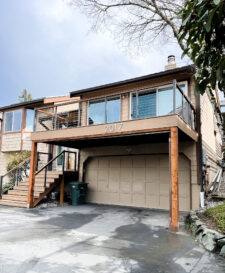
When we talk with South Hill homeowners about decking, the priorities are usually the same three things: something that won't rot or splinter in a few years, something that doesn't need to be stripped and re-stained every summer, and something that stays safe underfoot when it's damp — which, on South Hill, is most of the time. A wood deck can be beautiful, but it asks for a level of upkeep that a lot of busy households can't keep pace with in this climate. Composite decking, installed correctly, takes most of that maintenance burden off the table.
That last phrase — installed correctly — matters more than the marketing on composite decking packaging suggests. The material itself resists moisture and rot far better than wood, but a composite deck is only as good as the substructure, drainage, and flashing underneath it. We've seen composite decks fail early not because the boards were bad, but because the framing and moisture management underneath weren't built for a climate like ours.
Salt Air and Fasteners
Homes closer to the water's edge deal with airborne salt that accelerates corrosion on lower-grade hardware. It's a slower, quieter problem than a leaky roof, but over several seasons, standard fasteners and brackets can start to fail — which is a real safety issue on a structure people walk on. We spec corrosion-resistant, coated or stainless fasteners and structural hardware on every deck we build here, not as an upsell, but because it's the correct standard for this location.
Moss Season and Surface Drainage
Moss doesn't grow on a deck because the boards are dirty — it grows because moisture sits somewhere long enough to let it take hold. Board gapping, joist spacing, and slope all affect how fast water actually leaves the deck surface. A deck built with tight, poorly-spaced boards on a dead-flat frame will hold moisture in the gaps even if the boards themselves are moss-resistant composite. Getting the drainage geometry right during framing is what actually keeps moss from becoming a yearly power-washing chore.
Composite Decking Options and How They Compare
Not all composite decking is the same, and the differences matter more in a wet climate than in a dry one. Here's how the common categories stack up for a South Hill application:
| Material | Moisture Behavior | Maintenance | Best Fit For |
|---|---|---|---|
| Capped composite (wood-plastic composite with a protective shell) | Shell resists moisture absorption and staining; core is still wood-plastic blend | Occasional wash; no staining or sealing | Most South Hill homes — strong balance of cost, durability, and appearance |
| Uncapped composite | More prone to surface moisture absorption and mildew staining over time | Periodic cleaning, more attention in shaded areas | Budget-conscious projects in drier, sunnier yard locations |
| Cellular PVC decking | Contains no wood fiber, so it doesn't absorb moisture at all | Lowest maintenance of the group | Heavily shaded, low-airflow, or waterfront-adjacent South Hill lots |
| Traditional wood (for comparison) | Absorbs moisture readily; prone to cupping, splitting, and rot in wet climates | Annual sealing/staining recommended | Homeowners specifically wanting a natural wood look and willing to maintain it |
We don't push one brand or product line on every job. What we do is match the board type to the specific conditions of the lot — how much shade it gets, how close it sits to prevailing wind and rain, and how much upkeep the homeowner actually wants to commit to.
What a Correct Composite Deck Installation Involves
The board itself is the visible part, but most of what determines whether a deck lasts fifteen years or shows problems in three happens underneath it.
Substructure and Drainage
We frame to the joist spacing the manufacturer specifies for composite — this is tighter than typical wood-decking spacing in most cases, because composite boards flex differently under load and moisture than dimensional lumber. We also build in slope away from the house so water sheds off the deck surface instead of pooling, which is especially important on South Hill given how many rain events a deck here sees in a typical year.
Ledger Attachment and Flashing
Where the deck attaches to the house is the single highest-risk point for hidden water intrusion. If that ledger board isn't flashed correctly, water can work its way behind the siding and into the wall structure over time — a problem that stays invisible until it's expensive. We flash every ledger connection as if the house's structure depends on it, because it does.
Fastening and Board Gapping
Hidden fastener systems keep the deck surface clean and free of exposed screw heads that can loosen and become a snag or trip hazard. Board gapping is set to allow airflow and drainage without creating gaps wide enough to catch a heel or a dog's paw. Getting the spacing right is a small detail that has an outsized effect on how the deck performs through a wet Whatcom County winter.
Railings and Structural Connections
Composite decking codes and structural requirements have gotten more specific in recent years, particularly around railing post attachment and guardrail load ratings. We build to current code, not to whatever was standard when a neighboring deck went up ten or fifteen years ago.
Our Process, From Estimate to Finished Deck
- On-site walkthrough: We look at sun exposure, drainage patterns, existing structure (if replacing an old deck), and how the space will actually be used.
- Material and layout discussion: We go over board options, color, and layout with the homeowner, including honest trade-offs on cost and maintenance for each option.
- Written estimate: A clear, itemized quote — no vague allowances that turn into surprise costs later.
- Demolition and framing: Old decking is removed and the substructure is inspected or rebuilt to current code and to the load requirements of composite decking.
- Flashing and waterproofing: Every point where the deck meets the house gets flashed before any decking goes down.
- Decking installation: Boards, hidden fasteners, and trim are installed to manufacturer spec.
- Railings and final details: Guardrails, stairs, and lighting (if included) are installed and checked.
- Final walkthrough: We go over the finished deck with the homeowner before calling the job done.
Living With Moss, Mildew, and a Wet Climate
Even the best composite decking benefits from a little seasonal attention in a climate like ours. It's a fraction of what a wood deck demands, but it's not zero.
- Sweep leaves and debris off the deck regularly, especially in fall — trapped organic matter is what feeds moss and mildew growth.
- Rinse the surface with a garden hose every month or two during the wet season to keep pollen and grime from building up in the board texture.
- Use a soft-bristle brush and a mild soap-and-water solution for spots — avoid pressure washers on close settings, which can damage the board surface or void some manufacturer warranties.
- Keep planters and furniture legs off direct, permanent contact with the same spot on the deck to avoid trapping moisture underneath.
- Check railings and stair connections once a year for any looseness, especially after a hard winter.
- Clear gutters and downspouts near the deck so runoff isn't draining directly onto the deck surface or framing.
What Affects the Cost of a South Hill Composite Deck
| Factor | Why It Matters |
|---|---|
| Deck size and shape | Square footage and complexity (multiple levels, angles, cutouts) directly affect labor and material |
| Board tier | Uncapped, capped composite, and PVC decking carry different material costs |
| Substructure condition | Replacing failed or undersized framing adds cost but is not optional for safety or longevity |
| Height and railing requirements | Elevated decks need more substantial railing systems and stair structures |
| Site access | Steep South Hill lots or limited equipment access can affect demolition and material staging time |
| Flashing and waterproofing scope | Ledger board and house-connection detailing is not an area to cut corners on cost |
Composite decking generally costs more up front than pressure-treated wood, but the gap narrows — and often reverses — once you factor in years of staining, sealing, and board replacement that wood decking requires. We'll walk through real numbers for your specific project during an estimate rather than quoting a broad range that may not reflect your lot or layout.
Why Local Experience on South Hill Actually Matters
Decking looks like a straightforward trade from the outside, but the right approach on South Hill isn't identical to the right approach in a drier, more sheltered neighborhood elsewhere in Bellingham. A crew that regularly works this part of the city already knows how exposed a given lot is likely to be, how shaded yards typically stay through the wet months, and which framing and flashing details actually hold up here versus which ones just meet the minimum code requirement. That local pattern recognition shows up in fewer callbacks and fewer surprises for the homeowner down the road.
We're a Bellingham-based crew serving Whatcom County, and South Hill is a neighborhood we return to regularly. We're not guessing at what this climate does to a deck over time — we've seen it, and we build accordingly.
Get a Straightforward Estimate
If you're planning a new deck or replacing one that's showing its age, we're happy to take a look and give you an honest read on what your South Hill property needs — no pressure, no upsell script. Fill out the form below to schedule a free estimate.