 Bellingham Siding
 Why Ferndale Siding Takes a Different Kind of Beating
Ferndale sits close to the water just north of Bellingham, and that proximity changes what siding has to survive. Every home in Whatcom County deals with a wet Pacific Northwest climate, but Ferndale's location near the Strait adds a layer most inland towns don't fight: salt-laden air moving in off the water. Add driving rain that comes in sideways during winter storms, and a moss season that can stretch eight months or more in shaded or north-facing spots, and you get siding that ages on a different timeline than siding fifty miles inland.
We're not describing a disaster scenario — most siding in Ferndale holds up fine for years. But when it does fail, it usually fails for reasons specific to this environment: trapped moisture behind a surface that looked fine from the driveway, fastener corrosion nobody could see, or a moss mat that's been holding water against a wall for a season too long. Repairing that correctly means understanding the cause, not just patching the spot that looks bad.
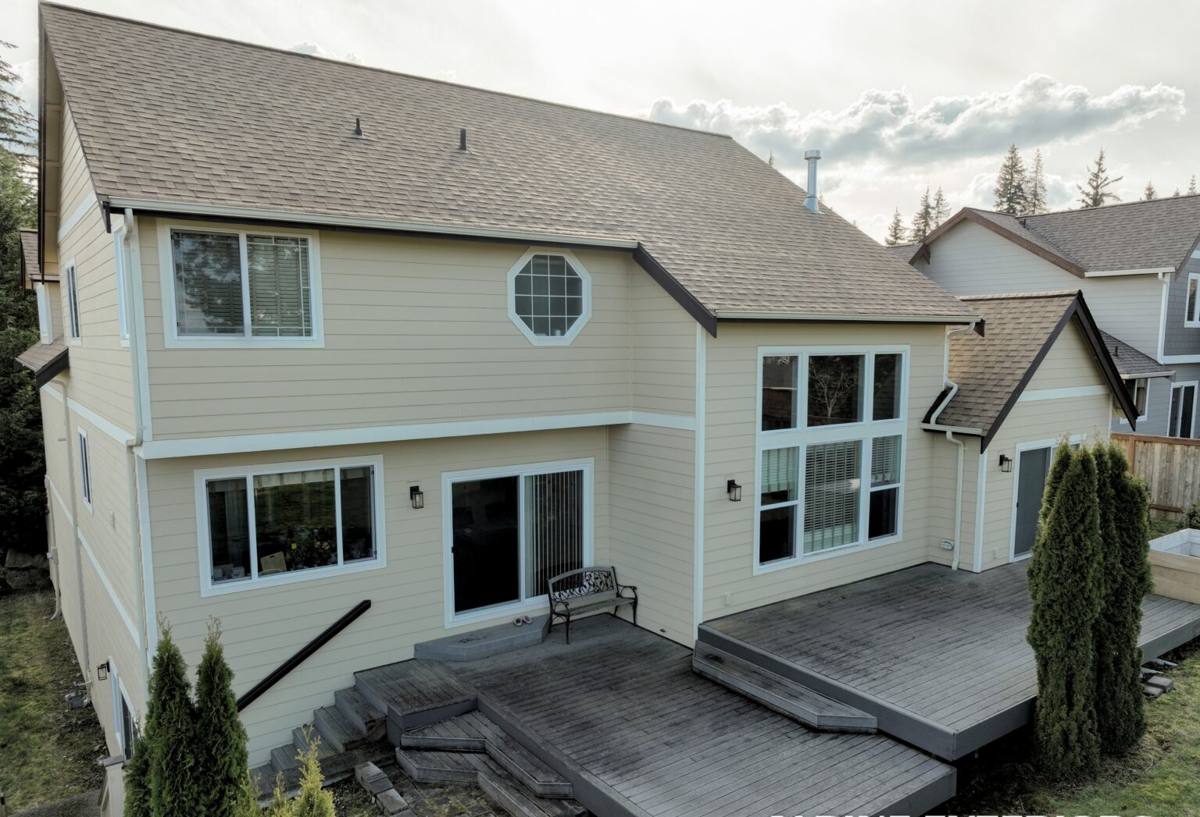
What Salt Air, Rain, and Moss Actually Do to Siding
Salt Air and Slow Corrosion
Airborne salt doesn't rot siding directly, but it accelerates corrosion of anything metal on the exterior — nails, fasteners, flashing, trim screws. Once a fastener starts corroding, it loses grip, siding boards work loose at the edges, and small gaps open up that let water behind the cladding. Salt exposure also breaks down some paint and coating systems faster than a dry inland climate would, which is part of why the coating on whatever siding you have matters as much as the siding itself.
Wind-Driven Rain and Hidden Moisture
Rain that falls straight down is manageable for almost any siding system. Rain that's being pushed sideways by wind off the water finds every seam, lap joint, and penetration that wasn't detailed correctly. It's not the volume of rain that causes problems here — it's the direction and duration. Water that gets behind siding during a storm and can't dry out before the next one arrives is what leads to rot in the sheathing, staining, and soft spots that show up months later, far from where the water actually got in.
Moss, Shade, and Prolonged Dampness
Ferndale has plenty of tree cover and north-facing walls that don't get much sun, which is exactly where moss thrives. Moss holds moisture against the siding surface long after the rest of the house has dried out. On wood-based products, that constant dampness is an invitation for rot. Even on more moisture-resistant materials, a thick moss mat traps debris and organic matter that can clog drainage paths and hold water where it doesn't belong.
Signs a Ferndale Home Needs Siding Repair, Not Just Paint
A fresh coat of paint can hide a lot of problems temporarily, which is exactly why so many siding issues get missed until they're expensive. Here's what actually indicates a repair need:
- Soft or spongy spots when you press on the siding, especially near the bottom courses or around windows and doors
- Visible gaps opening up at panel seams, corners, or where trim meets siding
- Paint that's bubbling, peeling, or failing in the same spots repeatedly, even after repainting
- Dark streaking or staining that follows a seam line rather than sitting on the open face of a panel
- Moss or algae buildup that keeps returning within a season of being cleaned
- Nail heads or fastener lines showing rust bleed through the paint
- Warping, buckling, or siding that no longer sits flat against the wall
- A musty smell near an exterior wall, or interior drywall staining that lines up with an exterior spot
What a Correct Siding Repair Actually Involves
Diagnose the Cause First
Replacing a damaged board without figuring out why it failed just buys you a few more years before the same spot fails again. Before we touch anything, we're looking for the actual water path — a failed kick-out flashing, a caulk joint that gave up, a moss mat that's been sitting against the wall, a fastener pattern that never should have been used in this climate. The repair has to address that cause, not just the symptom.
Match the Material and the Detailing
A repair that uses the wrong material, the wrong fastener, or the wrong lap detail can actually make things worse — it introduces a new weak point right next to the old one. Matching board profile, reveal, and coating matters for how the repair performs, not just how it looks.
Rebuild the Water Management, Not Just the Surface
Siding is a system — house wrap, flashing, drainage plane, and the cladding itself all work together. A repair that ignores the flashing or drainage behind a damaged section is a cosmetic fix, not a structural one. We rebuild the water management at the repair location so the fix actually lasts, rather than just replacing what's visible.
Repair or Replace? How We Help You Decide
Not every problem area means the whole house needs new siding, and not every "small" repair should be treated as small. Here's how we generally think about it:
| Factor | Repair Usually Makes Sense | Replacement Usually Makes Sense |
|---|---|---|
| Extent of damage | Isolated to one or two wall sections | Recurring across multiple elevations |
| Underlying cause | A single identifiable failure point (flashing, fastener, seal) | Systemic issue — original install or material problem throughout |
| Age of existing siding | Siding is otherwise sound and mid-life | Siding is near or past its expected service life |
| Material condition | Panels are structurally solid, damage is localized | Widespread rot, delamination, or warping |
| Match availability | Replacement material can be reasonably matched | Original product discontinued or badly faded/mismatched |
We'll tell you honestly which category your home falls into. A lot of repair calls really are repairs — we don't push full replacement when a targeted fix will hold up.
Why We Repair Into James Hardie Fiber Cement — Not Vinyl or LP SmartSide
When a repair requires new material — because the original product is discontinued, badly weathered, or not worth matching — we install James Hardie fiber cement, and only James Hardie. We don't install vinyl, LP SmartSide, or other wood-composite products, even for a partial repair, and we think that's worth explaining rather than just stating.
Vinyl siding can work fine in a lot of climates, but it's a poor match for the specific stresses Ferndale sees. It expands and contracts more with temperature swings, which can open gaps at seams over time, and it doesn't hold up as well against sustained wind-driven rain finding its way behind panels. Wood-based composite products like LP SmartSide use an engineered wood strand core — better than raw wood in some respects, but still a wood product at heart, meaning sustained moisture exposure (the kind moss season guarantees on shaded walls) is exactly the failure mode it's most vulnerable to.
James Hardie fiber cement is cement, sand, and cellulose fiber — it doesn't rot, it isn't a food source for moss or fungus, and it holds paint and factory ColorPlus finishes far longer in a salt-air, high-moisture climate than wood-based alternatives. It's also non-combustible, which matters given the Northwest's growing wildfire risk even in wetter counties like Whatcom. Hardie's HZ5 product line is specifically engineered for climates with the freeze-thaw and moisture cycling Western Washington sees. When we repair a Ferndale home, we want the fix to outlast the reason it was needed — not introduce a new material with a shorter track record in this exact environment.
Our Process for a Ferndale Siding Repair Call
- On-site assessment: we inspect the damaged area and probe adjacent sections to see how far the problem actually extends, not just where it's visible
- Root-cause identification: we trace the water path — flashing, seams, penetrations, moss buildup — before scoping any repair
- Honest scope and estimate: we tell you what needs to happen and what it costs, including whether we think it's a true repair or something bigger
- Removal and inspection of sheathing: once siding is off, we check the wall assembly underneath for rot or damage before closing anything back up
- Rebuild water management: flashing, house wrap, and drainage details are corrected at the repair location
- Install and finish: matched or replacement Hardie material is installed to manufacturer spec, sealed and finished correctly
- Final walkthrough: we show you what was found and what was done, in plain language
Why Hiring a Crew That Already Works Ferndale Matters
Siding repair done wrong in this climate doesn't just look bad — it fails again, often faster than the original problem. A crew that works Ferndale and the surrounding Whatcom County area regularly already knows which wall orientations take the worst weather, how aggressive moss growth gets in a typical shaded yard here, and what corners get cut on production-built homes that show up as repair calls years later. That local pattern recognition is the difference between a repair that solves the actual problem and one that just covers it up for a season.
It also means straightforward logistics — material sourcing, scheduling around Northwest weather windows, and being available if something needs a follow-up look. We're not driving in from out of the area for a one-time job; we're a crew based right here in Bellingham, working this region's homes on an ongoing basis.
If you're seeing soft spots, gaps, staining, or moss that won't quit on your Ferndale home's siding, we're glad to take a look. We'll give you a straight assessment of what's actually going on and a free, no-pressure estimate — no obligation, just an honest read on what your siding needs.