 Bellingham Siding
 Composite Decking in Columbia: Built for Bellingham's Wet Season
Columbia is one of Bellingham's established residential neighborhoods on the city's east side, with a mix of home ages, mature trees, and the kind of shaded, close-set lots common across older Bellingham neighborhoods. That tree cover is part of what makes the area attractive, and it's also exactly the condition that's hardest on an outdoor deck. Shade holds moisture on a deck surface long after the rain has stopped, and in a climate that already delivers salt-tinged marine air, wind-driven rain, and a moss season that can run most of the year, a deck built from the wrong material or installed with the wrong details starts breaking down faster than most homeowners expect.
Bellingham Siding Contractors builds and installs decks across Whatcom County, and composite decking is what we recommend by default for homes in wetter, shadier settings like Columbia. We also handle siding, roofing, and windows, which matters here because a deck is never really an isolated structure — it's attached to the house at the ledger board, and how that connection is built affects both the deck and the wall behind it. A deck project in this neighborhood is as much about protecting the house it's attached to as it is about the deck itself.
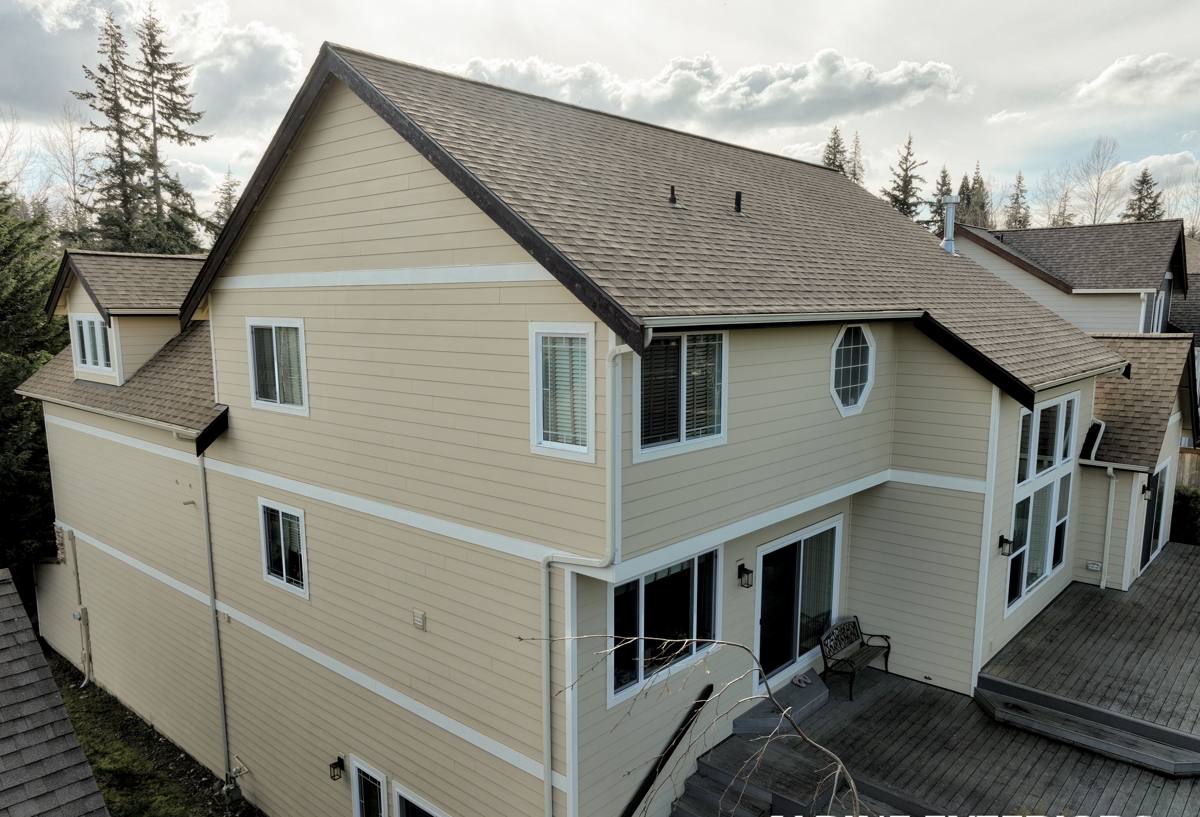
What This Climate Does to a Deck in Columbia
Moss, Algae, and Standing Moisture
Shaded decks in Columbia stay damp longer between rain events than a deck in full sun would, and that extended dampness is exactly what moss and algae need to take hold. On a wood deck, that moisture works its way into the grain and starts the slow process of rot. On lower-grade composite boards without a real capping layer, moisture can still get into exposed cores at cut ends and fastener holes, which is one of the most common complaints homeowners have about early-generation composite decking.
The Ledger Board: Where Most Deck Failures Actually Start
The ledger board is the piece that bolts the deck directly to the house, and it's the single most important detail on any deck build in this climate. If it isn't flashed correctly, water tracks behind it and into the rim joist and wall framing, often for years before anyone notices, because the damage is hidden behind the deck boards and the siding above it. We've seen this cause real structural problems on homes that otherwise looked fine from the yard. Getting the ledger flashing right is not optional, and it's not something a homeowner can verify by looking at the finished deck.
UV, Freeze-Thaw, and Salt-Tinged Air
Bellingham doesn't see the deep freeze-thaw cycling of colder inland climates, but it does see repeated freeze and thaw through the winter months, along with a steady dose of salt-carrying marine air. That combination is hard on fasteners, hardware, and any decking material that isn't dimensionally stable. Boards that expand and contract unevenly with moisture and temperature swings tend to cup, crown, or pull at their fasteners over a few seasons, which is part of why material choice matters as much as installation quality.
Why Composite Decking Makes Sense for Columbia Homes
We don't treat composite decking as automatically superior to wood in every situation, but for shaded, moisture-heavy lots like the ones common in Columbia, it solves problems that wood decking in this climate struggles with. Modern capped composite boards use a plastic-and-wood-fiber core wrapped in a protective shell, which means the board doesn't absorb water the way solid wood does, doesn't need annual staining or sealing, and resists the mold and mildew staining that shows up fast on shaded wood decking here. That matters more in a neighborhood with mature tree cover than it would on an open, sun-exposed lot, because shaded wood decking in this climate can start showing moss and soft spots within just a few seasons if it isn't maintained closely.
That said, composite isn't free of trade-offs, and we'd rather explain them upfront than have a customer discover them later. Composite decking costs more than pressure-treated lumber at the outset. Lower-quality or uncapped composite products can still take on moisture at cut ends if they aren't properly finished during installation. And composite boards need a correctly built substructure underneath them — they don't forgive a sagging or poorly spaced frame the way a homeowner might assume a "maintenance-free" product would. The material solves a real problem for this climate; it doesn't remove the need for correct installation.
Composite vs. Pressure-Treated Wood vs. Cedar
| Material | Moisture & Moss Behavior | Typical Maintenance | Realistic Lifespan Here |
|---|---|---|---|
| Capped composite | Resists water absorption and moss staining well; core protected by outer shell | Low; periodic washing to clear surface debris | 25-30+ years |
| Pressure-treated lumber | Absorbs moisture readily; prone to moss growth and splitting in shaded, damp spots | High; regular staining or sealing, board replacement over time | 10-15 years with diligent upkeep |
| Cedar | Naturally rot-resistant compared to other softwoods, but still absorbs moisture and grays or stains without upkeep | Moderate to high; periodic sealing to hold color and resist moisture | 15-20 years with diligent upkeep |
Cost, look, and how long you plan to stay in the home all factor into this decision. Upfront material cost is usually the biggest driver of price, but framing complexity, deck height, stairs, and railing style all add to the total, and a shaded Columbia lot with limited access can add labor time that a flat, open backyard wouldn't. We'll walk through the real trade-offs for your specific lot rather than defaulting to whichever material is easiest to sell.
Choosing a Board Color for a Shaded Lot
Board color is partly a style choice, but on a shaded property it also has a practical side. Very light, uncapped or lower-grade boards can show algae streaking and dirt more visibly over time in a damp, shaded setting, while darker or multi-tonal composite colors tend to mask the kind of surface debris and organic staining that's harder to avoid under mature trees. It's a small decision compared to the structural details underneath the deck, but it's worth factoring in if your lot in Columbia gets significant shade for much of the day.
What a Correct Composite Deck Build Requires
Substructure and Footings
Composite decking is only as good as the frame underneath it. That means footings set to the proper depth for this region's frost conditions, joists spaced correctly for the specific composite product being installed (composite generally needs tighter joist spacing than solid wood), and a frame that's level and properly braced before a single board goes down.
Ledger Flashing and Fastening
Where the deck attaches to the house, we install proper flashing that sheds water away from the band board and wall framing, along with lag bolts or through-bolts rated for the load, not just deck screws. This is the detail we treat as non-negotiable, because it's the one most likely to cause hidden damage to the house itself if it's done wrong.
Drainage, Board Spacing, and Fastening Systems
Composite boards need consistent gapping to let water drain through rather than pool on the surface, and joist tape over the frame helps keep moisture off the wood substructure underneath. Hidden fastener systems, which most composite manufacturers now support, give a cleaner surface and avoid the exposed screw heads that can trap water and stain over time.
Railings and Code
Any elevated deck in Bellingham needs a railing system that meets current building code for height and baluster spacing, and most attached decks above a certain height or size require a permit through the City of Bellingham before work starts. We handle that process as part of the job rather than leaving it for the homeowner to sort out.
How We Approach a Composite Decking Project in Columbia
Every deck starts with an on-site look at the actual lot, not a phone quote. From there, our process generally follows the same sequence:
- Walk the property to assess grade, drainage, shade exposure, and how the deck will tie into the existing structure
- Confirm footing depth and substructure design appropriate for the deck's size and this region's soil and frost conditions
- Pull permits through the City of Bellingham where required, before any framing begins
- Build and inspect the substructure, including proper ledger flashing at the house connection
- Install composite decking with correct board spacing and a hidden fastener system where the product supports it
- Install code-compliant railings and any stairs, then do a final walk-through with the homeowner before we consider the job done
Repair, Refresh, or Replace: Signs Your Deck Needs Attention
Not every aging deck in Columbia needs to be torn out and rebuilt. What it needs depends on where the problem actually is.
- Soft, spongy, or visibly rotted boards, especially near the ledger board or in shaded corners
- Moss or algae staining that returns quickly after cleaning
- Loose, wobbly, or visibly rusted railings and fasteners
- Gaps or separation where the deck meets the house, which can signal a failing ledger connection
- Cupped, crowned, or unevenly warped boards
- A deck surface that stays damp or slick well after the rest of the yard has dried out
A deck with a sound frame and a failing ledger connection or a handful of damaged boards is often a repair, not a full rebuild. A deck with widespread rot in the substructure, or one that was never properly flashed at the house, usually isn't worth patching. We'll tell you honestly which situation you're in before recommending either one, and we won't push a full rebuild when a targeted repair genuinely solves the problem.
Why a Crew That Already Works Columbia Matters
A crew that builds decks across this part of Whatcom County regularly sees how shade, moisture, and marine air actually behave on real lots, not just how a decking product performs on a spec sheet. That shows up in small but real decisions on a Columbia job: how much extra attention a north-facing, tree-shaded section of yard needs compared to a more open lot, how tight board spacing should be for a specific site's drainage, and where ledger flashing deserves extra care because of how a particular house was originally built. Those are the details that separate a deck that holds up for decades from one that starts showing problems within a few wet seasons. It also means showing up already familiar with the permitting process through the City of Bellingham, rather than learning it for the first time on your job.
If you're planning a new deck, replacing an aging one, or just want an honest read on what a deck in Columbia actually needs, we're glad to take a look. Reach out using the form below to schedule a free, no-pressure estimate.