 Bellingham Siding
 Getting Siding Installation Right for a Lynden Home
Siding installation looks straightforward from the curb — panels go up, seams get sealed, the house gets painted or comes pre-finished, done. In practice, installation is where a siding job either earns its 30-to-50-year lifespan or starts failing quietly within a handful of wet seasons. That gap matters more in Lynden and the rest of Whatcom County than in a lot of the country, because the climate here doesn't forgive shortcuts the way a drier region might. Salt-laden marine air, wind-driven rain that hits walls sideways instead of straight down, and a moss season that runs most of the year on shaded siding all put steady pressure on whatever's covering a house. A siding product rated for this climate still fails if it's installed like it wasn't.
This page is about the installation itself — what a correct job actually involves on a Lynden property, what we install and why, and how the process runs from first look to finished wall. We install James Hardie fiber cement siding exclusively. That's a professional standard, and understanding what goes into a proper installation is a big part of understanding why we've settled on one system rather than offering a menu of options.
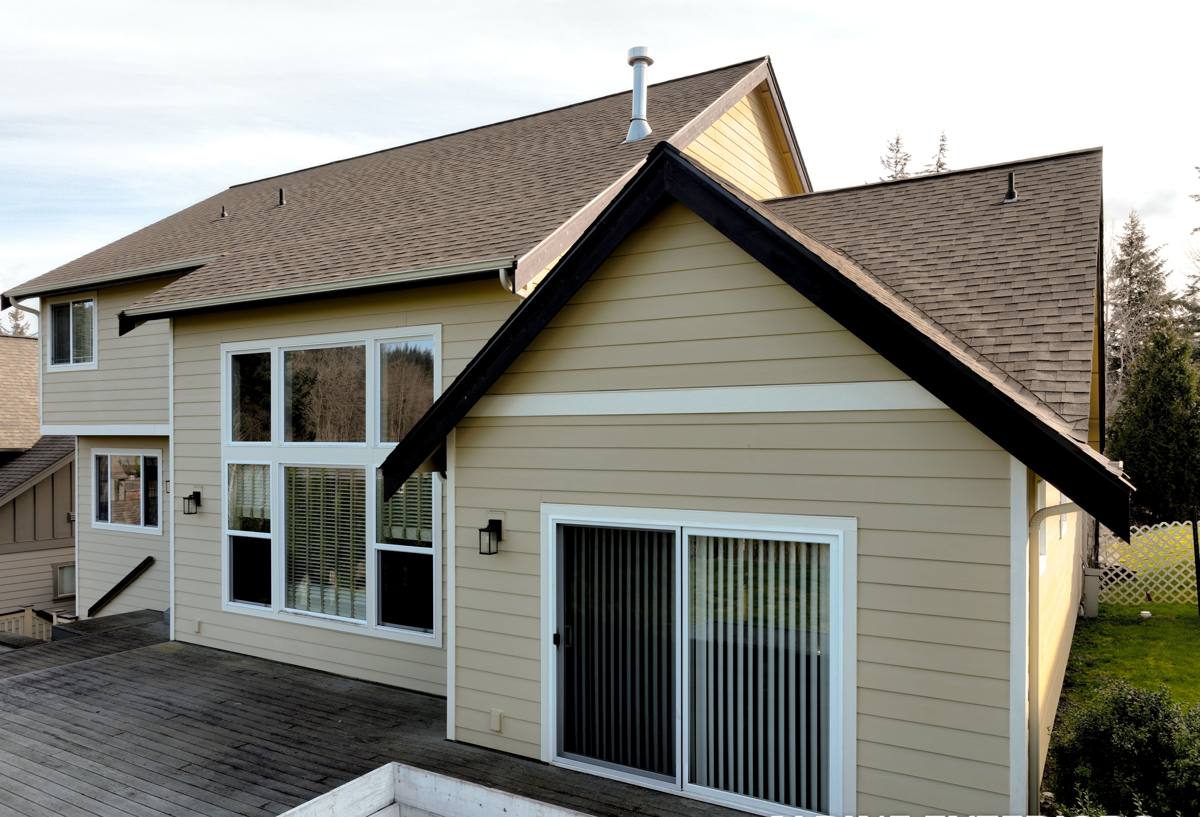
Why Installation Quality Matters More Here Than the Brochure Suggests
Wind-Driven Rain Finds Gaps, Not Just Surfaces
Rain in this part of Whatcom County rarely falls straight down through fall and winter. Wind pushes it sideways into wall assemblies, and that lateral pressure is what forces water into any gap, unsealed joint, or shortcut in the weather barrier behind the siding. A siding material can be excellent and still let water in if the house wrap, flashing, and butt joints underneath it weren't installed with that sideways load in mind.
Salt Air Works on Fasteners and Trim
Lynden sits inland enough that people sometimes assume salt exposure isn't a factor. It still is — marine air moves across this whole region, and over years it accelerates corrosion on lower-grade fasteners, flashing, and trim hardware. Installation-stage decisions about fastener type and trim material show up as rust streaking and loosened boards a decade later if they're cut corners at the time.
A Long Moss and Mildew Season
Mild temperatures and near-constant moisture add up to a moss season that can run close to year-round on shaded, north-facing walls. Installation details like proper clearance above grade, correct panel gapping, and adequate ventilation behind the cladding all affect how much moisture a wall assembly holds onto — and how much of a growth surface it becomes over time.
What a Correct Siding Installation Actually Involves
A siding installation is really a sequence of smaller jobs stacked on top of each other, and each one has to be done right for the next one to matter.
Tear-Off and Sheathing Inspection
Old siding has to come off before anyone can see what's really underneath. This is the point where rot, soft sheathing, or hidden moisture damage from a previous roof or window leak gets found — or doesn't, if a crew is moving fast and just wants the old material off the wall. Covering damaged sheathing with new siding hides the problem instead of fixing it, and that problem doesn't go away; it just gets more expensive to reach later.
Weather-Resistive Barrier
A house wrap or equivalent weather-resistive barrier goes over the sheathing before any siding goes up. This layer is the actual first line of defense against wind-driven rain, and it needs to be installed with correct overlaps and taped seams so water sheds down and out rather than working its way in at a horizontal lap.
Flashing at Every Penetration
Windows, doors, hose bibs, light fixtures, vents — every place something punches through the wall plane is a place water can get behind the siding if it isn't flashed correctly. This is the step that's easiest to rush and hardest to inspect once the siding is up and painted, which is exactly why it deserves the most attention rather than the least.
Fastening and Clearances to Manufacturer Spec
James Hardie's warranty is contingent on installation following their published specifications — correct fastener type, spacing, and depth; minimum clearance above grade, roofline, and decks; proper gapping at butt joints and trim. These aren't suggestions. Installing outside spec can void the warranty even if the siding itself is a genuine Hardie product, which is why we treat the spec sheet as the baseline for every job, not an upsell option.
Field Cutting, Sealing, and Finish Work
Fiber cement has to be cut and sealed correctly at every field edge to protect the cut face from moisture intrusion — factory edges are pre-sealed, but any cut made on site needs the same protection. Caulking at trim joints, careful attention to corners, and a clean finish around windows and doors are what separate a job that looks good on install day from one that still looks good in year ten.
Final Walkthrough
We walk the finished job with the homeowner before calling it done — reviewing what was installed, covering basic care and maintenance expectations, and confirming everything matches what was estimated.
Why We Install Only James Hardie Fiber Cement
We used to install a broader range of siding products. We narrowed to one system after seeing repeatedly what actually holds up through Whatcom County winters versus what looks good on a spec sheet and struggles a few wet seasons into real use.
- Non-combustible core: Fiber cement doesn't feed a fire the way wood-based siding can, which matters for both safety and insurance considerations.
- Factory-applied ColorPlus finish: Baked on in a controlled factory process rather than applied in the field, holding color and adhesion far longer under sustained moisture and UV exposure than a field-applied finish.
- Climate-engineered HZ product line: Hardie's HZ5 formulation is built for regions with significant moisture exposure and freeze-thaw cycling — a close match for Lynden and the rest of Whatcom County.
- Dimensional stability: Fiber cement doesn't swell, cup, or warp the way engineered wood siding can after repeated wetting cycles.
- A strong transferable warranty: Backed by one of the more substantial warranty structures in the industry, provided installation follows Hardie's published specs — which is the installation-quality argument this whole page is built around.
We don't install LP SmartSide, vinyl siding, Cemplank, Allura, primed spruce, or cedar. Each has a place in the market, and plenty of homeowners are satisfied with them elsewhere. Our position is a professional one: in a climate that puts this much sustained moisture and salt exposure on a wall, we'd rather install one system correctly and stand fully behind it than offer a lower-cost option that quietly shifts maintenance risk onto the homeowner down the road.
Installation Mistakes That Show Up Later, Not on Day One
| Installation shortcut | How it shows up later on a Lynden home |
|---|---|
| Insufficient clearance above grade or roofline | Wicking moisture into the bottom edge of siding, leading to swelling or staining at the base of walls |
| Skipped or poorly lapped weather barrier | Water intrusion at wall seams that surfaces as interior staining or hidden sheathing rot |
| Unsealed field cuts | Moisture absorption at cut edges, often the first place fiber cement shows deterioration |
| Incorrect fastener spacing or type | Panel movement, cracking, or rust streaking from corroding fasteners |
| Rushed flashing around windows and penetrations | Slow leaks that are difficult to trace and often blamed on the siding material itself |
Signs an Existing Lynden Home Needs New Siding Installed
- Moss or dark staining that returns quickly after cleaning, especially on shaded or north-facing walls
- Soft or spongy siding, particularly low on the wall or around window and door trim
- Peeling paint, cupping, or visible warping on older wood-based or engineered wood siding
- Cracked, buckled, or missing panels after a windstorm
- Rust staining running down from fasteners or trim hardware
- Musty odors or staining on interior walls that back up to exterior siding
- Existing siding older than 20-25 years with no documented replacement history
None of these automatically mean a full tear-off and reinstall, but each is worth a professional look before the next wet season adds to whatever damage is already there.
What Drives the Cost of a Siding Installation
Every estimate is specific to the house, but a handful of factors consistently move the number on a Lynden project:
| Factor | Why it matters |
|---|---|
| Total square footage and number of stories | More wall area and height both add material and labor time, and multi-story work adds scaffolding or lift needs |
| Sheathing condition once old siding is off | Rot or moisture damage found during tear-off has to be repaired before new siding goes on, which isn't knowable until the wall is open |
| Amount of trim and detail work | Homes with more window and roofline detail take more time to flash and finish correctly |
| James Hardie product line and color selected | Different HardiePlank, HardiePanel, and HardieShingle options carry different material costs |
| Site access | Tight lots, fencing, or landscaping close to the walls can add labor time for staging and cleanup |
We walk through these factors specifically during the estimate so a homeowner understands what's driving the number, rather than being handed a flat per-square-foot figure with no explanation behind it.
Why Hiring a Crew That Already Works in Whatcom County Matters
A siding installer who works this region regularly has already made the calls that matter for a Lynden house — how much clearance a given wall orientation actually needs, where extra flashing attention pays off, which field details are worth the extra time so a callback isn't needed two winters later. That's different from installation experience gained somewhere with a drier climate or less wind-driven rain, where some of these details simply don't come up as often. It also matters after the job is done: if a warranty question or maintenance issue comes up years later, it helps to be talking to a crew still working in the same county rather than trying to track down someone who's moved on.
If your Lynden home needs new siding installed, or you'd like an honest look at what your current siding will need in the next few years, we're glad to come take a look. Reach out using the form below for a free, no-pressure estimate.