 Bellingham Siding
 Why Roofs in York Wear Faster Than the Brochure Says
York is one of Bellingham's older, more established neighborhoods, and that comes with a lot of mature tree canopy, tucked-in lots, and roofs that spend most of the year in some combination of shade, rain, and salt-tinged air off Bellingham Bay. That combination is harder on a roof than most manufacturer warranties assume. Shingles rated for a "normal" climate are tested against sun and heat cycling, not against months of low sun angle, standing damp, and moss that never fully dries out between storms.
When we replace a roof in this part of Whatcom County, we're not just matching a spec sheet to a house — we're accounting for how the roof will actually behave here: how fast moss colonizes a north-facing slope under mature trees, how driving rain off the bay pushes water sideways under poorly lapped flashing, and how salt-laden air accelerates corrosion on exposed fasteners and metal components. A roof installed without that context can look fine for a year or two and then start failing in ways that are expensive to trace back to installation shortcuts.
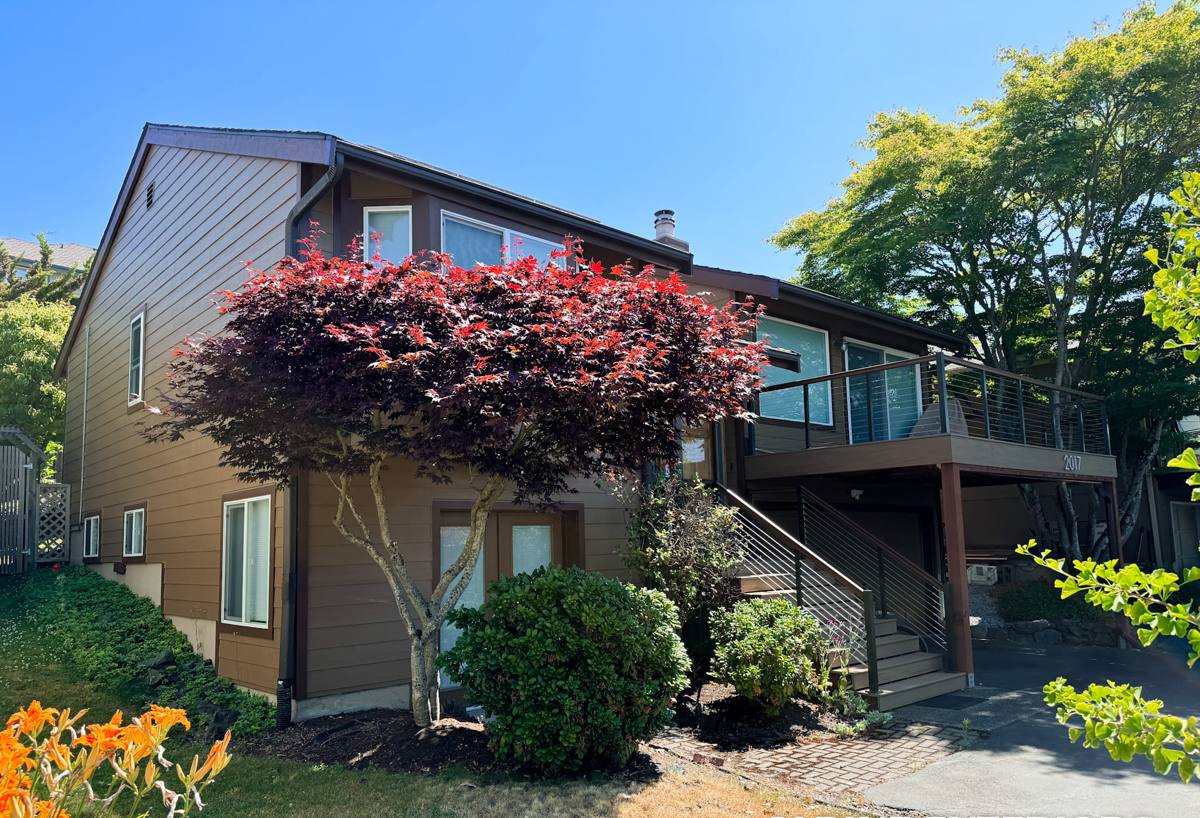
What a Correct Tear-Off and Replacement Actually Involves
"New roof" gets used loosely. A correct full replacement is a specific sequence of steps, and skipping or rushing any one of them is where most premature failures start.
- Full tear-off to the deck — no overlaying a new layer on old, failing shingles, which traps moisture and voids most manufacturer warranties.
- Deck inspection and repair — soft, delaminated, or water-stained sheathing gets replaced, not covered up. This is the step that's easiest to shortcut and the most consequential to skip.
- Ice-and-water shield at eaves, valleys, and around every penetration — the areas where wind-driven rain and moss dams are most likely to force water backward under the shingle field.
- Synthetic underlayment across the full deck as a secondary water barrier, since shingles alone are not a waterproof system — they're a shedding layer that depends on what's underneath it.
- New flashing at every roof-to-wall transition, chimney, skylight, and vent — reused flashing is a common source of leaks that show up months after the job is "done."
- Balanced intake and exhaust ventilation, covered in more detail below.
- Correct fastening and nailing pattern matched to the shingle manufacturer's wind rating — not just "enough nails," but the right count in the right zone.
Any one of these done wrong won't necessarily show up on the final walkthrough. It shows up two, five, or ten years later, usually as a leak that's blamed on "just an old roof" when it was actually an installation gap from day one.
Choosing a Roofing Material for a York Home
Most homes in this neighborhood are well suited to laminate (architectural) asphalt shingles, but metal roofing is worth a serious look on steeper pitches or homes with heavy tree cover, since it sheds moss and debris more effectively than any shingle. We don't install cedar shake or wood shingle roofs as a standard offering — in a climate with this much sustained moisture and shade, wood roofing requires a level of ongoing maintenance and moss management that most homeowners don't want to sign up for, and the moisture-related failure modes are harder to catch early than with asphalt or metal.
| Material | Typical Lifespan Here | Moss/Moisture Behavior | Best Fit |
|---|---|---|---|
| 3-tab asphalt shingle | 15–20 years | Lower wind rating, moss takes hold faster on shaded slopes | Budget-driven projects, low-slope simple roofs |
| Architectural (laminate) shingle | 25–30 years | Algae-resistant granule options available; better shedding profile | Most York homes — best balance of cost, durability, and appearance |
| Standing seam metal | 40–50+ years | Sheds moss and debris very well; minimal maintenance | Steep pitches, heavy tree cover, homeowners planning to stay long-term |
| Cedar shake/shingle | Varies widely | High maintenance burden in shaded, damp conditions | Not part of our standard recommendation in this climate |
Within architectural shingles, algae-resistant (AR) products use copper-infused granules that slow the growth of the black streaking common on north-facing, tree-shaded roofs. It's not a permanent fix, but it meaningfully extends the time between the roof looking new and looking neglected.
Ventilation: The Part of the Roof You Never See
Attic ventilation doesn't get much attention because it's invisible from the ground, but it directly determines how long the roof deck and shingles last. A balanced system pulls cool, dry air in low (soffit vents) and pushes warm, moist air out high (ridge vent), keeping the underside of the deck dry year-round. In a climate as consistently damp as Whatcom County's, an unbalanced or blocked system traps moisture in the attic, which shows up as premature deck rot, mold, and shingles failing from underneath rather than from weather exposure on top.
On older York homes, we frequently find soffit vents that were painted over, insulation stuffed against them, or a ridge vent that was never properly cut into the deck during a past reroof. Fixing ventilation is part of doing a replacement correctly — not an upsell.
Moss, Algae, and Salt Air: Managing the Long Game
No roofing material is permanently moss-proof in this environment, but the right installation choices slow it down considerably. Zinc or copper strips installed near the ridge release trace metal ions with every rain, which suppresses moss and algae growth on the slopes below. Combined with algae-resistant shingles and keeping gutters clear so water doesn't back up under the shingle edge, this is the most effective long-term approach — far more effective than pressure-washing a roof after moss has already established itself, which can strip granules and shorten the shingle's life.
Salt air off the bay is a slower, quieter problem: it accelerates corrosion on exposed fasteners, flashing, and metal roof panels. We use fastener and flashing materials rated for coastal exposure rather than the cheapest standard-grade hardware, which matters more here than it would 30 miles inland.
How Our Installation Process Works
Every full roof replacement follows the same sequence, whether the house is a small bungalow or a larger two-story:
- On-site inspection — we walk the roof and attic, not just the ground-level view, to assess deck condition, existing ventilation, and problem areas.
- Written estimate — material options, scope, and pricing laid out clearly, with no vague allowances.
- Permit handling — we pull the required City of Bellingham or Whatcom County permit so you don't have to navigate that process yourself.
- Material delivery and site protection — landscaping, siding, and windows get protected before tear-off begins.
- Full tear-off and deck inspection — any compromised sheathing is identified and replaced.
- Underlayment, flashing, and shingle installation — installed to manufacturer specification for full warranty coverage.
- Ventilation correction if intake or exhaust airflow is inadequate.
- Full site cleanup including magnetic sweep for stray nails.
- Final walkthrough so you can see the finished work and ask questions before we consider the job done.
Permits, Access, and Working Around Mature Trees
A reroof in Bellingham generally requires a building permit, and we handle that as part of the job rather than leaving it to the homeowner. In an established neighborhood like York, the bigger practical challenge is usually site access and tree cover — narrower lots, mature landscaping close to the house, and overhanging limbs that need to be worked around (or trimmed back, with your approval) for safe tear-off and material staging. Crews unfamiliar with this kind of lot layout tend to underestimate setup time and end up damaging landscaping or leaving debris behind. We plan for it up front.
Why Hire a Crew That Already Works in York
The technical side of roofing — flashing details, nailing patterns, ventilation math — is the same everywhere. What changes neighborhood to neighborhood is everything around the technical work: knowing what deck condition to expect under a given roof age, how much moss buildup is normal versus a sign of a deeper moisture problem, how to stage equipment on a tight older lot without tearing up the yard, and how local permitting actually moves. A crew that's worked in York before isn't guessing at any of that, which shows up in fewer surprises mid-project and a cleaner job site throughout.
What Drives the Cost
Every roof is priced individually, but the same factors move the number up or down on almost every job in this area:
| Factor | Why It Matters |
|---|---|
| Roof size and number of stories | More square footage and harder access both add labor time |
| Pitch and complexity | Steep roofs and multiple valleys/dormers take longer to flash correctly |
| Deck condition | Rotten or delaminated sheathing found during tear-off adds material and labor |
| Material choice | Standing seam metal costs more up front but less over its lifespan than repeated shingle replacements |
| Layers to remove | Tearing off two layers of old shingles takes longer than one |
| Tree cover and site access | Tight, shaded lots typical of older York properties can add setup and cleanup time |
We'd rather walk your roof and give you a real number than throw out a broad estimate that doesn't hold up once we're up there. If your roof in York is showing granule loss, persistent moss, curling edges, or you're just past its expected lifespan, we're happy to take a look and give you a straightforward, no-pressure estimate — use the form below to get started.