 Bellingham Siding
 Lynden's Climate Puts Real Demands on Siding
Lynden sits inland from Bellingham Bay in the flat, open farmland of the Nooksack Valley, but "inland" doesn't mean sheltered. Pacific storm systems move through Whatcom County carrying moisture-laden air off the Salish Sea, and that moisture doesn't stop at the coastline — it rides the wind straight across open fields and settles on every exposed wall in town. Add a long, gray wet season that runs roughly from October through April, and siding here spends most of the year damp.
Driving Rain and Wind Exposure
Because so much of Lynden and the surrounding county is open farmland, homes don't always get the wind-buffering that denser neighborhoods provide. Wind-driven rain can push water sideways into seams, laps, and trim joints that would stay dry on a calmer site. Siding that isn't installed with correct flashing and clearances will eventually let that water find a way in.
Moss, Algae, and Prolonged Dampness
Whatcom County's moss season is long, and it's not limited to roofs. North-facing walls, siding shaded by trees or outbuildings, and low areas near grade stay damp for extended stretches, which is exactly the environment moss and algae need to take hold. Materials that absorb moisture or that rely on a field-applied paint film to keep water out are the first to show streaking, soft spots, and green or black staining.
Temperature Swings and Material Fatigue
Whatcom County doesn't see extreme freeze-thaw cycling the way inland climates do, but it does see steady swings between damp, cold nights and milder days. Over years, that cycle stresses any siding material that expands, contracts, or absorbs water unevenly — which is part of why the product choice matters as much as the installation.
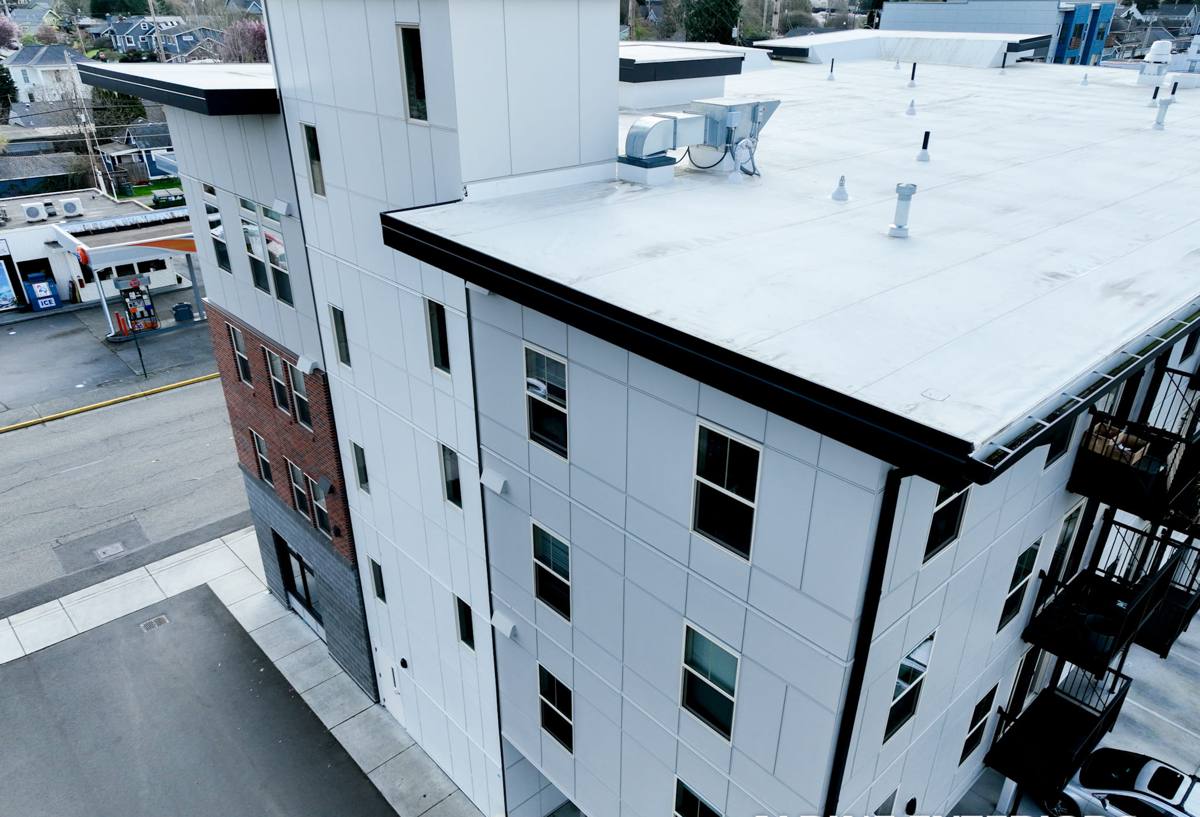
Why Fiber Cement Fits Conditions Here
Fiber cement siding is manufactured from cement, sand, and cellulose fiber, which makes it dimensionally stable in a way that wood-based and vinyl products aren't. It doesn't swell when it absorbs ambient moisture, it doesn't warp in the sun, and it won't rot, delaminate, or feed mold the way wood and some engineered wood siding products can when they stay damp for months at a time. For a climate like Whatcom County's, where "damp" is the default condition for half the year, that stability is the whole point.
Fiber cement is also non-combustible, which matters for wildfire ember exposure during dry summer stretches, and it holds a factory-applied finish far longer than field-painted materials, which reduces how often a homeowner has to think about repainting in a climate where painting windows are limited by rain.
Why We Install Only James Hardie
We don't install every fiber cement product on the market — we install James Hardie exclusively, and we don't install vinyl, LP SmartSide, or unfinished wood siding at all. That's a deliberate standard, not a sales preference. Hardie engineers its siding by climate zone (HZ5 for the Pacific Northwest), which means the product's moisture and thermal performance is matched to exactly the kind of weather Lynden gets. Their ColorPlus factory finish is baked on and warrantied against fading and peeling, which matters in a region where a homeowner shouldn't have to schedule repainting around the rain.
We've seen what inconsistent field performance looks like when a crew installs whatever product a homeowner asks for. Standardizing on one manufacturer, one installation spec, and one crew that knows that spec cold means fewer callbacks, fewer surprises, and siding that actually performs the way it's supposed to for the decades Hardie backs it for.
The Hardie Lineup We Use on Whatcom County Homes
Most Lynden homes end up on one of two Hardie profiles, sometimes combined for visual interest:
- HardiePlank lap siding — the standard horizontal siding profile, available in several exposure widths and textures, and the most common choice for full re-sides.
- HardieShingle siding — a shingle profile often used as an accent on gables, dormers, or entry features to break up large wall planes.
- HardieTrim boards — used at corners, window and door casings, and fascia to match the durability of the field siding instead of mixing in a wood trim product that will weather differently.
All of it is specified in the HZ5 exposure zone, which is Hardie's engineering designation for regions with the Pacific Northwest's combination of moisture and moderate freeze exposure.
What Correct Installation Involves
Fiber cement performs well, but only when it's installed to Hardie's published specifications. This is where a lot of the real-world failures we get called out to inspect actually originate — not in the material, but in shortcuts taken during installation.
- Weather-resistive barrier installed and lapped correctly behind the siding, with no gaps at seams or penetrations.
- Proper clearance maintained between the bottom of the siding and the roofline, deck, and grade — Hardie specifies minimum gaps to keep the plank out of standing water and splash-back.
- Flashing installed at every window, door, and horizontal trim transition, not just caulk covering the gap.
- Fasteners placed at the correct spacing and distance from panel edges, driven flush rather than overdriven, which can crack the board or compromise its water resistance.
- Panel and trim gaps sized correctly and sealed only where Hardie's details call for sealant — not everywhere, which traps moisture instead of shedding it.
- Cut edges primed or painted before installation, since factory finish doesn't extend to field cuts.
Any one of these done wrong won't necessarily show up right away. It shows up two or three wet seasons later, as staining, soft trim, or water intrusion at a window — which is often long after the crew that cut corners has moved on.
Our Process for Lynden Projects
We start with an on-site look at the existing siding and, where it's exposed, the sheathing underneath — on older Lynden homes that's sometimes the first sign of a moisture problem that's been developing behind the walls for years. From there we walk the homeowner through what a full tear-off will reveal versus what can be reasonably assessed up front, because we'd rather set honest expectations than surprise anyone mid-project.
Installation follows Hardie's written specification for HZ5 exposure — correct barrier, correct flashing, correct fastening, correct clearances — and we do a final walk-through before we call the job finished, checking seams, trim, and caulk lines while everything is still accessible.
Fiber Cement vs. Other Siding Options in This Climate
Homeowners comparing siding materials for a Whatcom County home are usually weighing the same handful of factors. Here's how fiber cement stacks up against the alternatives most commonly considered for a re-side:
| Factor | James Hardie Fiber Cement | Vinyl | Wood / Engineered Wood |
|---|---|---|---|
| Moisture resistance | Dimensionally stable, engineered for the region | Doesn't absorb water, but seams and panels can warp or buckle | Absorbs moisture; prone to rot without diligent maintenance |
| Fire resistance | Non-combustible | Combustible, can melt or deform near heat | Combustible |
| Finish longevity | Factory ColorPlus finish, warrantied | Color molded through, but fades and chalks over time | Field-painted; repaint cycle needed every several years |
| Maintenance | Occasional wash, minimal upkeep | Low, but cracks are hard to repair invisibly | Regular painting, caulking, and rot inspection |
| Typical lifespan when correctly installed | Multiple decades | Multiple decades, variable with UV exposure | Shorter without consistent maintenance |
Maintenance Through a Long Moss Season
Fiber cement needs far less upkeep than wood, but "far less" isn't "none." A few habits go a long way in a climate like this one:
- Keep gutters and downspouts clear so water isn't overflowing onto siding below the roofline.
- Trim back shrubs, trees, and vegetation that keep a wall shaded and damp, since airflow is what discourages moss and algae from taking hold.
- Rinse siding periodically with a garden hose and soft brush rather than a pressure washer, which can force water behind properly lapped panels.
- Have caulk lines and trim joints checked every few years, since sealant is the one part of the system that ages faster than the siding itself.
- Address any soft spots, staining, or gaps promptly rather than waiting — small issues are inexpensive to fix and expensive to ignore.
Questions to Ask Before You Hire
Whatcom County has no shortage of siding crews, and not all of them install to the same standard. Before hiring anyone for a fiber cement project in Lynden, it's worth asking:
- Are you licensed, bonded, and insured to do siding work in Washington State?
- Do you install to the manufacturer's published specification for our HZ5 climate zone, and can you explain what that means?
- Will the flashing and weather-barrier details be spelled out in the written scope, not just assumed?
- What's covered under the manufacturer's warranty versus your own workmanship warranty, and is that in writing?
- Can you speak to other siding work you've done in Whatcom County's climate specifically?
If you're weighing a re-side in Lynden and want a straight answer about what your home actually needs, we're glad to come take a look. The estimate is free, there's no pressure, and you'll walk away with a clear picture of the work and the cost before you decide anything.