 Bellingham Siding
 Edgemoor's Setting Is Beautiful — and Hard on Siding
Edgemoor sits close to Bellingham Bay, wrapped in mature trees and shaded lots that make it one of the prettier parts of Whatcom County to live in. That same setting is exactly what wears down siding faster than it would in a drier, more open neighborhood. Homes here deal with a combination most siding products were never engineered for: salt-laden air rolling off the bay, wind-driven rain that hits walls at an angle instead of just running off the roof, and deep shade from tree cover that keeps north and east-facing walls damp for days after a storm passes.
That combination is why we treat Edgemoor as its own case, not a copy-paste of a Bellingham siding job. Salt air accelerates corrosion on fasteners and trim metal. Persistent moisture under tree canopy is what feeds moss and mildew growth on siding that can't dry out between rains. And driving rain off the water finds every gap in flashing, caulking, and lap joints that a calmer inland site would never expose. None of this is exotic — it's just what happens when a home sits this close to marine weather for years on end.
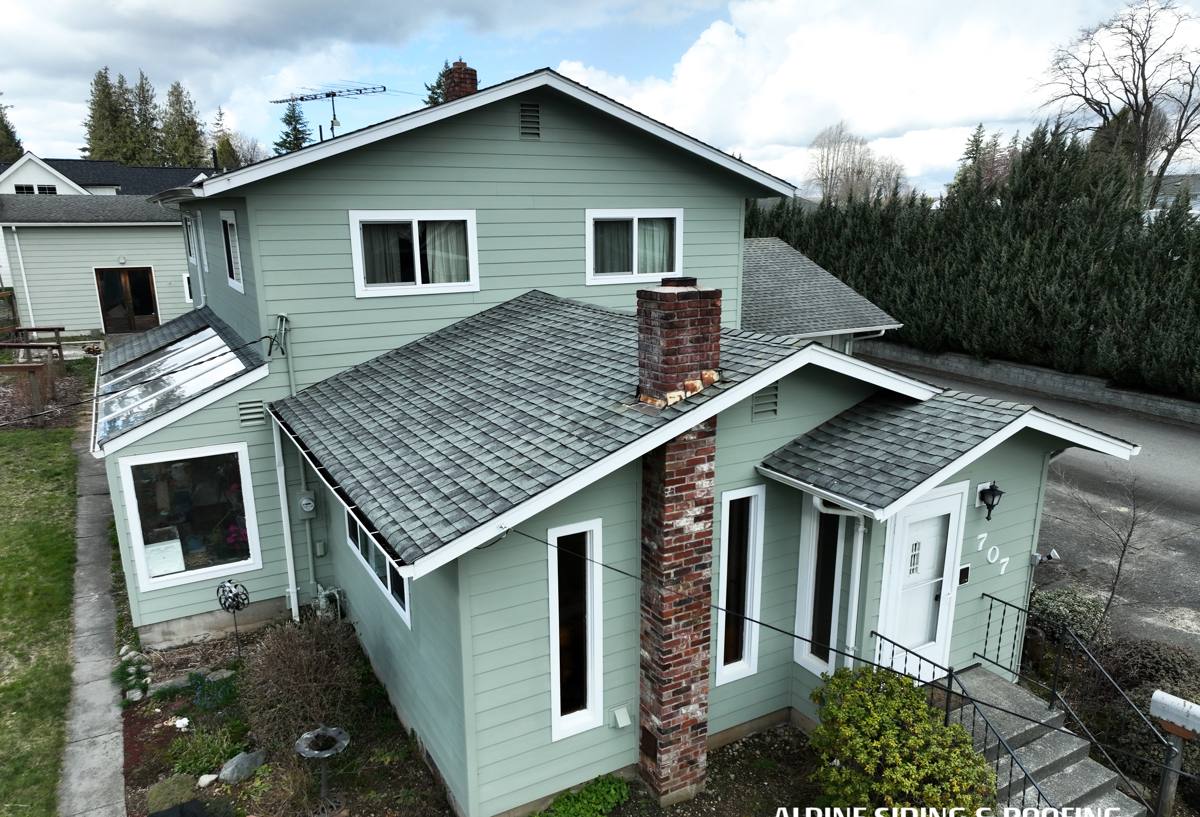
What Moss Season Actually Does to a Wall
"Moss season" in this part of Whatcom County isn't a single event — it's most of the year, running heaviest through the wet fall and winter months when siding rarely gets a full day to dry out. Moss and algae themselves aren't what destroys siding directly. The damage comes from what they trap: a layer of organic material that holds moisture against the wall surface far longer than bare siding would on its own.
On wood-based products — cedar, primed spruce, or engineered wood siding like LP SmartSide — that trapped moisture is a real problem, because the substrate itself can absorb water, swell, and eventually rot from the inside out even while the surface still looks intact. Fiber cement doesn't have that vulnerability. It's cement, sand, and cellulose fiber, and it doesn't swell, delaminate, or rot when it stays damp. That single difference is a big part of why fiber cement holds up better on shaded, moisture-heavy lots like the ones common in Edgemoor.
Where Moisture Problems Actually Start
- Poor clearance between siding and grade, decks, or roof lines, where splashback and standing moisture concentrate
- Caulked joints that were never meant to be a moisture barrier on their own
- Missing or undersized kick-out flashing where a roof plane meets a wall
- Butt joints between siding boards that weren't properly flashed or back-primed
- House wrap that was torn, taped incorrectly, or installed with the laps running the wrong direction
What a Correct Fiber Cement Installation Involves
Fiber cement siding is only as good as the installation behind it. The board itself resists rot and moisture intrusion, but the assembly around it — flashing, house wrap, fastening, clearances — is what determines whether water actually stays out of the wall. On an Edgemoor property, where wind-driven rain and shade are working against the building envelope every season, there's less margin for shortcuts than on a typical inland lot.
A correct install starts with a weather-resistive barrier installed shingle-style so every lap sheds water downward, not sideways into a seam. Flashing goes over every window and door head, and step flashing or kick-out flashing goes anywhere a roofline intersects a wall. Siding is fastened per the manufacturer's specification — proper nail type, spacing, and depth — because over- or under-driven fasteners are one of the most common causes of early siding failure. Boards get their required clearance from grade, roofing, and decking so they aren't sitting in a moisture trap from day one. Butt joints are flashed, not just caulked. And any factory-finished ColorPlus board gets field-touched with matching Hardie touch-up product at cut ends and fasteners, so the factory finish isn't compromised anywhere the panel was cut on site.
Why We Install Only James Hardie Fiber Cement
We don't install vinyl, LP SmartSide, Cemplank, Allura, primed spruce, or cedar. That's a deliberate standard, not a limitation in what we're capable of installing. Vinyl expands and contracts with temperature swings and can crack or warp in cold snaps, and it's not the material we want standing between an Edgemoor home and the weather coming off the bay. Wood and wood-based siding — cedar, primed spruce, LP SmartSide — require ongoing maintenance to stay ahead of moisture, and in a shaded, moss-prone environment, that maintenance burden only grows. Other fiber cement brands may be reasonable products, but we've standardized on one system so our crew installs it the same correct way every time, backs it with one warranty structure, and knows its behavior in this specific climate inside and out.
James Hardie's HZ5 product line is engineered specifically for the freeze-thaw and moisture cycling common to the Pacific Northwest. The ColorPlus factory finish is baked on and warranted separately from the substrate, which matters in a neighborhood where sun exposure varies wildly from one wall of a house to the next depending on tree cover. And Hardie's fiber cement is non-combustible, which carries real weight for coastal Washington homes surrounded by mature trees and seasonal wildfire smoke exposure.
Fiber Cement Compared to Other Siding Options
| Factor | James Hardie Fiber Cement | Vinyl | Wood / LP SmartSide |
|---|---|---|---|
| Moisture resistance | Does not rot, swell, or absorb water | Water-resistant, but seams can allow moisture behind panels | Vulnerable to rot and swelling if moisture gets trapped |
| Salt air / coastal exposure | Engineered for marine and freeze-thaw climates | Can become brittle and discolor over time | Requires diligent sealing and repainting to hold up |
| Moss and algae resistance | Substrate unaffected; surface can be cleaned safely | Surface growth possible; cleaning options limited | Trapped moisture under growth speeds rot |
| Fire resistance | Non-combustible | Melts/deforms under heat | Combustible |
| Finish longevity | Factory ColorPlus finish, separately warranted | Color molded in, can fade and chalk | Needs repainting/resealing on a recurring cycle |
Our Process for an Edgemoor Project
Every project starts with an on-site walkaround, not a phone estimate. We look at how much shade and tree cover each wall gets, where water currently drains and pools around the foundation, what condition the existing siding, trim, and flashing are in, and whether there's evidence of past moisture intrusion around windows, doors, or roof intersections. That inspection shapes the actual scope of work — sometimes it's a straightforward re-side, and sometimes it means addressing flashing, ventilation, or grading issues first so new siding isn't installed over a problem that will just resurface.
- On-site inspection of existing siding, trim, flashing, and moisture-prone areas
- Written estimate with product line, color, and scope clearly spelled out
- Removal of old siding and inspection of the sheathing and structure underneath
- Repair of any rot, damaged sheathing, or compromised framing found during tear-off
- Installation of a weather-resistive barrier, flashing, and James Hardie siding to manufacturer spec
- Final walkthrough covering fastener touch-up, caulking, and finish details
What Fiber Cement Costs Depend On
We don't publish flat per-square-foot pricing because it isn't honest — cost depends on real conditions specific to the home. What we can tell you is what actually moves the number on an Edgemoor job:
| Cost Factor | Why It Matters Here |
|---|---|
| Condition of existing sheathing | Tear-off often reveals moisture damage in shaded, tree-covered walls that needs repair before new siding goes on |
| Number of wall penetrations | Windows, vents, and roof intersections each need proper flashing, which adds labor |
| Siding profile chosen | Lap width, panel style, and trim detail all affect material and labor cost |
| Access and site layout | Wooded, sloped, or waterfront-adjacent lots can affect staging and scaffolding needs |
| Color and finish | Factory ColorPlus finishes cost more upfront than field-painted siding but eliminate a repaint cycle |
Keeping New Siding Looking Right in This Climate
Fiber cement is low-maintenance compared to wood, but "low-maintenance" doesn't mean "no maintenance" — especially under tree cover this close to the bay. A little seasonal attention keeps a Hardie job looking like it did the day it went up.
- Rinse siding with a garden hose once or twice a year to clear pollen, salt residue, and early moss growth before it takes hold
- Keep gutters clear so overflow doesn't run down the wall face during heavy rain
- Trim back branches and shrubs that keep siding shaded and damp longer than necessary
- Check caulking at trim and joints annually and re-caulk if it's cracked or pulling away
- Have flashing at roof-to-wall intersections inspected periodically, since that's where hidden leaks most often start
Why It Matters That We Already Work Edgemoor
A crew that's worked this neighborhood before isn't guessing about how much clearance a wall needs from grade, how far tree cover typically extends over a roofline, or where wind-driven rain tends to concentrate on a bay-facing wall. That local familiarity shows up in small decisions — flashing details, fastener choice, where extra attention goes during tear-off — that don't show up in a brochure but do show up in how the siding performs five and ten years out. Bellingham and Whatcom County's marine climate isn't uniform from one neighborhood to the next, and a job built for a dry inland lot isn't automatically right for a shaded, waterfront-adjacent one.
If you're weighing a re-side in Edgemoor, we're glad to come take a look, walk the property with you, and give you a straight answer on what your home actually needs — no pressure, no upsell. Reach out below for a free estimate.