 Bellingham Siding
 Cordata's Climate Is Harder on Siding Than It Looks
Cordata sits far enough north and close enough to Bellingham Bay that homes here take a steady, year-round beating most homeowners never fully clock until they're standing at the base of a ladder looking at soft trim boards. It isn't one dramatic event that wears out siding in this part of Whatcom County — it's the accumulation of small, constant exposures: salt-tinged air moving in off the water, driving rain that comes in sideways during fall and winter storms, and a moss and algae season that can stretch across eight or nine months of the year in shaded, north-facing exposures.
Each of those factors attacks siding differently. Salt air accelerates corrosion on fasteners and metal flashing. Wind-driven rain finds the smallest gaps in caulking, trim, and butt joints and pushes moisture behind the cladding instead of letting it run off the surface. Moss and algae hold that moisture against the siding face for weeks at a time, which is exactly the condition that rots wood-based products and delaminates poor-quality composites. None of this is exotic — it's just relentless. Siding replacement in Cordata has to be planned around all three, not just the one that's most visible.
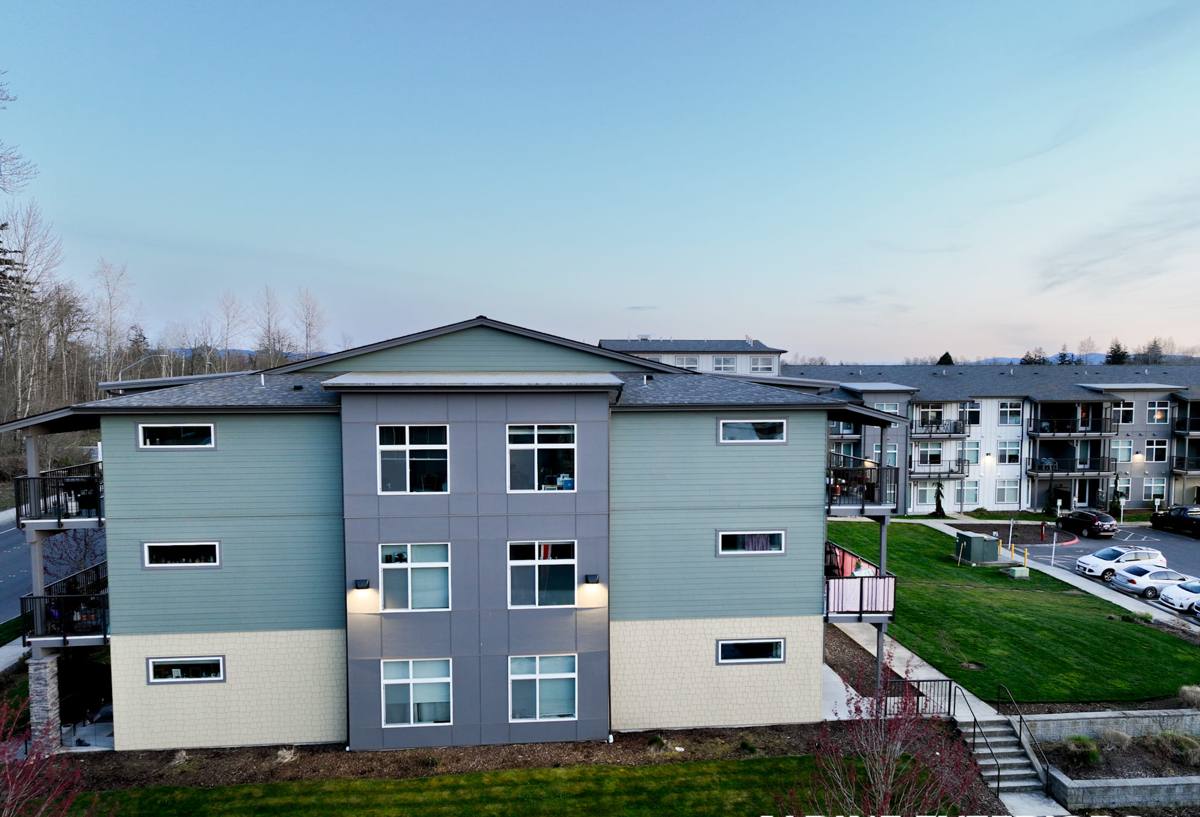
Signs a Cordata Home Actually Needs Replacement, Not Repair
Not every siding problem calls for a full tear-off. But there's a point where patching becomes a waste of money, and homeowners in this neighborhood tend to hit that point earlier than they expect because of how much moisture cycling the siding goes through each year.
- Soft or spongy spots when you press on siding near the bottom courses, corners, or below windows
- Paint that keeps failing within a year or two of repainting, even after prep work
- Persistent moss or dark streaking that comes back within a season of cleaning
- Visible gaps, warping, or buckling panels, especially on the north and west-facing walls
- Rot or staining around window and door trim, which usually means water has been getting behind the siding for a while
- Siding that's original to a home built in the 1980s–2000s, when lower-grade composite and hardboard products were common
If you're only seeing one or two of these in a small area, a targeted repair might be reasonable. If several of these show up across multiple walls, that's usually a sign the underlying moisture barrier and fastening have failed broadly, and repair work will just be chasing the same problem one board at a time.
Why We Install James Hardie Fiber Cement — Not Vinyl, Not LP, Not Cedar
We standardized on James Hardie fiber cement siding for every home we work on, including here in Cordata, and it comes down to how the product handles the specific stresses this climate creates.
Fiber cement is non-combustible and dimensionally stable — it doesn't expand and contract with moisture the way wood-based products do, which matters when a wall is cycling between soaked and dry for most of the year. James Hardie's HZ5 product line is engineered specifically for climates like ours, with a formulation designed to resist moisture damage and hold paint and color longer in wet, humid conditions. The ColorPlus factory finish is baked on under controlled conditions rather than field-applied, which means better adhesion and a finish that's far less likely to fail early from the kind of driving rain Cordata gets in the fall and winter.
We don't install vinyl, LP SmartSide, Cemplank, Allura, primed spruce, or cedar. Each of those products has legitimate uses elsewhere, but in a marine-influenced climate with heavy rain and long damp stretches, they carry trade-offs we're not willing to put on a customer's home — vinyl can warp and doesn't stop moisture intrusion at the wall assembly, engineered wood products are more sensitive to sustained moisture exposure at cut edges and seams, and cedar requires a maintenance commitment most homeowners don't realize they're signing up for until the first refinishing bill arrives. Hardie is what we've found holds up correctly, for the long term, without asking the homeowner to fight the climate every couple of years.
What a Correct Siding Replacement Actually Involves
Replacing siding well is not just pulling off old panels and nailing up new ones. In a wet climate like Bellingham's, the work that happens underneath the visible siding matters more than the siding itself.
Tear-off and inspection
Old siding comes off in full, not patched around. This is the point where we can actually see the sheathing and framing underneath — which is often where hidden rot or past water damage shows up, especially around windows, doors, and any spot where trim meets siding.
Sheathing repair
Any soft, delaminated, or water-damaged sheathing gets replaced before anything new goes up. Installing new siding over compromised sheathing just hides a structural problem behind a new finish.
Weather-resistive barrier and flashing
A properly lapped weather-resistive barrier, correctly integrated flashing at windows, doors, and penetrations, and rainscreen or drainage detailing where appropriate are what actually keep driving rain out of the wall assembly. This is the layer that does the real work in a climate like ours — the siding is the visible finish, but the barrier system underneath is what prevents rot.
Installation to manufacturer spec
James Hardie siding has specific fastening patterns, clearances, and caulking requirements. Installed off-spec, it can still look fine for a year or two and then fail early — which defeats the purpose of choosing a premium product in the first place. We install to the manufacturer's published specifications so the product performs the way it's engineered to and the warranty stays intact.
Our Process, Start to Finish
- Free on-site estimate — we walk the home, assess the current siding and any moisture damage, and give you an honest read on what's actually needed.
- Written scope and pricing — a clear breakdown of materials, labor, and any sheathing or trim repair we expect to encounter.
- Scheduling around weather windows — in Whatcom County, that means planning tear-off and barrier installation for stretches of drier weather where possible, so the wall isn't left exposed longer than necessary.
- Tear-off, repair, and barrier installation — the work described above, done in the right order.
- Hardie siding installation — installed to spec, with attention to fastening, clearances, and sealing at penetrations.
- Final walkthrough — we go over the finished work with you before calling the job done.
What Drives the Cost of a Siding Replacement
Every home is different, so we won't quote a number without seeing the house, but these are the factors that typically move the price up or down on a Cordata project:
| Factor | Why It Matters |
|---|---|
| Home size and wall complexity | More square footage, corners, and roof lines mean more material and labor time |
| Condition of the sheathing underneath | Hidden rot found during tear-off adds repair work that can't be quoted until the old siding is off |
| Siding profile selected | Lap, shingle, and panel styles from the Hardie lineup vary in material cost and install time |
| Trim and detail work | Window and door trim, corner boards, and fascia replacement add scope beyond the field siding |
| Access and site conditions | Tight lot lines, landscaping, or multi-story walls affect staging and labor time |
| Color and finish | Factory ColorPlus finishes vary in cost slightly by color and are typically more durable than field-painted options |
Why Hiring a Crew That Already Works in Cordata Matters
Siding installation isn't just a product question — it's an execution question, and execution depends on understanding the site conditions specific to this area. A crew that regularly works in and around Bellingham knows how to sequence a job around the wet season, knows what typical framing and sheathing conditions look like in homes of this area's common build eras, and knows how to detail flashing and drainage for a climate that doesn't give a wall much time to dry out between rain events. That local familiarity shows up in fewer surprises mid-project and a finished wall assembly that's actually built for the weather it has to survive.
It also matters for accountability. A contractor working a small radius around their home base has a direct incentive to get the detail work right the first time, because they're not moving on to a different state or region before problems would show up.
Maintaining Your New Hardie Siding in a Wet, Mossy Climate
- Rinse siding annually with a garden hose to knock down early moss and algae growth before it takes hold
- Keep gutters clear so overflow doesn't run down the wall face repeatedly
- Trim back vegetation and tree cover that keeps shaded wall sections damp longer than the rest of the house
- Re-caulk trim joints and penetrations if you notice gaps opening up over time
- Have flashing and caulking spot-checked every few years, particularly around windows and roof-to-wall intersections
Fiber cement holds up to this far better than wood-based or vinyl products, but no siding is entirely maintenance-free in a climate that's wet this much of the year.
If your Cordata home is showing signs of siding failure, or you'd just like an honest assessment of what condition your siding is really in, we're happy to come take a look. The estimate is free, there's no pressure, and you'll get a straight answer about what your home actually needs.