 Bellingham Siding
 Cordata's Climate Is Harder on Siding Than It Looks
Cordata sits in north Bellingham, close enough to the water and the marine air patterns that move through Whatcom County to catch the same weather punishment as the rest of the region — just with its own local texture. Homes here deal with a steady mix of salt-tinged air rolling in off Bellingham Bay and the Strait of Georgia, long stretches of driving rain that comes in sideways more often than straight down, and a moss and mildew season that can run from fall through spring without much of a break. None of that is dramatic on any single day. It's the cumulative effect that wears siding down — moisture that never fully dries out between rain events, organic growth that holds dampness against a wall surface, and salt air that slowly degrades finishes and fasteners that weren't built for it.
That combination is exactly why siding installation in Cordata isn't a generic job. A product and installation method that works fine in a drier inland climate can fail here in ways that don't show up for a few years — trapped moisture behind the cladding, swelling at butt joints, paint that chalks and fades faster than it should, or moss establishing itself in seams and never fully drying out. Getting it right the first time matters more here than in most parts of the country.
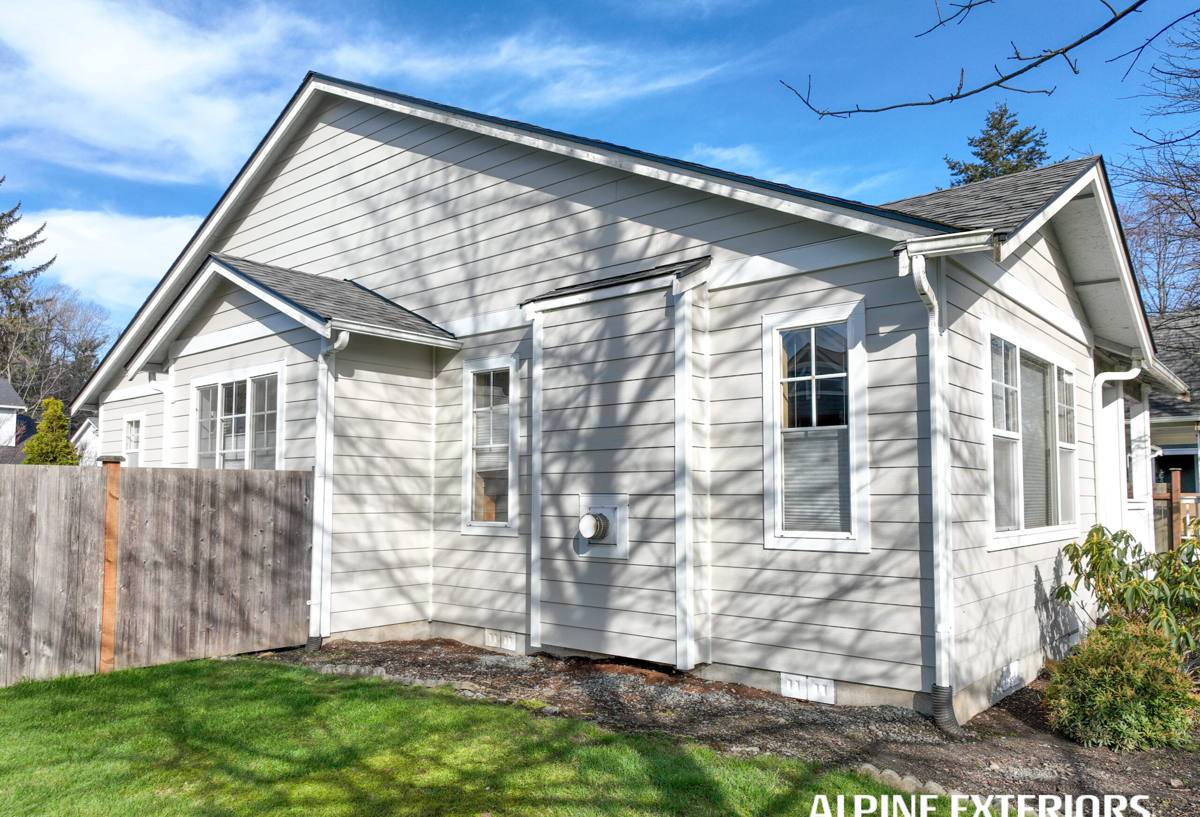
What Cordata Homes Actually Need From New Siding
Before we talk about product or process, it helps to be specific about what "right" means for this location. A siding system installed on a Cordata home needs to do four things well:
- Shed driving, wind-blown rain without letting water track behind the cladding at laps, corners, and penetrations
- Resist moisture absorption into the material itself, not just at the surface finish
- Hold up to salt-laden air without accelerated fastener corrosion or finish breakdown
- Resist moss, mildew, and algae growth on the surface, or at minimum not give it an easy foothold in unsealed edges and joints
This is the filter we run every material and installation decision through. It's also the reason we standardized on James Hardie fiber cement and stopped installing several other common siding products, which we'll get into below.
Why We Install James Hardie and Not the Alternatives
We get asked fairly often why we don't offer vinyl, LP SmartSide, cedar, or primed spruce siding, since all of them are legitimate, widely used products elsewhere. Here's the honest answer, product by product.
Vinyl
Vinyl is inexpensive and low-maintenance in the sense that it doesn't need painting. But it's a thin material that expands and contracts significantly with temperature swings, which loosens fastening over time, and it doesn't hold up well to the kind of sustained wind-driven rain Cordata sees — water tends to get behind panels at seams and around penetrations, with nowhere to go. It's also not the look most homeowners in this area are trying to achieve on a long-term investment property.
LP SmartSide and Other Engineered Wood
Engineered wood siding is a wood-strand product with a resin binder. It performs reasonably well when installation is flawless and maintenance never lapses, but wood-based siding is inherently more vulnerable to moisture intrusion than fiber cement — and moisture intrusion is the single biggest risk factor in a climate like this one. Once water gets past a compromised seam or a caulking failure, wood-based products swell, delaminate, or rot in ways fiber cement simply doesn't.
Cedar and Primed Spruce
Real wood siding looks great and has a long history in the Pacific Northwest, but it demands a maintenance commitment most homeowners underestimate: regular refinishing, vigilant caulk and paint upkeep, and constant attention to moss and mildew, which thrive on wood in exactly the conditions Cordata provides for most of the year. Skip a maintenance cycle or two and you're looking at rot repair, not just a repaint.
Why James Hardie Wins Here
James Hardie fiber cement is non-combustible, dimensionally stable across temperature and humidity swings, and engineered specifically for climates like this one through its HZ5 product line, which is formulated for the wetter, harsher weather zones of the Pacific Northwest. The factory-applied ColorPlus finish is baked on under controlled conditions and holds color and resists fading, chalking, and moisture far longer than field-applied paint on wood or engineered wood products. It comes with a strong transferable limited warranty, which matters if you sell the home. We install it because it's the product we can stand behind fully in this specific climate, not because it's the only siding that exists.
What a Correct James Hardie Installation Actually Involves
The product is only half the equation. Fiber cement siding installed poorly will still fail in a wet climate — trapped moisture doesn't care what the cladding is made of. A correct installation on a Cordata home includes:
- A properly detailed water-resistive barrier (house wrap) with all seams taped and integrated correctly with window and door flashing
- Rainscreen or drainage gap furring where conditions call for it, so any moisture that does get behind the siding can drain and dry instead of sitting against the sheathing
- Correct fastener type, spacing, and penetration depth — James Hardie has specific fastening schedules, and getting this wrong voids warranty coverage and invites cracking
- Proper clearance at grade, decks, patios, and roof lines so siding never sits in standing water or constant splash-back
- Factory-cut and factory-primed edges kept intact wherever possible, with any field cuts properly sealed per manufacturer specification
- Correct caulking and sealant only at the joints Hardie specifies — over-caulking traps moisture just as badly as under-caulking lets it in
Every one of these details is inspectable, and a homeowner is entitled to ask a contractor to walk through exactly how each one will be handled before work starts.
Our Process on a Cordata Job
The steps are straightforward, but we don't skip any of them:
- Walkthrough and assessment — we look at the existing siding, sheathing condition, moisture history, and any trouble spots (window returns, deck ledger connections, roof-to-wall transitions) before quoting anything.
- Tear-off and sheathing inspection — old siding comes off and we check the sheathing underneath for rot or existing moisture damage before anything new goes on. This step catches problems that a surface-level look can't.
- Water management layer — house wrap, flashing, and drainage detailing installed and integrated correctly at every penetration.
- Hardie installation — installed to manufacturer fastening and clearance specifications, not shortcuts.
- Finish detailing — trim, corners, and caulking done to spec, followed by a final walkthrough with the homeowner.
Nothing here is unusual — it's just the difference between doing each step correctly and doing it fast.
Cost Factors for a Cordata Siding Installation
Every home is different, and we won't quote a number without seeing the house, but these are the main variables that move the price up or down:
| Factor | Why It Matters |
|---|---|
| Home size and wall complexity | More square footage and more corners, dormers, and cutouts mean more labor and material waste |
| Existing siding and sheathing condition | Rot repair or full sheathing replacement adds cost beyond the siding itself |
| Hardie product line chosen | Lap siding, panel siding, and shingle-style products differ in material and install labor cost |
| Trim and accessory scope | New trim boards, soffit work, and corner detailing add to the total project |
| Access and site conditions | Tight lots, second-story work, and limited staging area affect labor time |
James Hardie Product Lines That Fit This Climate
James Hardie's HZ5 line is formulated for the Pacific Northwest's wetter, harsher weather zone rather than a one-size-fits-all national product. Within that line, homeowners in Cordata typically choose between HardiePlank lap siding for a traditional horizontal look, HardiePanel for a more modern vertical or board-and-batten style, and HardieShingle for a textured, dimensional look on accent areas. ColorPlus finishes come in a range of factory-baked colors engineered to resist the fading and chalking that field-applied paint struggles with in a climate this damp. We'll walk through which line and finish makes sense for your home's exposure and style during the estimate — a wall that takes constant driving rain off the water may call for different detailing than a more sheltered elevation on the same house.
Caring for Hardie Siding in a Cordata Climate
Fiber cement is low-maintenance compared to wood, but "low-maintenance" doesn't mean "no maintenance," especially with the moss and mildew pressure this area sees for much of the year.
- Rinse siding down once or twice a year to clear pollen, road film, and early moss growth before it establishes
- Keep gutters clean and downspouts directed away from the wall so water isn't sheeting down siding repeatedly
- Trim back landscaping and tree cover that keeps siding shaded and damp longer than it needs to be
- Recaulk any joints that show gaps or cracking before the next wet season sets in
- Watch for any soft spots, staining, or bubbling in the finish and address them early rather than waiting
Why Hiring a Crew That Already Works Cordata Matters
A lot of siding problems in this climate trace back not to the product but to installation details that don't account for local conditions — a crew used to a drier region skipping a drainage gap, under-flashing a window because that's what worked somewhere else, or not accounting for how much water a north Bellingham wall actually sees over a winter. A crew that regularly works Cordata and the surrounding Whatcom County area already knows how this specific weather pattern behaves against a wall assembly, and builds every detail around that reality instead of a generic installation manual.
If you're considering new siding for a Cordata home, we're happy to come take a look, walk the exterior with you, and put together a straightforward, no-pressure estimate — no high-pressure sales tactics, just an honest look at what your home needs.