 Bellingham Siding
 Blaine's Marine Climate and What It Does to Siding
Blaine sits on Semiahmoo Bay and Drayton Harbor at the far northwest corner of Whatcom County, right where the Salish Sea meets the Canadian border. That location is part of what makes Blaine a beautiful place to live, and it's also exactly why siding here takes a harder beating than siding thirty miles inland. Homes close to the water deal with salt-laden air, wind that drives rain sideways into wall assemblies, and a wet season that stretches long enough to keep shaded surfaces damp for months at a time. Siding that would hold up fine in a drier, more sheltered part of Whatcom County can start showing problems within a few years out here if it wasn't built or installed with this exposure in mind.
We install fiber cement siding across Bellingham and the surrounding county, but Blaine projects get evaluated differently from the start. Orientation to the water, wind exposure, and how much shade a wall gets all change what a correct installation looks like before we ever pick a color.
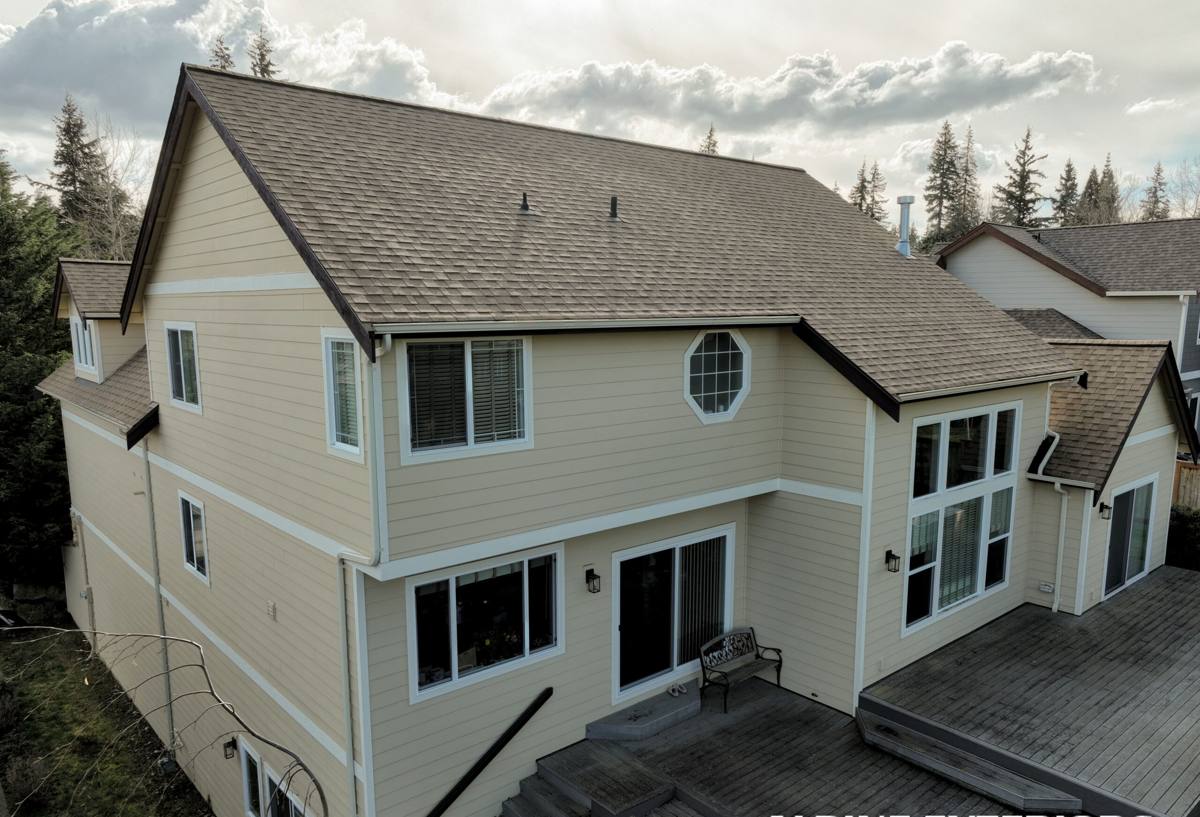
What Fiber Cement Siding Has to Handle Here
Salt-Laden Air and Corrosion
Airborne salt from the bay doesn't just affect boats and metal railings — it settles on exterior surfaces and accelerates corrosion on anything that isn't rated for it. Fasteners, flashing, and trim hardware all need to be chosen with that in mind. The siding board itself matters less here than the metal and fastener choices around it, which is a detail a lot of installers skip past.
Wind-Driven Rain and Wall Moisture
Rain that falls straight down is manageable for almost any siding material. Rain that's being pushed sideways by wind off the water is a different problem — it finds gaps, laps, and penetrations that would stay dry in calmer conditions. Blaine's waterfront and near-waterfront homes see this kind of wind-driven exposure more often than homes set back from the coast, which raises the bar for flashing detail and drainage behind the siding, not just the siding surface itself.
A Long Moss and Mildew Season
Whatcom County's wet fall-through-spring stretch is long, and Blaine's marine humidity extends it further. Shaded elevations, areas under tree cover, and walls that don't get much direct sun can stay damp for extended periods. That's a moss and mildew problem more than a structural one for most siding materials, but it's a maintenance and appearance issue homeowners deal with year after year if the siding and the drainage behind it weren't set up to dry out properly.
Why We Install Only James Hardie Fiber Cement
We made a decision as a company to install James Hardie fiber cement siding exclusively — no vinyl, no LP SmartSide, no primed spruce or cedar, no other fiber cement brands. That's not a marketing position, it's a standard we hold because of what we've seen these products do over time in exactly this kind of climate.
Where Other Materials Fall Short in This Climate
Vinyl siding is inexpensive and low-maintenance in mild conditions, but it's a thin material that expands, contracts, and can warp with temperature swings, and its seams and panels rely on lapping rather than a sealed, monolithic surface — not ideal when wind is actively driving rain at a wall. Engineered wood products like LP SmartSide use a wood-fiber core, which performs well when kept dry but is more sensitive to sustained moisture exposure than a cement-based product, which matters in a climate where some walls rarely get a chance to fully dry out. Primed spruce and cedar are attractive, traditional options, but they're organic materials that need diligent, ongoing paint or stain maintenance to keep water out — skip a maintenance cycle in a wet marine climate and you're inviting rot.
None of that means those products are junk. It means they each carry trade-offs — maintenance burden, moisture sensitivity, or long-term durability — that we're not willing to install and then hand a homeowner a callback problem five years later. James Hardie fiber cement is a cement-and-cellulose composite that's non-combustible, dimensionally stable, and doesn't rot the way wood-based products can. Its ColorPlus factory finish is baked on under controlled conditions rather than painted on-site, which gives a more consistent, longer-lasting finish than field paint. Hardie also engineers its HZ5 and HZ10 product lines for different climate zones — the Pacific Northwest's wetter, more freeze-thaw-prone conditions call for a different specification than a dry inland climate would. And Hardie backs its siding with a strong, transferable warranty, which only means something if the installation was done to spec in the first place.
What a Correct Installation Involves in Blaine
Fiber cement siding is only as good as the assembly behind it. In a coastal environment like Blaine, a handful of installation details matter more than they would inland.
| Installation Detail | Why It Matters in Blaine |
|---|---|
| Fastener and trim material selection | Salt air accelerates corrosion on standard hardware; corrosion-resistant fasteners and flashing hold up under marine exposure |
| Weather-resistive barrier and drainage gap | Gives wind-driven moisture that gets past the siding surface a path to drain and dry instead of sitting against sheathing |
| Window, door, and penetration flashing | These are the most common entry points for wind-driven rain, and the ones most often under-detailed by crews unfamiliar with coastal exposure |
| Clearance from grade, decks, and hardscape | Reduces splash-back and ground moisture reaching the bottom courses of siding |
| Joint and caulk treatment per manufacturer spec | Seals entry points without trapping moisture that needs to escape |
| Panel overlap and fastening pattern | Correct spacing and nailing keeps the siding performing as a system rather than a collection of individual boards |
Any one of these done wrong won't necessarily show up right away. It shows up two, five, or ten years later as a moisture problem behind siding that looks fine from the curb — which is exactly why the installation matters as much as the product.
Our Process for Blaine Projects
- On-site assessment — we look at wall orientation to wind and water, existing siding condition, shade patterns, and any signs of moisture behind current siding
- Detailed proposal — product line (HZ5 or HZ10), profile, color, and trim specified before any work starts, no surprises added mid-project
- Tear-off and sheathing inspection — old siding comes off and sheathing gets checked for rot or damage before anything new goes on; problems get addressed, not covered up
- Weather-resistive barrier and drainage plane installation — the moisture-management layer behind the siding, set up correctly the first time
- Hardie siding installation — installed to manufacturer specification and local building code, with attention to the flashing and fastening details specific to coastal exposure
- Trim, caulking, and finish work — final details completed and checked before walkthrough
- Walkthrough and warranty registration — we confirm the work with you and make sure your Hardie warranty is properly on file
Cost Factors for Blaine Homes
| Factor | How It Affects the Project |
|---|---|
| Home size and wall square footage | Larger surface area means more material and labor |
| Existing siding removal and sheathing repair | Rot or damage found underneath adds scope, but skipping repair isn't an option |
| Product line (HZ5 vs. HZ10) | Climate-engineered specification appropriate for coastal exposure |
| Siding profile (lap, shingle, panel) | More detailed profiles and trim patterns take more labor time |
| Trim complexity | Corners, window and door surrounds, and fascia detail add material and labor |
| ColorPlus factory finish vs. field paint | Factory finish carries its own warranty coverage and reduces future repainting |
| Site access | Waterfront lots, hillside access, or tight lots can affect staging and labor time |
We won't quote a number without seeing the home, but we'll walk you through exactly what's driving the cost on your specific project before we ask for a commitment.
Keeping Blaine-Installed Siding Looking Right
- Rinse salt residue and general grime off the exterior periodically, especially on homes close to the water
- Keep gutters and downspouts clear so rainwater isn't dumping directly against walls
- Trim back vegetation and tree branches that shade walls or trap moisture against the siding
- Check caulking and joints annually, particularly around windows, doors, and trim
- If you chose a field-painted finish, keep to a repaint schedule appropriate for a wet marine climate
- Watch shaded and north-facing elevations for moss or mildew and clean it early with gentle, non-abrasive methods
Why Hire a Crew That Already Works in Blaine
General siding experience doesn't automatically translate to coastal siding experience. A crew that's used to sheltered, inland jobs doesn't always think to flag the flashing and drainage details that matter most on a wind-exposed Blaine wall — not out of carelessness, just because it hasn't come up as often for them. Working regularly in Blaine and along the Whatcom County coastline means we already know which elevations tend to need extra attention, how local wind and rain patterns actually behave against a wall, and what Whatcom County's permitting and code requirements look like in practice. It also means we're a known, accountable local business — not a crew that did one job in town and moved on.
If you're planning a siding project in Blaine and want a straight answer about what your home needs, we're glad to take a look. Reach out for a free, no-pressure estimate — we'll walk the property, talk through what we see, and give you a clear picture before you decide anything.