 Bellingham Siding
 Siding Installation Built for Ferndale's Coastal Climate
Ferndale sits close enough to the water and to the open farmland of the Nooksack valley that homes here take a specific kind of beating: salt-tinged air drifting in off Bellingham Bay and the Strait, long stretches of driving rain through fall and winter, and a moss season that seems to start earlier every year and end later. Siding that works fine in a drier inland climate often struggles here. We install James Hardie fiber cement siding in Ferndale because it is the one product system we trust to hold up to all three of those pressures at once without turning into a maintenance project for the homeowner.
This page is about one thing: what a correct siding installation looks like on a Ferndale home, why the local conditions matter to the decision, and how our process is built around a crew that already knows this part of Whatcom County.
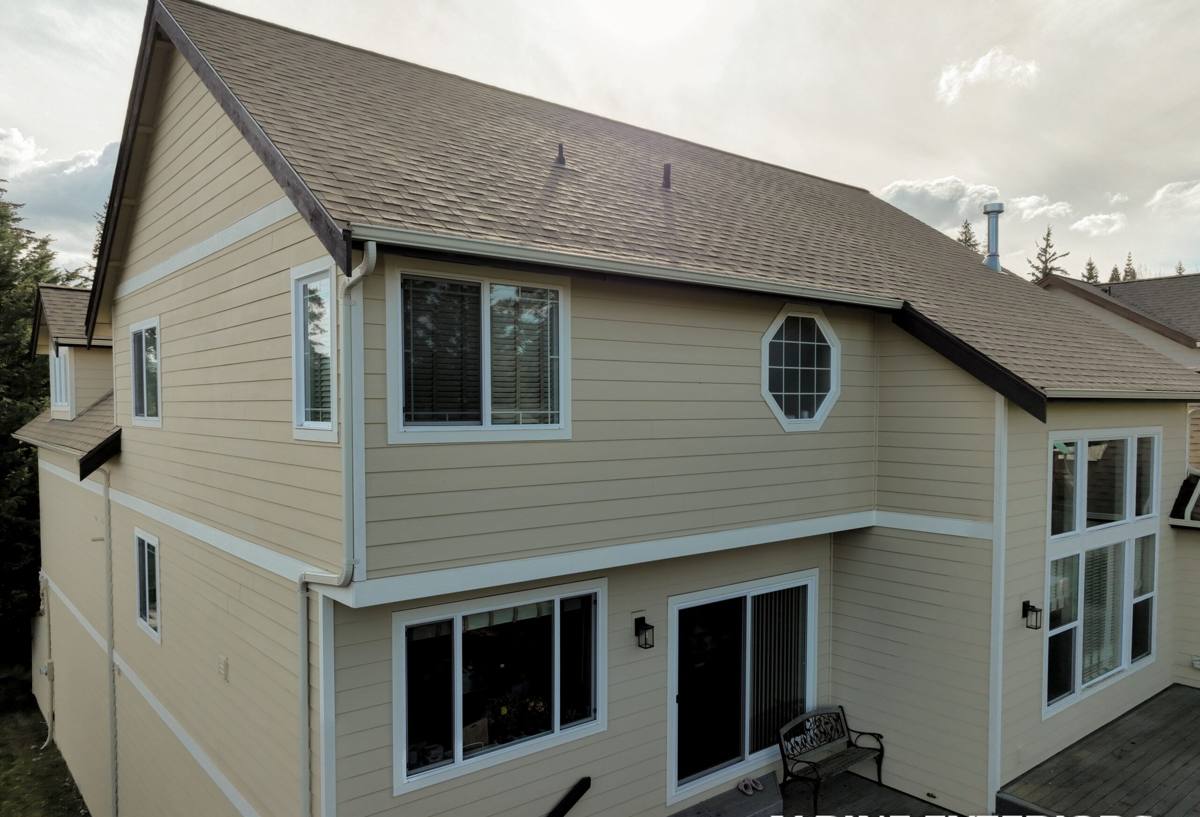
What Ferndale's Climate Actually Does to Siding
Salt Air and Moisture
Ferndale isn't right on the beach, but it's close enough that salt-laden air reaches homes regularly, especially on west-facing walls. Salt air accelerates corrosion on exposed fasteners and trim, and it interacts with moisture to speed up the breakdown of anything not engineered to resist it. Paint film on lesser materials chalks and fades faster near the coast than it does twenty miles inland.
Driving Rain
Whatcom County gets a lot of rain, but the more damaging factor is wind-driven rain that gets pushed sideways into wall assemblies, particularly on exposed elevations and around window and door openings. Siding systems that rely on tight seams or paint film alone to keep water out are more likely to let moisture behind the cladding over time. What matters just as much as the siding material is the water-management details underneath it: house wrap, flashing, and drainage gaps that give any moisture that does get past the siding somewhere to go.
Moss and Organic Growth
Shaded walls, north-facing elevations, and anything near mature trees or fences in Ferndale tends to grow moss and algae faster than homeowners expect. Wood-based products are especially vulnerable because moss holds moisture against the surface and the substrate underneath can start to soften. Fiber cement doesn't feed organic growth the way wood-based sidings can, and a factory-cured finish resists staining better than field-applied paint.
Why We Only Install James Hardie
We don't install LP SmartSide, vinyl, Cemplank, Allura, primed spruce, or cedar. That's a deliberate standard, not a sales pitch, and it's worth explaining honestly rather than just asserting it.
- Vinyl is affordable and low-maintenance in mild climates, but it can warp or crack in temperature swings, and it doesn't hold paint if a homeowner ever wants to change the color. In coastal wind, seams and panels can also work loose over time.
- LP SmartSide and other engineered wood products perform reasonably well when installed and maintained exactly to spec, but they're wood-based at the core, which means they're more sensitive to sustained moisture exposure than fiber cement — a real concern given how much rain Ferndale sees.
- Primed spruce and cedar are traditional and can look great, but they require ongoing repainting, caulking, and vigilance against moisture and pests. In a climate with this much rain and moss pressure, that maintenance burden is real and recurring.
- Cemplank and Allura are other fiber cement brands, and they're not bad products. We standardized on James Hardie specifically because of its ColorPlus factory-applied finish, its HZ5 product engineering for the Pacific Northwest, and the strength of its transferable warranty — not because competing fiber cement is defective.
James Hardie is non-combustible, engineered specifically for wet climates through its HZ5 line, and finished at the factory with ColorPlus Technology, which resists fading and chipping far better than field-applied paint. It holds up to salt air, sheds driving rain when installed correctly, and doesn't give moss anything to hold onto. That combination is why it's the only product we put on Ferndale homes.
What a Correct Installation Actually Involves
The siding material only does its job if the installation underneath it is done right. A lot of siding failures homeowners blame on the product are actually installation failures. Here's what we control for on every Ferndale project:
Water-Resistive Barrier and Flashing
Every wall gets a continuous water-resistive barrier, properly lapped and taped, before any siding goes up. Window and door openings get flashed so that any water that reaches the barrier is directed out and down, not into the wall cavity. This is the layer that actually keeps a home dry — the siding is the first line of defense, not the only one.
Rainscreen Drainage Gap
We install with a drainage gap behind the siding wherever the wall assembly calls for it, so that any incidental moisture that gets behind the panels can drain and the wall can dry out rather than trapping water against the sheathing. This matters more in a climate like Ferndale's than it does somewhere drier.
Fastening and Clearances
James Hardie has specific fastening patterns, nail placement, and gap tolerances at butt joints, corners, and penetrations. Getting these wrong is one of the most common causes of premature caulk failure and water intrusion on fiber cement jobs generally, regardless of brand. We follow manufacturer specs exactly because that's also what keeps the warranty valid.
Ground and Roof Clearance
Correct clearance from grade, decks, roof lines, and other horizontal surfaces prevents wicking moisture and gives moss and algae less opportunity to establish themselves at vulnerable transition points.
Comparing Siding Options for a Ferndale Home
| Factor | Vinyl | Engineered Wood | Cedar / Primed Spruce | James Hardie Fiber Cement |
|---|---|---|---|---|
| Salt air resistance | Moderate | Moderate | Low without upkeep | High |
| Driving rain / moisture behavior | Moderate (seam-dependent) | Sensitive if compromised | Sensitive, needs maintenance | Engineered for wet climates (HZ5) |
| Moss / algae resistance | Moderate | Moderate | Low | High |
| Finish durability | Fades over time | Field-paint dependent | Repaint every few years | Factory ColorPlus finish |
| Fire resistance | Low | Moderate | Low | Non-combustible |
| Typical maintenance | Low | Moderate | High | Low |
Why a Bellingham-Based Crew Matters for a Ferndale Job
Siding installation isn't one-size-fits-all across Whatcom County. A crew that works Ferndale regularly already understands which elevations tend to take the worst of the wind-driven rain, where moss pressure tends to be worse because of shade and tree cover, and how much clearance to plan for around ground-level plantings and irrigation that's common in this area. That local pattern recognition doesn't replace following manufacturer spec — it adds to it, because it means fewer surprises during the job and a better outcome once the siding is up.
Working locally also means we're not driving a crew in from out of the area for warranty visits or follow-up questions. If something needs a look years down the road, we're still here.
Our Process for a Ferndale Siding Installation
- On-site evaluation: We look at the home's exposure — which walls take the most wind-driven rain, where moss has already taken hold, and the condition of the sheathing and any existing water damage.
- Product and color selection: We walk through James Hardie's plank profiles, panel options, and ColorPlus palette so the choice fits the home and the neighborhood.
- Written estimate: A clear scope covering removal of existing siding, sheathing repair if needed, water-resistive barrier, flashing, and the Hardie installation itself.
- Installation to manufacturer spec: Proper barrier, flashing, drainage gap, fastening, and clearances — the details that determine whether the siding performs for decades or needs attention in a few years.
- Final walkthrough: We go over the finished work with the homeowner before considering the job done.
Signs a Ferndale Home May Need New Siding
- Soft or spongy spots when you press on the siding, especially near the bottom of walls or under windows
- Persistent moss or algae staining that comes back shortly after cleaning
- Paint that's peeling, bubbling, or chalking faster than it should
- Visible gaps, warping, or cracked panels, particularly on west- or north-facing walls
- Rising energy bills that might point to a compromised wall assembly behind the siding
- Wood rot or staining on trim boards and corner boards
What This Costs to Do Right
Siding installation costs depend on the size and shape of the home, how much of the existing siding and sheathing needs to come off, trim and detail work, and story height. We won't quote a number here without seeing the house, but we're upfront that a correct James Hardie installation — with proper water management underneath it — costs more up front than vinyl or a bargain wood product. The trade-off is a system engineered for this exact climate, backed by a strong transferable warranty, that doesn't need repainting every few years.
If you're weighing siding options for a home in Ferndale, we're happy to take a look and give you a straightforward, no-pressure estimate — just fill out the form below.